ITBP trains personnel in advanced unarmed combat craft post Galwan

Bhanu (Panchkula), Oct 30: The ITBP that guards the LAC with China is training its personnel in a new unarmed "offensive" combat technique to gain better skills in taking on the adversary in situations like the Galwan clash of 2020 where crude weapons were used to inflict fatal injuries on Indian troops by the Chinese PLA.
The training module comprises 15-20 different fight manoeuvres taken from various martial arts techniques like judo, karate and krav maga that involve moves like punching, kicking, throwing, joint lock and pinning down.
The about three-month long training is being imparted by seasoned Indo-Tibetan Border Police (ITBP) trainers who hone new recruits at the basic training centre (BTC) here for battle inoculation just before getting commissioned into the border force.
"The new unarmed combat technique involves both defensive and offensive moves. We brought in this module for our troops last year on the directions of our former director general Sanjay Arora. The combat skills will render the opponent immobile and can also incapacitate them," ITBP Inspector General Ishwar Singh Duhan told PTI.
Duhan heads the BTC located in the Bhanu area here, about 25 km from Chandigarh.
The Chinese soldiers used stones, nail-studded sticks, iron rods and clubs in carrying out brutal attacks on Indian soldiers after they protested the erection of a surveillance post by China on the Indian side of the LAC at Galwan (Ladakh) in June, 2020 resulting in 20 casualties on the Indian side while China belatedly claimed only four of its troops were killed.
The Russian official news agency TASS had reported that 45 Chinese servicemen were killed in the Galwan Valley clash. According to an American intelligence report, the number of casualties on the Chinese side was 35.
The unarmed combat technique trains the troops to channelise their power in such a manner that can land a deadly punch to the opponent, a senior officer supervising the training here said.
Duhan said the force has also introduced special training capsules aimed at enhancing the "physical capacity" of the troops deployed in some of the most arduous posts along the Line of Actual Control (LAC) that continuously face vagaries of nature like snow blizzards, avalanches and thin oxygen levels.
"We have now put in place a plan where a troop deployed on the border and higher altitudes will not be deployed for more than 90 days at a stretch. Logistics have been put in place that will ensure timely replacement of troops from the border posts," the IG said.
It is not that these measures and instructions were not there earlier but we are implementing these things seriously as the border is very active now, Duhan said.
Officials said the ITBP studied a number of scientific parameters and got inputs from the DRDO's Defence Institute of Physiology Allied Sciences (DIPAS) that showed how prolonged deployment of personnel can bring about "irreparable damage" to the human body.
It was then decided that troops deployed at high-altitude need to be rotated within a three-month duration.
Given the standoff, the ITBP has implemented the directive in letter and spirit now, the senior officer quoted above said.
India and China are locked in a lingering border standoff in eastern Ladakh for over 29 months. The bilateral relationship came under severe strain following the deadly clash in Galwan Valley in Eastern Ladakh in June, 2020.
The eastern Ladakh border standoff erupted on May 5, 2020, following a violent clash in the Pangong lake areas.
Both sides gradually enhanced their deployment by rushing in tens of thousands of soldiers and heavy weaponry.
As a result of a series of military and diplomatic talks, the two sides completed the disengagement process last year on the north and south banks of the Pangong lake and in the Gogra area.
Last month, the Indian and Chinese militaries carried out disengagement from the Patrolling Point 15 in the Gogra-Hotsprings area.
However, there has been no progress yet on resolving the standoff in the Demchok and Depsang regions.
The about 98,000 personnel strong ITBP is mandated to guard the 3,488 km long LAC running across from Ladakh to Arunachal Pradesh and is currently deployed along with the Army at these locations since the standoff started.
Let the Truth be known. If you read VB and like VB, please be a VB Supporter and Help us deliver the Truth to one and all.
CM Siddaramaiah alleges ‘criminal conspiracy’ in Sringeri recount, vows legal action
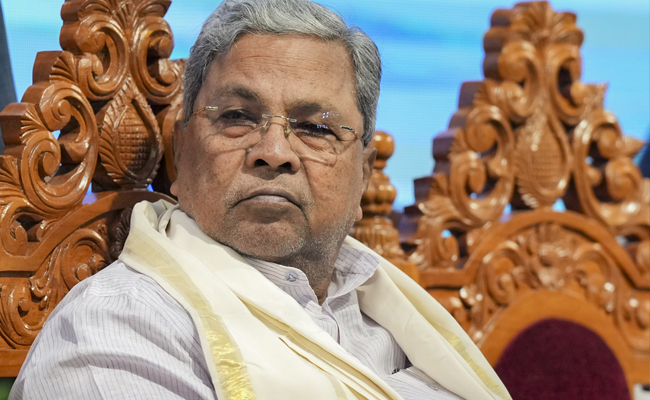
Bengaluru (PTI): Alleging a “criminal conspiracy” by BJP candidate D N Jeevaraj in the Sringeri Assembly poll recounting, Karnataka CM Siddaramaiah on Tuesday said the outcome was manipulated after valid postal ballot votes in favour of Congress leader T D Raje Gowda were tampered with during the recounting process.
Following a Karnataka High Court order on an election petition filed by Jeevaraj, challenging Raje Gowda’s election, the reverification and recounting were conducted on Saturday.
After the reverification and recount of postal ballots for the Sringeri Assembly constituency, votes polled in favour of Raje Gowda were reduced by 255, the returning officer said.
A report on the matter has been submitted to the Election Commission of India for further action, the officer added.
Congress leader Raje Gowda had won the 2023 Assembly polls from Sringeri by 201 votes, defeating his nearest rival Jeevaraj.
Addressing a press conference in Bengaluru, Siddaramaiah said the High Court had directed the recounting of postal ballots and that irregularities were noticed during the exercise conducted on May 2.
“This is a clear case of criminal conspiracy,” Siddaramaiah said, alleging that valid votes cast in favour of Raje Gowda were altered after being accepted by counting agents of all parties, including Congress, BJP, and JD(S).
He claimed that during the recounting of postal ballots, 255 votes were initially accepted as valid by all agents but were later tampered with by subordinate officials.
“There is a second mark on the votes polled in favour of Raje Gowda. They had accepted these as valid votes. Subsequently, another mark was made by officials. This is a clear case of criminal conspiracy,” he said.
When asked who was behind the alleged conspiracy, the CM replied, “It was hatched by Jeevaraj and others. It is planned.”
Siddaramaiah further alleged that the returning officer acted improperly by declaring the result despite the presence of an Election Commission observer during the recounting.
“Immediately after the counting, the returning officer announced the result. He should not have done so; this is against the law,” he said.
He pointed out that Raje Gowda had originally won by 201 votes, but after the recounting, the BJP candidate was declared the winner by 52 votes.
“The BJP has committed a criminal act of conspiracy. This is not vote chori but vote dacoity,” he alleged.
The CM said a police complaint had already been filed by Raje Gowda’s election agent, Sudhir Kumar, and emphasised the need for electoral integrity.
“We want transparency and free and fair elections. That is what our Constitution mandates,” he added.
Stating that the government would pursue legal remedies, Siddaramaiah said, “We are preparing an appeal challenging the returning officer’s announcement in a court of law.”
Responding to a separate query on elections in other states, the CM said there appeared to be an anti-incumbency factor in West Bengal, while results in Tamil Nadu were “surprising,” adding that Vijay’s party was emerging as the largest there.
Following the victory of party candidates in Bagalkote and Davanagere South, Siddaramaiah expressed confidence about future electoral prospects in Karnataka.
“Even in 2028, we will win the Assembly elections. We will come back,” the CM said.
Siddaramaiah added that he would order a forensic examination into the alleged tampering of postal ballots.