It's 90 per cent versus 10 per cent now, says CM Adityanath on UP polls
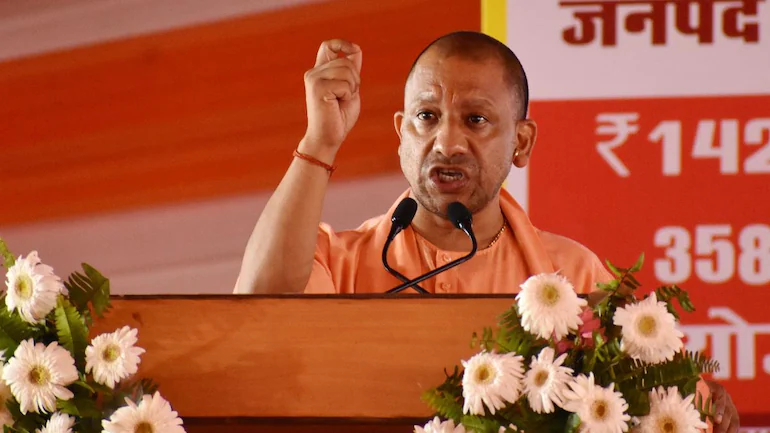
Lucknow/Shamli, Feb 5: Claiming that the BJP was heading to a landslide victory in Uttar Pradesh assembly polls, Chief Minister Yogi Adityanath on Saturday said that the electoral battle now will be "90 percent versus 10 percent" in favour of his party instead of "80 per cent versus 20 per cent"
Emphasising on his government's zero-tolerance policy against crime and criminals, he said that "bulldozer and development" will go together in the state under the BJP.
"The people of UP are going to choose a strong double-engine government and not the spineless government of SP that hides behind the mafia," he said.
"Even before the first phase of polling in the UP elections, the fight has now turned into 90 percent versus 10 percent instead of the 80 percent versus 20 percent," he said.
On a visit to Shamli district, the chief minister visited the district hospital and reviewed the arrangements made for COVID-19.
Later addressing a public gathering, he attacked the Samajwadi Party alleging the development under the previous government was limited to the construction of cemetery boundaries and said the SP should "ask for votes there".
"In today's Uttar Pradesh, there are no more bomb explosions... rather there is now Kanwar Yatra amidst chants of 'Bum-Bum'," Adityanath said.
Listing the achievements of his government, he said, "Infrastructural development like airports, expressways, and giving respect to farmers has never been on the agenda of SP. Whenever they were in power, they gave shelter to the criminals," he said.
Recalling the Muzaffarnagar riots, the chief minister, said Now these rioters walk around begging for their lives with placards hanging around their necks".
While interacting with the public in the Thana Bhawan assembly constituency, the CM took a jibe at the alliance of SP and RLD saying this "do ladkon ki jodi" has nothing new to serve.
These people belong to the "'dark zone" (drought-hit) as even the hand pumps dried down during their government, he said.
Targeting Akhilesh Yadav and Jayant Chaudhary, he said that when the Muzaffarnagar riots were taking place and people were migrating from Kairana, they were hiding in their dens.
One of them caused riots sitting in Lucknow, but BJP leaders like Suresh Rana and Sanjeev Baliyan risked their lives for the safety of the public, he said.
Let the Truth be known. If you read VB and like VB, please be a VB Supporter and Help us deliver the Truth to one and all.
Iran Foreign Minister Araghchi begins 3-day India visit
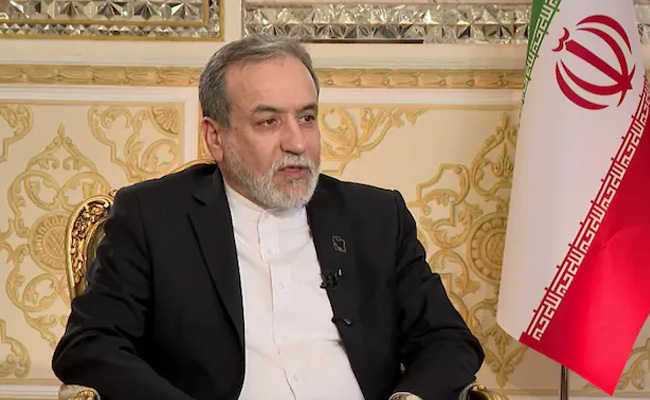
New Delhi (PTI): Iranian Foreign Minister Abbas Araghchi began a three-day official visit to India on Wednesday, marking the first high-level diplomatic engagement from Tehran since the outbreak of the US-Israel war with Iran more than two months ago.
Araghchi is visiting India primarily to attend a two-day meeting of BRICS foreign ministers beginning Thursday.
The Iranian foreign minister is set to hold wide-ranging bilateral talks with his Indian counterpart S Jaishankar, focusing on the escalating crisis in West Asia.
The situation surrounding the Strait of Hormuz is expected to feature prominently. The Indian side is likely to press for the safe passage of remaining merchant vessels through the strategic waterway, according to people familiar with the matter.
Araghchi and other foreign ministers of the BRICS member states are scheduled to call on Prime Minister Narendra Modi on Thursday.
"A very warm welcome to Foreign Minister of Iran, Seyed Abbas Araghchi, on his arrival in New Delhi for the BRICS Foreign Ministers' Meeting," External Affairs Ministry spokesperson Randhir Jaiswal said on 'X'.
The escalating crisis in West Asia and its impact on the global energy supply chain are expected to dominate deliberations at the BRICS foreign ministers' meeting.
India, as the chair of BRICS, is hosting the conclave of the foreign ministers ahead of the annual summit of the grouping in September.
It will be interesting to see if the foreign ministerial conclave manages to produce a consensus statement on the conflict in West Asia.
Sharp differences among the member states over the US-Israel war on Iran stalled India's efforts to build a consensus position on the conflict during a meeting of the grouping's deputy foreign ministers and special envoys on Middle East and North America last month.
No consensus statement on the conflict could be reached largely due to differences between the United Arab Emirates (UAE) and Iran. The two neighbouring countries have sparred in recent weeks over Iran's alleged attacks on energy infrastructure in the UAE.
"The active presence of the Islamic Republic of Iran in mechanisms such as BRICS represents a strategic choice to strengthen genuine multilateralism, expand equitable cooperation, and participate in shaping a more just order in international relations," Iranian Deputy Foreign Minister Kazem Gharibabadi said on 'X'.
"The BRICS foreign ministers' meeting in New Delhi can be an important opportunity for dialogue on the future of Global South cooperation, reforming international economic governance, developing independent trade, strengthening financial and banking ties, and reducing countries' dependence on discriminatory and unilateral mechanisms," he said.
Gharibabadi said Iran, with its geopolitical, energy, transit, scientific, and human capacities, can play an effective role in the BRICS agenda for balanced development, economic security, regional connectivity, and amplifying the voice of independent countries.
The Iranian deputy foreign minister is in New Delhi for the BRICS meeting.
"In this path, opposition to America's unilateral coercive measures and their illegal and anti-development effects is an inseparable part of defending economic justice and the rights of nations to development," he said.
After the West Asia conflict escalated, Iran urged India, as the current BRICS chair, to leverage its "independent role" to halt the US-Israel hostilities against Iran.
Global oil and gas prices have surged after Iran virtually blocked the Strait of Hormuz, a narrow shipping lane between the Persian Gulf and the Gulf of Oman that handles roughly 20 per cent of global oil and LNG (liquefied natural gas).
BRICS, originally comprising Brazil, Russia, India, China, and South Africa, expanded in 2024 to include Egypt, Ethiopia, Iran, and the UAE, with Indonesia joining in 2025.
It has emerged as an influential grouping as it brings together 11 major emerging economies of the world, representing around 49.5 per cent of the global population, around 40 per cent of the global GDP and around 26 per cent of the global trade.
The BRICS foreign ministers held their last meeting on the margins of the 80th session of the United Nations General Assembly (UNGA 80) in September 2025.