It's Lalu Prasad Yadav vs Rohini Acharya in Bihar's Saran LS seat
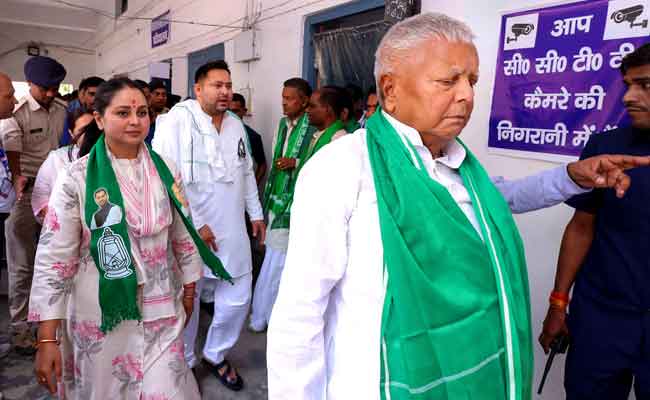
Patna (PTI): RJD supremo Lalu Prasad Yadav's daughter Rohini Acharya's bid to reclaim the Saran Lok Sabha seat, once represented by the socialist leader, for the party is being challenged by a namesake of her father.
Contestant Laloo Prasad Yadav, a local farmer from Bihar's Saran district, the 'karmabhoomi' of his famous namesake, has a penchant for contesting elections.
This time, he filed his nomination papers as a candidate of the Rashtriya Jansambhavna Party (RJP) for Saran Lok Sabha seat on April 26.
Earlier, Laloo Prasad Yadav had filed his nominations for 2022 Presidential polls as well. He had also filed his nomination papers for the 2017 Presidential polls, which was a contest between the then Bihar Governor Ram Nath Kovind, who went on to win, and former Lok Sabha Speaker Meira Kumar, who was a native of the soil.
However, his papers got rejected in the 2017 Presidential polls since those were not endorsed by an adequate number of proposers.
"I have been contesting Lok Sabha polls from Saran constituency for the last several terms. I had contested against former Bihar chief minister Rabri Devi as well. This time, I am contesting against her daughter Rohini Acharya," Laloo Prasad Yadav told PTI over the phone.
He also exuded of "winning the election by a comfortable margin".
"I engage in agriculture for a living and also do social work. I keep trying my luck, from panchayat to Presidential polls. I am leaving no stone unturned to win this election... people of Saran are with me," Yadav said.
When asked about his opponents calling him 'dharti pakad' (one who clings on to the earth), a term associated with those who like to contest polls for the sake of thrill and publicity, and 'vote katwa' (one who divides votes), Yadav said, "I don't care about all these labels. They are my opponents and they will say such things. I contest polls only for the sake of my electorate in Saran."
According to the affidavit filed by the RJP candidate, Yadav has Rs 5 lakh cash in hand whereas his wife has 2 lakh cash. He owns movable assets worth Rs 17.60 lakh and his wife owns movable assets worth Rs 5.20 lakh.
Let the Truth be known. If you read VB and like VB, please be a VB Supporter and Help us deliver the Truth to one and all.
CBSE plan for 2026-27: Three-language formula from Class 6; two levels of maths, science for Class 9
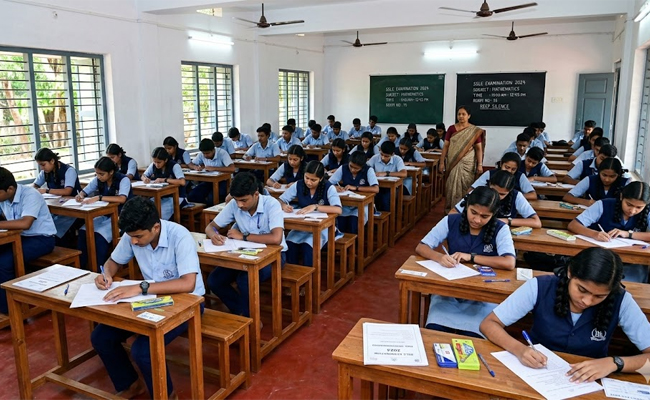
New Delhi (PTI): The Central Board of Secondary Education (CBSE) has rolled out its new curriculum, launching a phased implementation of the three-language formula from Class 6 and a two-level system of mathematics and science for Class 9 starting in the 2026-27 academic session, officials said on Friday.
While the three-language formula mandated under the new National Education Policy (NEP) will be implemented from 2026 for Class 6, introduction of the two-level system of mandatory standard and optional advanced courses in mathematics and science will be done for Class 9.
"Languages are organised through a structured three-language framework across stages: R1, R2 and R3. As per recommendations of new National Curriculum Framework (NCF), two of these three languages must be native to India. In continuation of the board's phased implementation of multilingual education, a third language will be made mandatory from Class 6 with effect from the academic session 2026-27, ensuring that every learner studies at least two Indian languages," a senior board official said.
"While it is desirable that the same scheme of languages is adopted, under exceptional circumstances for students returning from foreign schools where the third language studied till Class 8 or 9 is not available in domestic schools, such students may be exempted as per approved norms. However, such students will be required to study the total number of subjects as stipulated in the scheme of studies," the official added.
Mathematics and science will see a major structural shift with the introduction of a two-level system starting in the 2026–27 academic session.
"All students will study the standard curriculum and appear for a common 80-mark examination of three hours; those opting for higher proficiency can choose an additional 'advanced' level in either or both subjects. This advanced component will consist of a separate 25-mark, one-hour paper designed to test higher-order thinking skills and deeper conceptual understanding.
"Students must mandatorily take the standard exam, while the advanced paper remains optional. Importantly, performance in the advanced paper will not be added to the overall aggregate; instead, students scoring 50 per cent or above will have the advanced-level qualification reflected separately in their mark sheet," the official said.
The two-level system (standard and advanced) in mathematics and science will begin in the 2026–27 academic session for Class 9 students, and the first board exams for Class 10 students with this structure will be held in 2028 for that cohort.