J-K: SIA files chargesheet against journalist, PhD scholar in "narrative terrorism" case
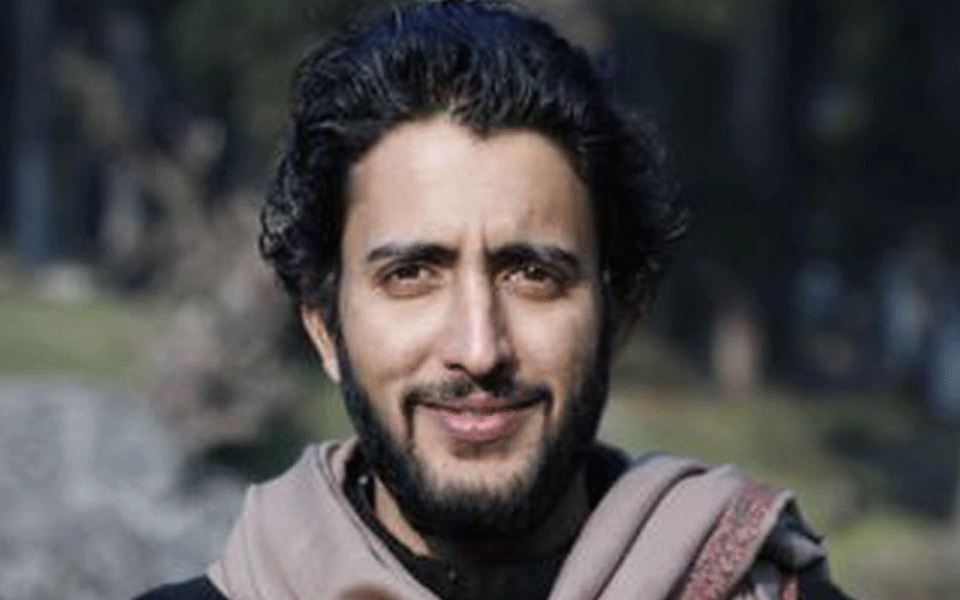
Jammu (PTI): The State Investigation Agency (SIA) of Jammu and Kashmir on Thursday filed a chargesheet against a digital magazine editor and a PhD scholar in a "narrative terrorism" case here.
Accused Peerzaada Fahad Shah, editor of monthly online magazine 'Kashmirwalla' and a resident of Srinagar, and Aala Fazili of Budgam have been booked under the Indian Penal Code and the Unlawful Activities (Prevention) Act, the SIA said in a statement here.
While Shah was arrested on February 5 for "glorifying terrorism, spreading fake news, and inciting the public against law and order", Fazili, a PhD scholar at the University of Kashmir, was arrested on April 17 for his "highly provocative and seditious" article in the online magazine.
"The case relates to narrative terrorism wherein as part of a criminal conspiracy to spread terrorism and create a false narrative, accused Fazili, by his highly provocative and seditious write-up, intended to create unrest, and aid and abet the gullible youth to take the path of violence," the SIA said in the statement.
It said the article was found to be "against national integration and supported the claim of secession of a part of the country's territory, challenged sovereignty and territorial integrity, glorified violence, and advocated and abetted commission of terrorist acts".
The SIA alleged that Shah intentionally conspired with Fazili and published the article, and this led to an increase in terrorism and unlawful activities across Jammu and Kashmir.
Calling the duo "contaminated and compromised media persons", the SIA said their end objective was to "create, sustain, and spread disaffection, hatred and enmity against the Indian State".
"Their interim objective was to preserve Pakistani influence by manipulating and playing with facts, subtly or brazenly, by putting information without context or out of context or selective reporting or selective exaggeration or underplaying or muting others and by craftily and cunningly invoking the legal rights to press freedom and political dissent guaranteed by the very Indian State which they wanted to undermine," the statement read.
Let the Truth be known. If you read VB and like VB, please be a VB Supporter and Help us deliver the Truth to one and all.
Deepfake video of Nirmala Sitharaman used to dupe Belagavi man in Rs 7.9 lakh scam
Belagavi (Karnataka) (PTI): A 76-year-old man in Belagavi city was allegedly cheated of Rs 7.9 lakh in an online investment scam that used an AI-generated deepfake video misusing the name of Finance Minister Nirmala Sitharaman to lure investors, police said on Wednesday.
An online fraud case was registered at the cybercrime police station on May 1, they said.
According to Belagavi Police Commissioner Bhushan Gulabrao Borase, the victim, Prakash Gubbi, a senior citizen, stated in his complaint that in November last year, he came across a video on YouTube in which Finance Minister Nirmala Sitharaman appeared to endorse an investment scheme.
The video also mentioned a link in its description for making investments.
The victim clicked on the link, entered his details, and was later contacted on social media by a person identifying himself as Adarsh Anand, who persuaded him to invest, the officer told reporters.
Citing the complaint, the officer said the victim initially invested a small amount, after which the application began showing profits of USD 65,000.
When he attempted to withdraw the amount, the accused demanded a “customs duty” payment of Rs 4.2 lakh, claiming it was required to process the withdrawal.
The victim paid the amount, after which he was asked to pay an additional Rs 2 lakh. It was at this stage that he realised he had been cheated. In total, he lost around Rs 7.9 lakh in the fraud, the officer added.
A case has been registered under relevant provisions of the Information Technology Act, and police are investigating the matter, police said.
The commissioner cautioned the public not to trust such videos, stating that the finance minister does not endorse any such schemes.
He warned that such content is created using artificial intelligence and deepfake technology.
He further advised the public to remain vigilant, avoid offers that appear too good to be true on the internet, and invest only through legitimate, registered agencies or trusted channels.
Deepfake technology enables the creation of realistic videos, audio recordings, and images that can mislead viewers by superimposing one person’s likeness onto another, altering their words and actions. This can present a false narrative or spread misinformation.