Jaishankar becomes first career diplomat to be appointed External Affairs minister
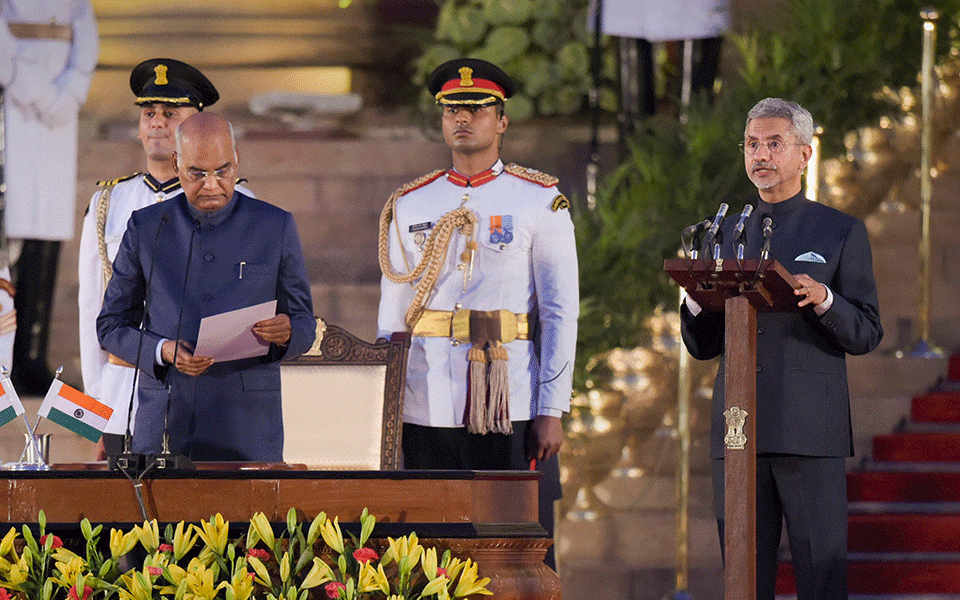
New Delhi: Former foreign secretary S Jaishankar was given charge of the External Affairs ministry on Friday, the first career diplomat to handle the key portfolio.
Considered an expert on China and the US, the new External Affairs minister's moves will be keenly watched to see whether he brings any changes in India's approach in dealing with a hostile Pakistan.
Jaishankar, who takes charge of the ministry nearly 16 months after he retired as foreign secretary, will also have to deal with overall expectations of expanding India's global influence and stature, particularly in key multilateral forums like G-20, Shanghai Cooperation Organisation and BRICS.
However, a major focus of the ministry under his leadership is likely to be on further boosting India's trade and defence ties with the US, Russia, France, Japan and the European Union as well as with the countries of the neighbourhood.
Another challenge for him will be to further strengthen India's ties with China, badly hit by the Doklam standoff in mid 2017.
The 64-year-old -- who is not a member of either the Rajya Sabha or the Lok Sabha at this point -- is also likely to push for deepening cooperation with the African continent where China is fast expanding its influence and presence.
Getting the long-awaited membership of the UN Security Council and Nuclear Suppliers Group is expected to be another area of interests of the new government.
India has also been trying enhance ties with the Gulf region as well as the hydrocarbon rich Central Asia, and Jaishankar is set to ensure continuity on it.
Jaishankar, son of the late K Subrahmanyam, one of India's leading strategic analysts, was a key member of the Indian team which negotiated the landmark Indo-US nuclear deal.
The deal, initiated in 2005, took several years to craft, and was signed by the UPA government headed by Manmohan Singh in 2007.
Jaishankar's appointment as foreign secretary in January 2015 evoked a sharp reaction from various quarters over the timing of the government's decision to remove Sujatha Singh.
He had earlier served as India's Ambassador to the US and before that to China.
A 1977-batch IFS officer, Jaishankar played a key role in resolving the crisis following the incursion in Ladakh's Depsang and the Doklam stand-off, handling the tough negotiations with Beijing.
Among other positions, Jaishankar has been India's High Commissioner to Singapore and Ambassador to the Czech Republic.
Last year, Tata Group appointed Jaishankar, who was Indian foreign secretary from January 2015 to January 2018, as its president for global corporate affairs, within three months of his retirement from the government service.
A graduate of St Stephen's College, Jaishankar is an MA in Political Science and an MPhil and PhD in International Relations from Jawaharlal Nehru University (JNU).
Jaishankar is married to Kyoko Jaishankar and has two sons and a daughter.
In 2019, Jaishankar was conferred with the Padma Shri, the fourth highest civilian award of the country.
Let the Truth be known. If you read VB and like VB, please be a VB Supporter and Help us deliver the Truth to one and all.
Trump says EU has until July 4 to approve last year's trade deal or it will face higher tariffs
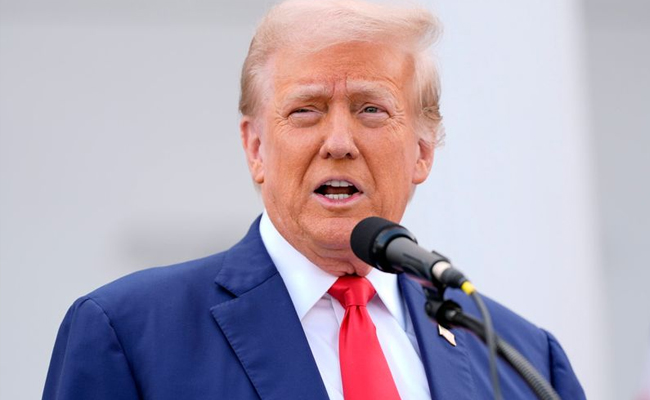
Washington (AP): President Donald Trump has said in a social media post that goods from the European Union would face higher tariff rates if the 27-member bloc fails to approve last year's trade framework by July 4.
The announcement on Thursday appeared to be a deadline extension after the president said last Friday that EU autos would face a higher 25 per cent tariff starting this week. Trump made the updated announcement after what he described as a "great call" with European Commission President Ursula von der Leyen.
Still, the US president was displeased that the European Parliament had yet to finalize the trade arrangement reached last year, which was further complicated in February by the US Supreme Court ruling that Trump lacked the legal authority to declare an economic emergency to impose the initial tariffs used to pressure the EU into talks.
"A promise was made that the EU would deliver their side of the Deal and, as per Agreement, cut their Tariffs to ZERO!" Trump posted. "I agreed to give her until our Country's 250th Birthday or, unfortunately, their Tariffs would immediately jump to much higher levels."
It was unclear from the post whether Trump was implying that the tariff rates would jump on all EU goods or the increase would only apply to autos.
His latest statement indicates he might be backing away from his earlier threat on EU autos by giving the European Parliament several more weeks to approve the agreement.
Under the original terms of the framework, the US would charge a 15 per cent tax on most goods imported from the EU.
But since the Supreme Court ruling, the administration has levied a 10 per cent tariff while investigating trade imbalances and national security issues, aiming to put in new tariffs to make up for lost revenues.