Jaitley says GST had only transient impact on growth
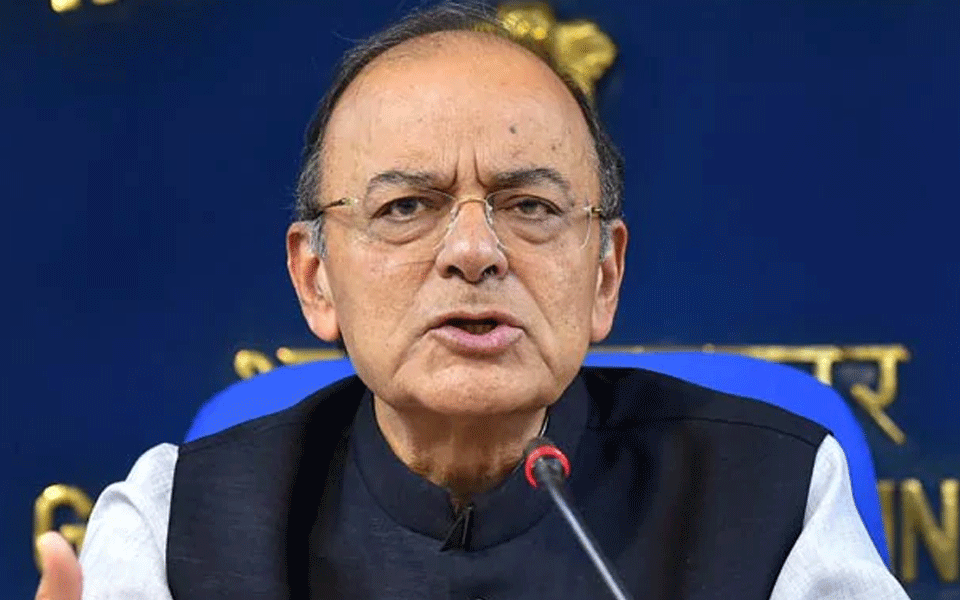
Mumbai, Nov 11 : Finance Minister Arun Jaitley Sunday hit out at the "critics and cynics" who blame GST for growth deceleration, saying the indirect tax reform had only a "transient" impact on growth and that too for two quarters.
In remarks apparently aimed at former Reserve Bank governor Raghuram Rajan, who Friday blamed the Goods and Services Tax roll-out along with demonetisation for lower GDP growth, Jaitley said the economy recovered fast from the limited "disruptionist impact" of the tax reform.
But the minister was silent on Rajan's criticism of the note-ban, which has disrupted everyone's life in general and that of small traders and small businesses in particular.
Though the stated objectives of the move was to curb blackmoney and choke the channels pumping in fake notes into the economy, the RBI in July had stated that as much as 99.3 per cent of the cancelled notes had come back to the system and also cash in circulation had topped the pre-note-ban days.
Interestingly, the government did not celebrate the second anniversary of the controversial decision on November 8, unlike the first anniversary when it had listed out the benefits of the move as increased tax payers' base and higher digital transactions.
Claiming that GST had a smooth implementation, Jaitley, without naming anyone, said, "You will always have critics and cynics who will come up and say it slowed down growth."
Jaitley, who was addressing the centenary celebrations of the state-run Union Bank of India through a video message, described GST as a "monumental reform" that impacted growth for just two quarters, as GDP numbers since then climbed up to 7, 7.7 and 8.2 per cent in the subsequent quarters.
He was also quick to point out that these numbers are much higher compared to 5-6 per cent achieved between 2012 and 2014 under the previous government.
The minister said ever since the Narendra Modi government assumed office, the country has been able to retain its position as the fastest growing major economy.
Delivering a lecture in the US Friday evening, Rajan, whose three-year stint at the RBI ended in September 2016 two months before demonetisation and almost a year before GST implementation in July 2017 had termed the twin moves as "hard blows" to the economy when global growth was much better, thus the country losing out from the rest of the world.
"The two successive shocks of demonetisation and GST had serious impacts on growth, which has fallen off interestingly at a time when the global economy was picking up fast," Rajan had said.
"The reality is that seven (7 per cent growth) is not enough for the kind of people coming into the labour market and we need jobs for them. So, we need more and cannot be satisfied at this level (of growth)," Rajan had added.
Jaitley said "reforms," including GST, demonetisation and the much-contested Aadhaar, have ensured greater formalisation of the economy and made available extra resources which are now being utilised for building infrastructure, rural roads and also for paying for various social sector schemes aimed at uplifting the masses.
"Leaders should not be cowards, they should be decisive decision-makers who should have the capacity to take these decisive decisions, bear the criticism, and eventually in the larger interest of the nation, implement them," Jaitley said.
Within the first year of GST implementation, Jaitley said the number of people who registered for GST has gone up by 74 per cent and government has also been able to bring down tax rates for as many as 334 commodities than previous levels.
He reiterated that the Aadhaar and the schemes working through it are alone has helped save over Rs 90,000 crore and welcomed the Supreme Court order upholding the biometric-based identity project, though with many conditions.
The minister gave out a list of a slew of schemes where government has been able devote resources because of the additional resources across sectors.
Let the Truth be known. If you read VB and like VB, please be a VB Supporter and Help us deliver the Truth to one and all.
26 killed, 61 injured in blast at fireworks factory in China
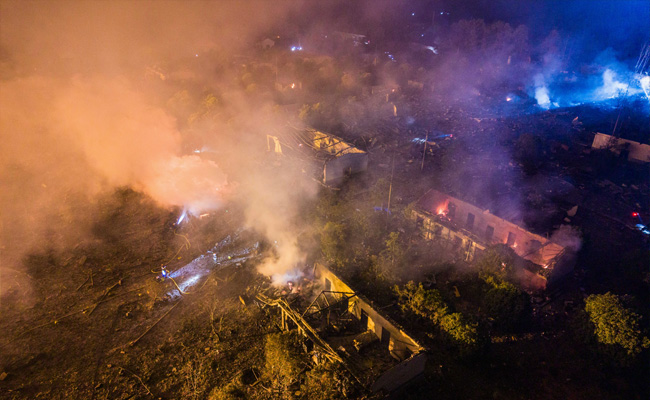
Beijing (PTI): At least 26 people were killed and 61 others injured in a massive explosion at a fireworks factory in China's Hunan province, officials said on Tuesday.
The explosion occurred on Monday afternoon at the plant operated by the Huasheng fireworks manufacturing and display company in Liuyang, a county-level city under Changsha, the provincial capital.
Videos circulating on Chinese social media showed massive destruction of property spanning several kilometres.
ALSO READ: Will of people supreme, says Mahua Moitra after BJP's landslide victory in Bengal
More than 480 rescuers, organised into five teams, have been deployed for relief operations, with three rescue robots pressed into service.
Officials said 26 people were killed and 61 others were injured. The injured have been rushed to hospitals for treatment, while a second round of search operations is underway.
China is a leading manufacturer and exporter of fireworks.
As the explosion site is located near two black powder warehouses, the rescuers have evacuated nearby residents and set up a buffer zone to prevent a secondary accident, the state-run Xinhua news agency reported.
The Ministry of Emergency Management has dispatched experts to the scene to guide rescue efforts.
The person in charge of the company has been detained by police and the cause of the accident is being investigated, the report said.