Jaitley targets Congress over Kumaraswamy breaking down
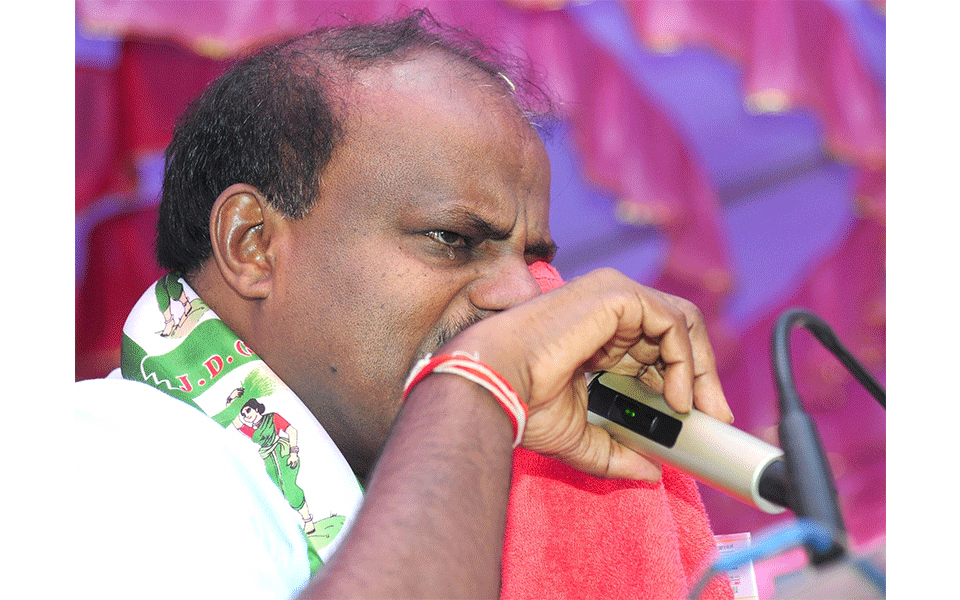
New Delhi, July 16 : Union Finance Minister Arun Jaitley on Monday targeted the Congress over Karnataka Chief Minister H. D. Kumaraswamy breaking down at a public event, saying the party believed that "only members of one family can rule India" and that others should be pushed to weeping publicly.
Jaitley's remark came in a facebook post: "Is the Karnataka a preview of what the Congress and the Federal Front promise for the future?" Jaitley said the country is keenly watching Karnataka where the Congress and the Janata Dal-Secular joined hands post-elections to form a government in May.
"It is a repeat of what the Congress did to Chaudhary Charan Singh, Chandra Shekhar, H.D. Deve Gowda and I.K. Gujral. It is the obvious consequence of a non-ideological opportunistic alliance (working) with no positive agenda. The basis of the negative agenda is 'keep Modi out'," Jaitley said.
He said people had, in the last few days, seen Kumaraswamy pouring out his emotions with tears, declining to accept bouquets and garlands.
Kumaraswamy broke down at a public event on Saturday stating that he was "not happy" holding the top post and that he was swallowing the pain like 'Vishakantha' (Lord Shiva), who drank poison.
Jailtley said non-ideological opportunistic coalitions always get trapped within their own contradictions and their only objective remains survival and not service of the nation.
"Their longevity is suspect. If a Prime Minister of such a coalition has to weep before cameras with a wish to exit from office, it will be a scenario worse than the policy paralysis of UPA II. The Congress firmly believes that only members of one family can rule India. If anybody else gets a chance, he should be pushed to the desperation of throwing his hands up and weeping publicly," he said.
Jaitley said Prime Minister Narendra Modi has clearly demonstrated the advantages of a decisive leadership.
"India's Prime Minister and his government have to overcome the challenges that India faces today. He cannot be seen like the Chief Minister of Karnataka as a tragedy king. If such a coalition is a cup of poison, why even dream of inflicting it on the nation?" he said.
Jaitley cited parts of Kumarswamy's speech and said it reminded him of tragedy-era Hindi films.
He said India needs a sustained high-trajectory growth, cohesive government and a decisive political leadership to face global challenges, including terrorism.
The minister said the country needs a government which is able to resist unfair pressures of allies and regions.
"If fighting terror has to be compromised because of vote-bank pressures of allies, then such a government would be a liability. Can a leadership unsure of itself meet the challenge of eliminating poverty and transforming the world's fastest growing economy into a developed nation?" he asked.
Let the Truth be known. If you read VB and like VB, please be a VB Supporter and Help us deliver the Truth to one and all.
Adequate LPG stock in Chhattisgarh, no need to panic, says CM Sai
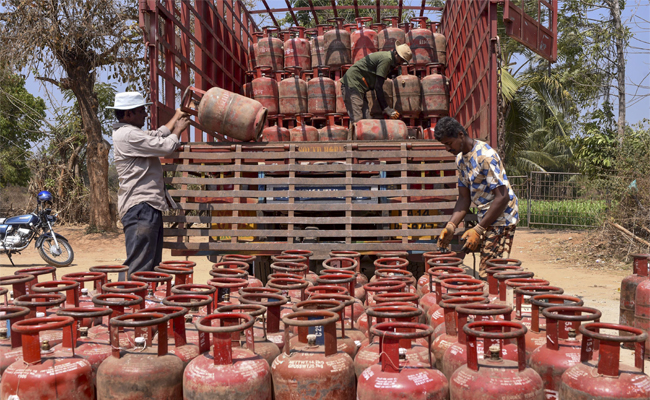
Raipur (PTI): Amid reports of shortage of commercial LPG cylinder in several parts of the country due to the US-Israel-Iran conflict, Chhattisgarh Chief Minister Vishnu Deo Sai on Tuesday assured people that they need not worry about the availability of cooking gas in the state.
He asserted that adequate stock of LPG as well as petrol and diesel was available in the state.
Sai said in a statement that authorities have been directed to regularly monitor stock at gas agencies and keep a close watch on the supply chain. Necessary instructions were issued to officials in all districts to ensure a smooth supply of LPG.
The chief minister instructed officials to take strict action if any complaint of black marketing or hoarding of LPG cylinders is received.
Sai urged state residents not to pay attention to rumours and to book cooking gas cylinders as per their actual requirement.
The government was fully alert to ensure the availability of essential commodities to citizens, he emphasised.
Meanwhile, the Chhattisgarh Hotel and Restaurant Association has issued an advisory to hotels, restaurants, caterers and other food businesses across the state, urging them to maintain calm and avoid panic buying.
In the advisory, Taranjeet Singh Hora, president of the association, asked members to maintain coordination and immediately inform it about any major disruption in LPG supply.
He cautioned businesses against hoarding cylinders, saying such practices could worsen the situation for the entire hospitality sector.
The association advised hotels and restaurants to prioritise essential kitchen operations, core menu items and already committed banquet events.
Use electric cooking equipment wherever possible for emergency and staff kitchens such as induction cooktops, electric hot plates, electric rice cookers and kettles, the advisory stated.