Jal Shakti minister says Chennai, Bengaluru will become Cape Town if people don't act to save water
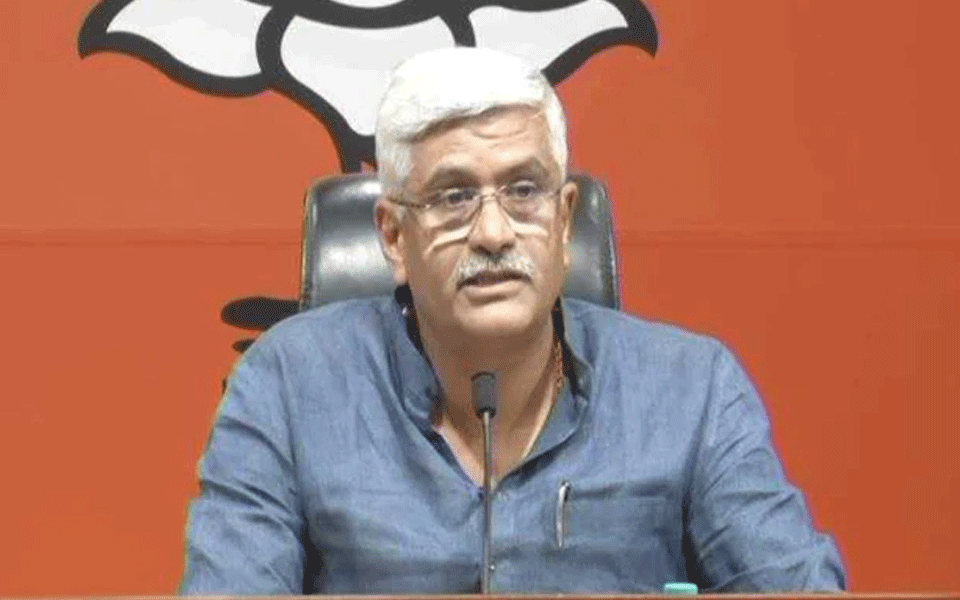
New Delhi: Union Jal Shakti Minister Gajendra Singh Shekhawat warned on Wednesday that if people still don't understand their responsibility to save water, a large part of India's population will be severely affected and Chennai and Bangalore "will become Cape Town".
Water crisis in Cape Town peaked during 2017-18 when the South African capital almost ran out of water. It then introduced the idea of Day Zero, when most of the port city's taps would be turned off to focus everyone's attention on managing water consumption.
Rapid urbanisation, burgeoning population and poor water management have led to taps drying, groundwater levels falling, and lakes becoming toxic, froth-filled in Bangalore. A large number of people have no access to piped water and are dependent on water tankers. The situation in Chennai, another metropolis, is no better.
Shekhawat said water availability per capita has come down from 5,000 cubic metres at the time of Independence to 1,540 cubic metres. "If it continues to decline and the population continues to increase, not only Chennai and Bangalore will become Cape Town, a large part of India's population will be affected," he said.
Citing Justice Swatanter Kumar, former chairperson of the National Green Tribunal, he said in India, people worship rivers. Still, it has the most-contaminated water resources. On an average, India gets 1,068 mm rain and 4,000 million cubic metres of water per year through precipitation, yet it's a water-scarce country, the Union minister said. Israel, which gets 100 mm rain per year, is water-abundant and exporting the resource.
Despite all constitutional provisions, India lacks the same responsibility towards saving water and the environment that prevailed before Independence through an unwritten set of fundamental, cultural principles, he said.
"In India, people talk more about rights and less about responsibilities... The government is certainly responsible, but it's also the responsibility of the people and the industry," he said.
Shekhawat said everything was perfect when people were the custodians of natural resources. "Problem began when we started considering ourselves owners of natural resources."
"India is the most groundwater-dependent country in the world. Still, it's total water retention capacity is below 300 million cubic metres," the minister said, emphasizing the need to conserve water and recharge aquifers.
Let the Truth be known. If you read VB and like VB, please be a VB Supporter and Help us deliver the Truth to one and all.
Delhi to adopt fully digital system for time bound traffic challan disposal
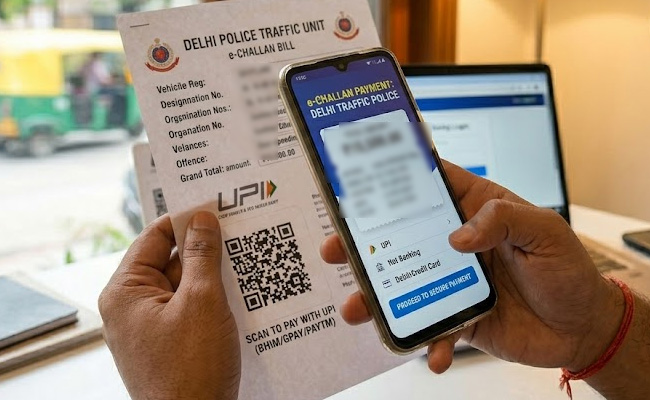
New Delhi (PTI): The Delhi government will soon implement amended Central Motor Vehicles Rules, 1989, making the traffic challan process completely digital and time-bound, to curb violations and enhance road safety, Chief Minister Rekha Gupta said on Sunday.
Under the new framework, avoiding challans will no longer be possible and timely resolution will be mandatory for all citizens. Importantly, violators will not be able to approach courts directly to contest a challan without first going through the prescribed process, said a Delhi CMO statement.
Anyone committing five or more traffic violations within a year will be classified as a "serious offender" and will risk suspension or disqualification of their driving licence under the amended rules, it said.
Gupta noted that the issuance of challans will now be fully modernised.
Police or authorised officers can issue challans either physically or electronically. In addition, violations captured through cameras and digital surveillance systems will automatically generate challans. The e-challans will be delivered within three days to the violators through their mobile numbers, and a physical notice will be delivered within 15 days.
Once a challan is issued, the violator will have 45 days to either pay the fine or challenge it before a grievance redressal officer through the online portal, supported by documentary evidence. If no action is taken within this period, the challan will be deemed accepted, and payment must be made within the next 30 days, the statement said.
If a challenge is rejected, the individual can either pay the fine within 30 days or approach the court after depositing 50 per cent of the challan amount.
Failure to act within the stipulated time will result in the challan being treated as accepted, with payment required within 15 days thereafter.
Payments can be made through electronic modes. The grievance redressal officer will be required to upload a decision on the portal within 30 days, it said.
The chief minister made it clear that once deadlines lapse, daily electronic notices will be issued. Continued non-payment will lead to restrictions on all vehicle-related services, including payment of taxes and processing of driving licence or registration-related requests.
The vehicle will be flagged on the official portal as 'not to be transacted,' effectively blocking any further transactions until the dues are cleared. In cases where necessary, and subject to court orders, police or authorised officers may also impound vehicles involved in violations.
All challans will be issued in the name of the registered vehicle owner, who will be notified via SMS, email or other digital means, it added.