Jamaat-e-Islami Hind condemns Maulana Tauqeer Raza's arrest, claims 'misuse' of state machinery
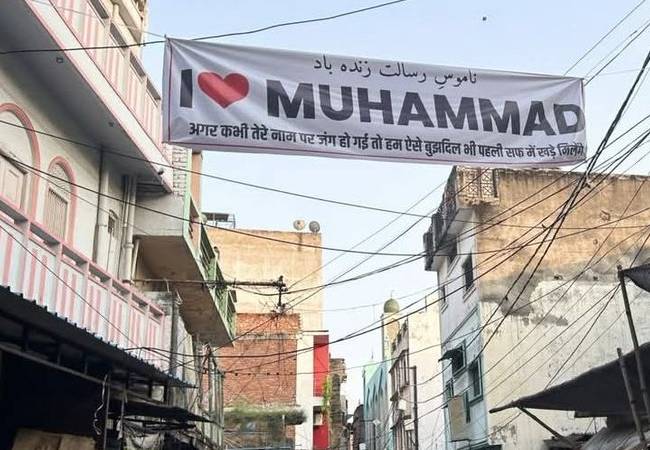
New Delhi (PTI): Amid a row over the 'I Love Muhammad' campaign, prominent Muslim organisation Jamaat-e-Islami Hind on Sunday condemned the arrest of Maulana Tauqeer Raza Khan and others in Bareilly, and alleged "misuse" of state machinery for political ends.
The organisation also claimed that law and order challenges were being turned into opportunities for "communal polarisation".
The president of Jamaat-e-Islami Hind, Syed Sadatullah Hussaini, strongly condemned the "unjust arrest" of Maulana Tauqeer Raza Khan and others in Bareilly.
"The arrest of respected scholar Maulana Tauqeer Raza Khan, along with several others, in Bareilly is a matter of grave concern and a troubling reflection of the direction in which communal politics and hatred-driven governance are steering our country," Hussaini said.
"What began with the simple slogan 'I Love Prophet Muhammad' -- an expression of devotion and reverence -- was cynically equated with threats to public order. To criminalise such peaceful affirmation of faith through sweeping FIRs and mass arrests is not merely unjustified; it is an outrageous assault on India's civilisational ethos of respect and pluralism," the Jamaat president said.
For centuries, the people of India have lived together with mutual respect for each other's religious sentiments, he said.
"It is inconceivable that such an expression of devotion could polarise society; rather, it is political mischief that has manufactured this crisis," he said.
Hussaini claimed reports suggest that Raza was initially placed under house arrest, and subsequently, sweeping FIRs were registered under the harshest provisions of the Bharatiya Nyaya Sanhita (BNS), naming hundreds of Muslims without proper investigation.
"Even more disturbing is the derogatory language used by some political leaders against a respected scholar of Maulana's standing -- revealing the ugly politics behind this entire episode.
"Such disproportionate use of state power not only undermines the rule of law but also deepens alienation and mistrust," Hussaini said.
Similar agitations in the past have been managed with measured responses, without draconian charges or sweeping criminalisation of entire communities, he said.
Applying selective and excessive measures against one group violates both the spirit of the Constitution and the principles of fair governance, Hussaini said.
"What we are witnessing today is the misuse of state machinery and law enforcement for political ends, turning law-and-order challenges into opportunities for communal polarisation.
"Each time elections approach, the same cycle is repeated: communities are divided, mistrust is manufactured, and the social fabric of the nation is sacrificed for narrow gains," he alleged.
This is a dangerous path that erodes democratic institutions and constitutional values, the JIH president said.
He appealed to the Muslim community to remain steadfast, peaceful, and guided by the Prophet's message of patience, mercy, and compassion.
He also called upon the government to immediately withdraw the exaggerated charges, release those "wrongfully" detained, and restore parity, proportionality, and justice in governance.
"India's strength lies in its Constitution, its pluralism, and its social fabric of mutual respect. Undermining these foundations for short-term political advantage harms not only one community, but the entire nation." Hussaini said.
Tensions erupted in several districts of Uttar Pradesh recently, including Barabanki, Mau and Muzaffarnagar, after violent protests in Bareilly over the 'I Love Muhammad' campaign after Friday prayers, with police carrying out overnight house-to-house raids to nab the "culprits", arresting Raza in the process.
Officials on Saturday said that security forces had been deployed in strength and social media was being closely monitored to keep the situation under control.
Following the clashes in Bareilly, tension prevailed in Faizullaganj village in Barabanki district, located adjacent to state capital Lucknow, after a banner with the words 'I Love Muhammad' was torn down.
One side alleged that a local watchman named Dhanni broke the rope with a stick and brought down the banner. Following the incident, members of one community gathered at the scene and expressed their displeasure.
Members of the other community also began gathering, creating a tense atmosphere in the village.
The entire incident was recorded on a CCTV camera installed at a nearby mosque. The footage reportedly shows Dhanni using a stick to topple the banner. Police have seized the video and launched an investigation.
Dhanni's house was reportedly vandalised by some youths. Upon receiving the information, police swung into action.
The additional superintendent of police and the circle officer arrived at the scene, and cops from several police stations were called to the village.
Dhanni's wife alleged that some people broke into the house, vandalised it and stole their belongings.
Ajay Singh, the SP's public relations officer, said a dispute had arisen over the removal of a banner, but peace has now been restored at the scene.
Police in Barabanki arrested eight people for taking out a procession after the incident in Faizullaganj.
Let the Truth be known. If you read VB and like VB, please be a VB Supporter and Help us deliver the Truth to one and all.
Advocate found dead in car on Nainital court premises

Nainital (PTI): A 55-year-old advocate allegedly died by suicide after shooting himself inside his car at the Nainital district court parking lot here on Monday, police said.
According to the police, Puran Singh Bhakuni, a resident of Mallital, was found in the rear seat of his vehicle with a gunshot wound to his temple.
Police recovered a licensed pistol from his hand and a suicide note from the car’s dashboard. The note stated that Bhakuni was unwell and suffering from depression.
"We received information through lawyers around noon. The deceased was lying in the back seat with a pistol in his hand and blood near his ear," Circle Officer Anjana Negi said.
Forensic teams and ballistic experts reached the spot to collect evidence, as no witness reported hearing the gunshot.
Government counsel Sushil Sharma stated that Bhakuni left home at 9 am and was found dead at 9.30 am.
Sharma raised concerns over the circumstances, noting that the body was in the rear seat, and demanded a thorough probe to rule out foul play. Bhakuni, who worked as a notary, had married six months ago, he said.
Police took the body into custody and sent it for a postmortem to confirm the cause of death.
The forensic laboratory will examine the suicide note and the ballistics of the weapon, the police said, adding that the investigation is ongoing.