Japan stops cash for bullet train after project stalled over land row

The protest against land acquisition for the Ahmedabad-Mumbai bullet train project has become a huge roadblock for the cash flow from Japan.
The latest installment that funding agency Japan International Cooperation Agency (JICA) was supposed to release for last quarter, did not reach, said sources from Gujarat government. The JICA stopped the payment on the grounds that the project did not show any progress due to several disputes.
A senior state official, said on condition of anonymity, "As issues over acquisition of land for the bullet train project surfaced in Gujarat as well as in Maharashtra, no progress could be made. The agreements for payment of installment is conditional and the funds arrive from JICA if the progress is constant. The first installment of Rs 125 crore was sanctioned when the Japanese PM visited Gujarat in last September."
"The state government has been trying hard to expedite the land acquisition by talking to farmers. The next installment of fund will not arrive unless the progress is achieved," said the official.
The JICA has agreed to provide nearly Rs. 80,000 crore for the High Speed Rail Project (HSRP) estimated at 1 lakh crore.
The amount to be provided by the Japanese body to India will be given in installments as a soft loan for 15 years. The fund will come in installments.
While the rest of Rs. 20,000 crore will be paid by Gujarat and Maharashtra state government jointly and that too in installments. The special purpose vehicle (SPV) for the project was formed with the equity of Rs. 500 crore in last September only.
The chief secretary of Gujarat Dr JN Singh coordinates with different partner agencies in the project on behalf of Gujarat government. Talking on the issue, Singh said, "The Gujarat government is hardly aware of any development of cash flow from JICA for the project as it is not our purview. If that has happen in any case, the installment will come in future anytime as it comes viz a viz project implementation."
The revenue minister Kaushik Patel said that the Gujarat government was seriously making effort for land acquisition and CM has asked the government to ensure that no farmer should be meted with injustice in due process.
Courtesy: www.dnaindia.com
Let the Truth be known. If you read VB and like VB, please be a VB Supporter and Help us deliver the Truth to one and all.
Bengal: Over 55 pc turnout till 1 pm in repoll in 15 booths of 2 assembly seats
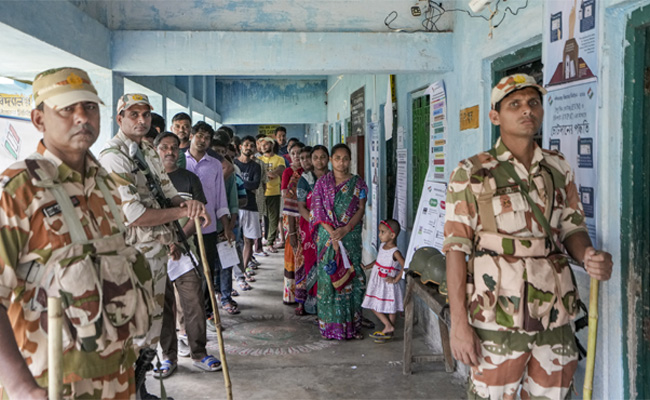
Kolkata (PTI): Over 55 per cent turnout was recorded till 1 pm in repoll in 15 booths of two assembly constituencies in West Bengal's South 24 Parganas district on Saturday, an official said.
Voting was underway more or less peacefully at 11 polling stations of Magrahat Paschim assembly constituency and four in Diamond Harbour, where the EC ordered repoll a day ago, following reports of electoral malpractices.
However, at booth number 179 at Chanda Primary School of Diamond Harbour seat, the Trinamool Congress alleged that a specially abled voter and his mother were harassed by central forces. The alleged incident sparked protests by party workers and locals.
The TMC claimed that the voter's mother, who had entered the booth to assist him, and her son were detained for a considerable time by central forces over alleged rule violations.
ALSO READ: Man arrested for duping Delhi resident of Rs 2 lakh in online car sale fraud
"TMC leaders Manmohini Biswas and Pratik Ur Rahman reached the spot and led the protests, with residents terming the action unwarranted harassment. The matter has been taken care of by our officials there," an official of the poll body said.
Polling was otherwise peaceful across 15 booths in the area, he added.
Voting began at 7 am and will continue till 6 pm, the official said, adding that till 1 pm, the turnout was 55.57 per cent.
Magrahat Paschim registered 56.33 per cent voter turnout, while in Diamond Harbour, it was 54.9 per cent, a poll official stated.
Voting in these two assembly constituencies was held in the second phase of the state elections on April 29.
The repoll order was based on reports received from returning officers and observers of the two constituencies and "material circumstances", the Election Commission official said.
In Magrahat Paschim, TMC's Md Samim Ahamed Molla is pitted against BJP nominee Goursundar Ghosh, while Abdul Majid Halder of the Congress and ISF candidate Abdul Aziz Al Hassan are also in the fray.
TMC candidate Panna Lal Halder is contesting against Dipak Kumar Halder of the BJP in the Diamond Harbour seat. Goutam Bhattacharya of the Congress and CPI(M)'s Samar Naiya are among other candidates.
The BJP had alleged rampant electoral malpractices in certain polling stations of both the assembly seats under the Diamond Harbour Lok Sabha constituency, which is represented by TMC national general secretary Abhishek Banerjee.
The EC had deputed its special observer, Subrata Gupta, to fact-check the allegations from the ground.
The poll panel will decide on repolling in the Falta assembly constituency on Saturday.
The West Bengal assembly elections were held in two phases -- April 23 and April 29 -- amid unprecedented security arrangements.
Counting of votes will take place on May 4.