Jharkhand assembly polls to be held in five phases from Nov 30, counting on Dec 23: EC
New Delhi: Jharkhand assembly polls will be held in five phases between November 30 and December 20, and the counting of votes will take place on December 23, the Election Commission said on Friday.
Chief Election Commissioner Sunil Arora told reporters that the polls to 81-member assembly will be held on November 30, December 7, 12, 16 and 20.
The assembly polls in the Naxalism-affected state were held in five phases in 2014 as well.
The BJP is in power the state, which has a large tribal population, and an alliance of opposition parties, mainly the Congress and the Jharkhand Mukti Morcha, is making a determined bid to oust the government headed by Chief Minister Raghubar Das.
Thirteen constituencies will go to the polls in the first phase, 20 in the second phase, 17 in the third, 15 in the fourth phase and 16 constituencies will go to polls in the fifth phase.
With the Jharkhand polls coming on the heels of assembly elections in Maharashtra and Haryana, its result will be keenly followed as political watchers believe that the opposition has been emboldened by the outcome in the two states where its numbers have been better than expectations.
Though the BJP, which was in power in Maharashtra and Haryana, emerged as the single largest party in both states, its numbers fell short of expectations even though the opposition was written off by the media and most pundits.
The saffron party has asserted that it has provided a stable, clean and development-oriented government in Jharkhand, with the opposition claiming that the state's progress has stalled under its rule.
Das is the first state chief minister to have completed the full term of five years in the state, long plagued by fractured mandate and unstable governments.
Let the Truth be known. If you read VB and like VB, please be a VB Supporter and Help us deliver the Truth to one and all.
Indian startup's 'Drishti' satellite launched aboard SpaceX rocket
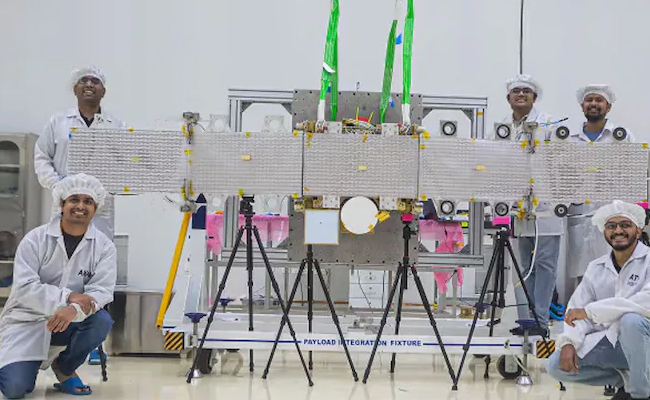
New Delhi (PTI): Bengaluru-based space start-up GalaxEye's Mission Drishti satellite was launched on Sunday aboard SpaceX's Falcon 9 rocket from California.
Mission Drishti is the world's first OptoSAR satellite, integrating electro-optical (EO) and synthetic aperture radar (SAR) sensors into a single operational platform, according to the company.
While EO sensors capture high-resolution images during sunlight and clear skies, SAR sensors provide all-weather and all-time images, using radar pulses.
In a statement, Suyash Singh, founder and CEO of GalaxEye, said, "With the satellite (Mission Drishti) now successfully in orbit, our immediate focus is on completing its commissioning. As we move through this phase, we are already witnessing strong global interest in the differentiated datasets enabled by our OptoSAR payload."
The satellite will help address long-standing limitations of conventional systems and enable more reliable and consistent data acquisition across diverse environmental conditions, the company said.
As a dual-use Earth observation satellite, the mission will support use cases across defence, agriculture, disaster management, maritime monitoring, and infrastructure planning.
The satellite is also expected to complement India's broader initiatives, including the 29 active Earth Observation satellites outlined in ISRO's recent annual report.
The launch came after five years of indigenous research and development, and extensive environmental testing and performance validation of the Mission Drishti.
In a statement, Lt Gen AK Bhatt (Retd), director general of Indian Space Association (ISpA), said, "GalaxEye has achieved what only a few global players have, which is seamlessly combining optical and SAR capabilities on a single platform to enable persistent, all-weather intelligence."
What stands out is not just the technology, but its broader impact on how downstream applications will increasingly define value in the space economy, particularly in Earth observation, where timely, decision-grade insights are critical," he added.
ISpA is the premier industry association of space and satellite companies in the country.
Union Minister Jitendra Singh also took note of the Mission Drishti launch, saying the development marked a significant milestone in India's space journey.
In a post on X, the minister said, "The successful launch of the world's first OptoSAR satellite, and the largest privately-built satellite in the country, reflects the immense potential of our young innovators driving nation-building."
GalaxEye aims to scale up Mission Drishti to a constellation of 10 satellites by 2030, developing a robust and sovereign Earth observation infrastructure for India.