Hemant Soren govt wins trust vote in Jharkhand Assembly amid opposition walkout
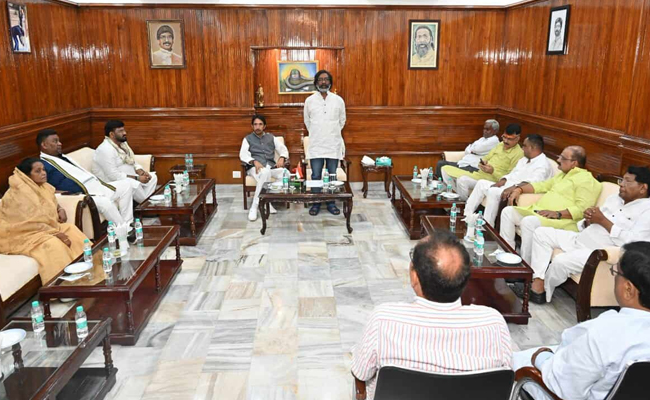
Ranchi (PTI): The JMM-led government in Jharkhand headed by Chief Minister Hemant Soren on Monday won the vote of confidence in the assembly amid a walkout by opposition members.
A total of 45 MLAs, including nominated member Josheph P Galastaun, voted in favour of the confidence motion.
BJP and AJSU legislators walked out of the House as headcount for voting started. The BJP-led opposition has 24 legislators of the saffron party and three of the AJSU Party.
Earlier, BJP legislators trooped into the well seeking Speaker Rabindra Nath Mahto's permission to allow MLA Bhanu Pratap Sahi to speak, which was turned down by the Speaker.
Seventy-five MLAs were present in the assembly during the voting. Independent legislator Saryu Roy abstained from voting.
ALSO READ: Delhi HC seeks Tihar reply to Kejriwal's plea for additional meetings with lawyers
The ruling alliance comprises the JMM, Congress and the RJD while it is supported from outside by the lone CPI (ML) Liberation legislator.
After the Lok Sabha elections, the strength of the JMM-led alliance has been reduced to 45 MLAs in the 81-member House, with 27 of the Jharkhand Mukti Morcha, 17 of the Congress and one of the Rashtriya Janata Dal.
Two JMM MLAs – Nalin Soren and Joba Majhi – are now parliamentarians, while Jama legislator Sita Soren resigned to contest the Lok Sabha elections on a BJP ticket.
The JMM expelled two more legislators – Bishunpur MLA Chamra Linda and Boriyo MLA Lobin Hembrom – from the party.
Similarly, the BJP's strength in the assembly has reduced to 24, as two of its MLAs – Dhulu Mahto (Baghmara) and Manish Jaiswal (Hazaribag) – are now MPs. The saffron party expelled Mandu MLA Jaiprakash Bhai Patel after he joined the Congress.
The current strength of the 81-member Jharkhand Assembly is 76. The ruling JMM-Congress-RJD alliance had handed over a support list of 44 MLAs to the Governor when Hemant Soren staked his claim to form the government on July 3.
Hemant Soren, the JMM executive president, was sworn in as the 13th chief minister of the state on July 4, a day after his predecessor Champai Soren stepped down from the post.
Hemant Soren was released from jail on June 28 after the Jharkhand High Court granted bail to him in a money laundering case linked to an alleged land scam. He had resigned as the chief minister, shortly before his arrest on January 31 by the Enforcement Directorate.
VIDEO | Jharkhand CM Hemant Soren (@HemantSorenJMM) wins trust vote in the Assembly.
— Press Trust of India (@PTI_News) July 8, 2024
“Today, everyone got to see the unity and strength of the ruling party again. I thank the Speaker of the Legislative Assembly and all the party members,” he said.
(Full video available on PTI… pic.twitter.com/exUaD68Xko
Let the Truth be known. If you read VB and like VB, please be a VB Supporter and Help us deliver the Truth to one and all.
Vaishnaw flags off Jammu-Srinagar Vande Bharat, services from May 2
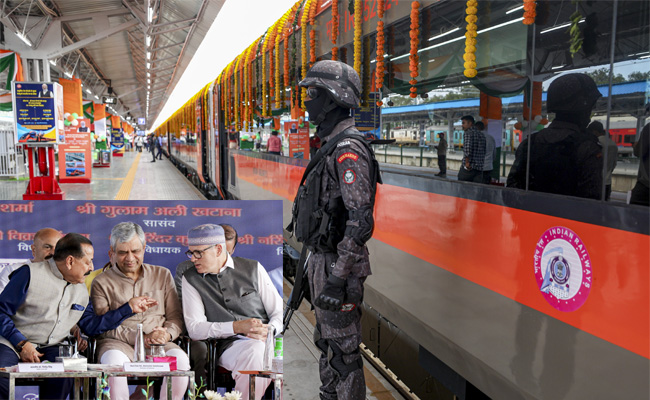
Srinagar (PTI): Railways Minister Ashwini Vaishnaw on Thursday flagged off the 20-coach Vande Bharat Express train between Jammu and Srinagar, the first direct train between the twin capitals of Jammu and Kashmir.
Chief Minister Omar Abdullah and Minister of State in the Prime Minister's Office, Jitendra Singh, were among the dignitaries present at the flagging off ceremony.
The direct train services between Srinagar and Jammu will reduce travel time between the twin capitals of Jammu and Kashmir, and boost tourism, besides providing an all-weather surface transport link.
Prime Minister Narendra Modi inaugurated the first direct train service between Katra and Srinagar on June 6, 2025. This service is now being extended up to the Jammu Tawi Railway Station.
The work on the Rs 43,780-crore rail project, linking Kashmir to the rest of the country, began in the late 1990s, with the first train operating in the Kashmir Valley in October 2008.
While train services had reached Udhampur by 2005, the treacherous terrain through the mountainous Pir Panjal range made it tough to link the valley with the rest of the country until 2025.
"The modern 20-coach Vande Bharat train will commence its maiden journey from Jammu Tawi, traversing the route up to Srinagar while connecting the challenging geographical terrains of the Valley," an official said, adding that a train from Srinagar has also started moving towards Jammu simultaneously.
Before the commencement of the Jammu-Srinagar service, a trial run of the Vande Bharat was conducted on Tuesday from Jammu to Shri Mata Vaishno Devi Katra railway stations, officials said.
The inaugural Vande Bharat train, equipped with state-of-the-art amenities and comprising 20 coaches, will cover a total distance of 267 kilometres.
The Jammu-Srinagar train service -- scheduled to start on May 2 -- will operate six days a week. There will be no train service on this route on Tuesdays.
"Constructed using indigenous technology, this Vande Bharat Express will offer passengers a world-class travel experience," Senior Divisional Commercial Manager Uchit Singhal said.
"It features amenities such as the 'Kavach' safety system for passenger security, a GPS-based information system, and comfortable rotating seats. This service will not only reduce travel time but also provide a massive boost to the local economy and tourism," he added.
The extension of the Vande Bharat to Jammu Tawi is the latest milestone in a decade-long effort to transform railway connectivity in Jammu & Kashmir.
The Udhampur-Katra section was commissioned in 2014. The Kashmir Valley saw its first electric train in February 2024, while a dedicated Jammu Railway Division was created in January 2025.
Stations at Jammu Tawi, Katra, Udhampur, and Budgam are being redeveloped under the Amrit Bharat Station Scheme.
The Udhampur-Srinagar-Baramulla Rail Link, built at a total cost of Rs 43,780 crore with 36 tunnels spanning 119 km and 943 bridges, is the connective tissue that makes all of this possible, an official said.