JK incomplete without PoK, says Rajnath Singh; warns Pakistan on terror camps
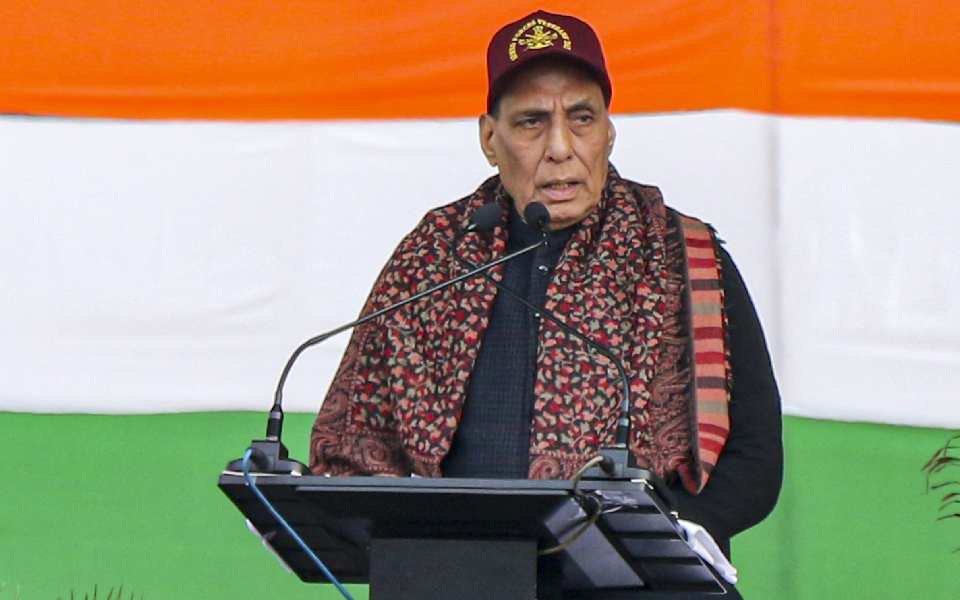
Akhnoor (JK), Jan 14: Declaring that Jammu and Kashmir remains "incomplete" without Pakistan-occupied Kashmir (PoK), Defence Minister Rajnath Singh delivered a strong message to Pakistan on Tuesday warning Islamabad to dismantle its terror infrastructure or face serious consequences.
Speaking at a gathering of armed forces veterans in Akhnoor, Singh emphasised that the abrogation of Article 370 has initiated a transformation in the region.
"The situation in Jammu and Kashmir has changed drastically, and this truth must be accepted. Jammu and Kashmir is incomplete without PoK, which remains the crown jewel of India," he said.
Reaffirming India's stance, Singh said, "For Pakistan, PoK is nothing more than foreign territory" and the aspirations of the people of Jammu and Kashmir have never aligned with those of Pakistan.
He cited the sacrifices made by many Muslim residents of the region in the fight against terrorism, highlighting that PoK has been exploited by Pakistan as a base for terrorist training camps and infiltration activities.
The defence minister said that the land of PoK is being used to run the "business of terrorism" and India is well aware of the launch pads created near the border.
"... Pakistan ko inko khatm karna hi hoga, nahin to dot dot dot (Pakistan must destroy this (these terror camps), otherwise)," Singh said while delivering a strong ultimatum to Pakistan.
The Defence Minister also condemned the recent remarks made by Anwar-ul-Haq, the so-called prime minister of PoK, who batted for the continuation of Pakistan's anti-India agenda, and added that the people of PoK have been deprived of a dignified life and manipulated by Pakistan's rulers under the guise of religion to further their agenda of exporting terror to India.
Criticising Pakistan's persistent support for terrorism, Singh said, "Pakistan has always made every effort to destabilise India. Despite international pressure, it has never abandoned its policy of supporting terrorism. The terrorists infiltrating Jammu and Kashmir come from Pakistan".
At the event, the Defence Minister announced that doorstep delivery of medical facilities through mobile medical units will be provided to ex-servicemen and their families in remote areas across the country.
"The government has taken several steps to support ex-servicemen and their families. While I do not claim that all measures are sufficient, one significant initiative this year is the introduction of mobile medical units for veterans and their families in remote areas," he said.
J-K Chief Minister Omar Abdullah, Lt Governor Manoj Sinha, Chief of Defence Staff General Anil Chauhan and General Officer Commanding-in-chief M V Suchindra Kumar were prominent among those who attended the event organised by the Army at Tanda Artillery Brigade in the Akhnoor sector near Jammu to celebrate the ninth Armed Forces Veterans’ Day celebrations.
Abdullah praised the armed forces for safeguarding the country and assured the veterans of his government's complete support in mitigating their problems.
He said efforts are underway to improve and strengthen the relationship between the government and the forces.
The Defence Minister recalled the bravery of the Indian Army during the 1965 war with Pakistan, emphasising the strategic brilliance and sacrifices that led to India's victory.
Singh particularly highlighted the significance of the Battle of Akhnoor, where the Indian Army successfully thwarted Pakistan's Operation Grand Slam and advanced towards Lahore.
"History stands as a testament that Pakistan has lost every war against India -- be it the tribal invasion of 1948, the 1965 war, the 1971 war, or the 1999 Kargil conflict. In each case, Pakistan has faced humiliation and defeat," he remarked.
Reflecting on the lessons learned from the 1965 war, Singh criticised the missed opportunity to capitalise on strategic military gains during negotiations, citing Haji Pir as an example where territory was ceded despite army success.
"If that had not happened, the routes for terrorist infiltration would have been closed back then. However, we began to change this by abrogating Article 370," he concluded.
Let the Truth be known. If you read VB and like VB, please be a VB Supporter and Help us deliver the Truth to one and all.
Rahul Gandhi joins Haryana Congress leader's 'Sadbhav Yatra' in Gurugram

Gurugram (PTI): Congress leader Rahul Gandhi on Friday joined the 'Sadbhav Yatra' of Haryana Congress leader Brijendra Singh here.
Gandhi, who is the Leader of Opposition in the Lok Sabha, reached Gurugram in the evening and joined the yatra. He also walked some distance with Brijendra, state Congress chief Rao Narender Singh and other leaders.
Huge crowds had turned up for the occasion.
Later, Gandhi proceeded to the venue where he addressed a public gathering.
Leader of Opposition in Haryana Bhupinder Singh Hooda and other Congress leaders, including Randeep Singh Surjewala, B K Hariprasad, state Congress chief Rao Narender Singh, were also present.
Brijendra Singh had on Thursday said it is a matter of joy for them that Gandhi was joining the 'Sadbhav Yatra' in Gurugram-Badshahpur, "thereby strengthening the Indian National Congress' campaign for brotherhood and harmony".
The 'Sadbhav Yatra' began from Danoda village at Narwana in Jind on October 5, 2025, and has covered 85 of the 90 assembly segments in the state.
The foot march was started by Brijendra Singh, son of Congress veteran Birender Singh, to highlight several national and regional issues.
State Congress chief Rao Narender Singh had asked all party leaders to take part in Friday's event.
Days before his yatra began in October, Brijendra Singh, who narrowly lost the 2024 assembly polls from Jind's Uchana Kalan, accused the ruling BJP of playing "divisive politics" and said that "sadbhav" (harmony) has come under stress in the last decade.
Brijendra Singh was a sitting MP from Hisar for the BJP when he resigned ahead of the 2024 general election and switched over to the Congress. He also alleged that the saffron party creates a wedge in society to achieve its political purpose.
The 'padyatra' has so far covered 85 assembly constituencies in Haryana, traversing more than 2,700 kilometres.
Addressing the public gathering, Brijendra Singh said the yatra is inspired by Rahul Gandhi's Bharat Jodo Yatra, where he took the party's vision and values directly to the people of the country.
Singh said the yatra has highlighted issues like "Vote Chori" (vote theft), unemployment, poor law and order situation, agrarian distress, and issues related to government employees, labourers and traders.
"Sadbhav (harmony) and bhaichara (brotherhood), which the BJP is attempting to weaken, are the messages of this yatra," he said, adding that its slogan is "Congress ka haath bhaichara ka saath".
"This yatra is a natural extension of the Bharat Jodo Yatra," Brijendra Singh said.