JNU first in research, first in nationalism, says VC
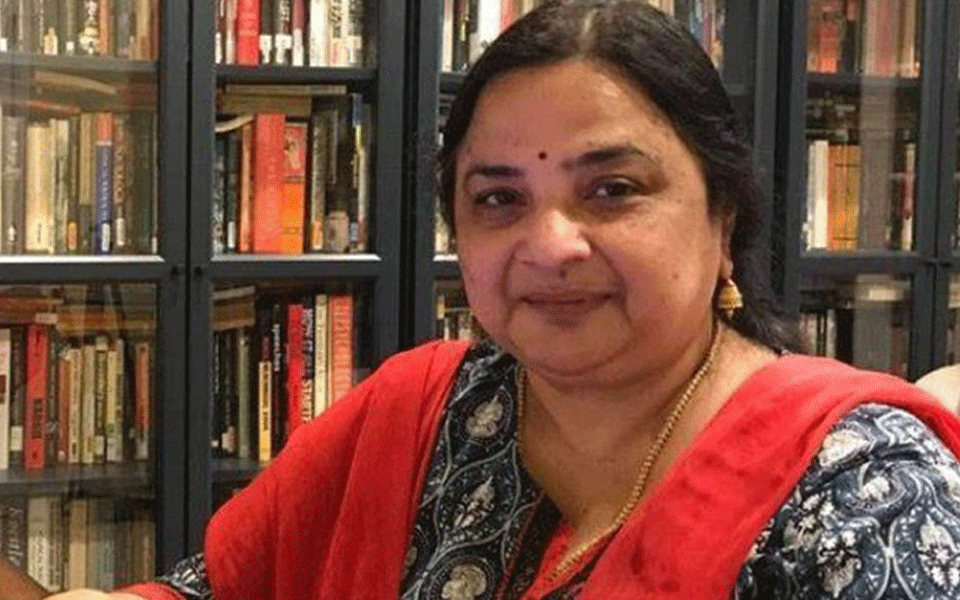
New Delhi (PTI): JNU Vice-Chancellor Santishree Dhulipudi Pandit on Thursday reaffirmed the varsity's commitment to Prime Minister Narendra Modi's vision of setting all Indians on the path to development and nationalism.
Speaking at an event at the varsity, Pandit said, "JNU is first in academics, first in research and first in nationalism and in paying our tributes to freedom fighters, unsung heroes of this great nation."
"On the occasion of Azadi ka Amrit Mahotsav, JNU reaffirms its commitment to Prime Minister Narendra Modi's paradigm shift. This paradigm shift has been in getting all the Indians towards development and nationalism... a vision with a mission," she added.
The Jawaharlal Nehru University (JNU) vice-chancellor was addressing the foundation stone-laying ceremony of a 'Tribute Wall' to commemorate the unsung heroes of the Indian Independence. The Tribute Wall is being built in collaboration with Chakra Foundation.
The 60-foot-long and seven-foot-high wall will have the names of 1,040 freedom fighters inscribed on granite stones with QR (Quick Response) codes. People can go to the Chakra app and scan the code to read about a freedom fighter.
"Through the Tribute Wall, we join tradition with modernity... A forgotten history into living memory. We, the people, who have taken our freedom for granted should remember the great heroes. Please rededicate yourself to the nation in the spirit of these unsung heroes," Pandit said.
Pandit's speech was greeted with slogans of 'Bharat Mata ki Jai' and 'Vande Mataram' from students in the audience.
The event was also attended by Puducherry Assmebly Speaker Embalam R Selvam, Lok Sabha MP Ramesh Bidhuri, and Chakra Foundation Founder Chakra Rajasekar.
Selvam said, "This initiative of putting up the tribute wall will inspire the young generation. This will create an impact on the youth who don't know about freedom fighters." PTI VA
Let the Truth be known. If you read VB and like VB, please be a VB Supporter and Help us deliver the Truth to one and all.
Muslim organisations seek restoration of 2B reservation, place 10 demands before govt
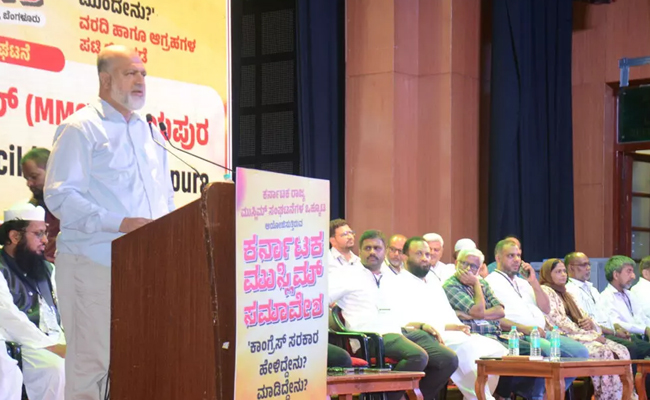
Bengaluru: The Karnataka Rajya Muslim Sanghatanegala Okkoota has placed 10 major demands before the state government at the ‘Karnataka Muslim Convention’, including the restoration of reservation for Muslims under Category 2B of the Other Backward Classes (OBC) and the repeal or amendment of the anti-cow slaughter law and the withdrawal of the anti-conversion law.
Presenting the demands in his keynote address at the convention organised by the federation at Town Hall in Bengaluru on Saturday, social activist Muhammad Yaseen Malpe said the Congress government had promised to withdraw the order issued by the previous BJP government banning hijab for Muslim girl students. He said the restriction remained in force until the date of the convention was announced and thanked the government for withdrawing it.
On reservation, Yaseen Malpe said the Congress government has not restored the reservation for Muslims under Category 2B, which was abolished by the previous BJP government in 2023, despite being in power for three years. He said that although the Supreme Court of India had stayed the order abolishing the reservation, no legislative steps have been taken to restore it, and urged the government to do so at the earliest.
Referring to the anti-conversion law, he said the state cabinet had decided on June 15, 2023 to repeal the legislation introduced by the BJP government. However, he noted that no Bill to withdraw the law has yet been introduced in the Legislative Assembly. He said the law, which he described as intended to harass minorities and curtail religious freedom, continues to remain in force and demanded that it be withdrawn immediately.
On the anti-cow slaughter law, he said the Karnataka Prevention of Slaughter and Preservation of Cattle Act, 2020 had become a “death warrant” for farmers, labourers, meat traders and cattle transporters and alleged that it was enacted with the sole intention of targeting Muslims. He demanded that the law be repealed or amended without delay.
Yaseen Malpe said the Congress had promised in its election manifesto to allocate Rs 10,000 crore annually for minority welfare. However, he pointed out that only around Rs 4,762 crore has been earmarked in the 2026-27 Budget, which he said was less than half of the promised amount. He urged the government to fully implement the commitment in the coming years.
On waqf properties, he alleged that large-scale encroachment, illegal transfers, undervalued leases and weak administration continue to affect waqf assets. He said the government had not done satisfactory work in recovering, developing and ensuring accountability in respect of waqf properties. He also expressed dissatisfaction that the state government had not clearly opposed the Waqf (Amendment) Act, 2025 and called for a concrete plan to protect waqf properties.
Regarding the caste survey, he said neither the caste census report of the Kantharaj Commission nor the report of the survey conducted under the leadership of Madhusudhan R. Naik has been tabled in the legislature. He said this had stalled important reforms relating to reservation and welfare and alleged that the government had caused great injustice and disappointment to backward classes, Dalits, minorities and other weaker sections.
On hate speech, hate crimes and hate campaigns, he said incidents targeting Muslims, including mob violence, moral policing and economic boycotts, continue to occur. He said repeated offenders were not facing effective legal action and urged the government to take necessary steps.
On political representation, Yaseen Malpe said Muslims remain underrepresented in the Legislative Assembly, Legislative Council, corporations and boards, universities, commissions and local bodies. He noted that Muslims constitute around 13 per cent of Karnataka’s population, but only 19 of the Congress party’s 136 MLAs are Muslims. He also said that since this government came to power, only one Muslim had been given an opportunity in the selection to 15 seats in the Legislative Council.
He further stated that not a single Muslim heads any of the state’s major government medical institutions and demanded representation for Muslims in legislative bodies and key government institutions in proportion to their population.
On education, he said the government had undertaken some positive measures for Muslim students and expressed gratitude for them. However, he said substantial work remains to be done in staff recruitment, staff deployment, curriculum coverage, proper disbursal of scholarships and hostel capacity. He also pointed out that the condition of Maulana Azad Schools is highly concerning in several places.
On the Special Intensive Revision (SIR) of electoral rolls, he demanded that the Karnataka Legislative Assembly pass a resolution opposing the exercise, which he said had adversely affected minorities in Bihar and West Bengal. He urged the government to ensure that SIR is not implemented in Karnataka and that no voter is deprived of the right to vote.