JNU imposing fines of up to Rs 15k over protests, claim students
_vb_21.gif)
New Delhi (PTI): A section of students at Jawaharlal Nehru University (JNU) has claimed that the administration has imposed thousands of rupees fines on them for participating in protests and "banned" them from registering for the next semester.
The amount of fine varies from Rs 10,000 to Rs 15,000, the students claimed and accused the administration of "harassment".
However, JNU chief proctor Rajnish Kumar Mishra has denied the allegations, saying the actions are taken after following due procedure.
Among the students, who have got notices, are student activists -- former JNU Sudents Union (JNUSU) vice president and PhD scholar Simone Zoya Khan and Kaushik Raj.
Kaushik has been served notice for the 2018 protest in which, he claims, he did not even present.
As per the notice dated August 29, Kaushik has been directed to submit Rs 10,000 by September 5 "in any case".
"...He is therefore directed to deposit the amount of Rs 10,000. Otherwise, he may not be allowed to register during the coming semester until he gets clearance from the office," the notice signed by the chief proctor read.
Speaking to PTI, Kaushik, who is in his final year of PhD, alleged that the fine imposed on him is erroneous as he was not present during the protest in 2018 where several students gathered in a seminar room against compulsory attendance.
Kaushik fears that he will not be allowed registration for the new semester and all his hard work will go waste.
"I was not present during the protest. Even during the proctorial enquiry, I made the oral and written deposition that I was not present. Still I am being fined. I know five-six more students who have received a similar notice," Kaushik said.
Simone Zoya Khan, who is also in the last year of her PhD, said that the university is targeting student activists for organising demonstrations.
Simone has also been served notice for the same 2018 protest. She was then JNUSU vice president.
Simone said she could not take the risk and arranged the fine money as she has to submit her thesis this year.
"It is not fair. The university is targeting the students. Dozens of false and unfounded complaints are brought against students. The yearly fee at the varsity is Rs 200-300 and they are levying a fine of Rs 15,000. How is this fair?" Simone asked.
In a statement, All India Students' Association said that the action by the JNU proctor office is politically motivated. The student organisation has accused the administration of targeting students from marginalised backgrounds with heavy fines.
Chief proctor Mishra said that the imposition of fine is not a new thing and all the actions are taken after following due procedure.
"We are not stopping students from taking admission. This is a regular procedure based on several proctorial enquiries. It is not a new thing," Mishra told PTI over phone.
Democratic Students' Federation (DSF) also said that proctorial enquiry has been levied against several students over the protest for offline classes at School of International Studies on June 20.
"It is to bring to the notice of all of you that two of our fellow classmates, Poshal Gyamba and Sakshi Sinha have had a proctorial enquiry levied against them with respect to the 'protest demonstration for offline classes' at SIS-1 on 20th of June. The report also mentions fellow students Harshit Raj Chaudhary and Raghav Gill, although they haven't been summoned yet," the DSF said.
Let the Truth be known. If you read VB and like VB, please be a VB Supporter and Help us deliver the Truth to one and all.
Muslim organisations seek restoration of 2B reservation, place 10 demands before govt
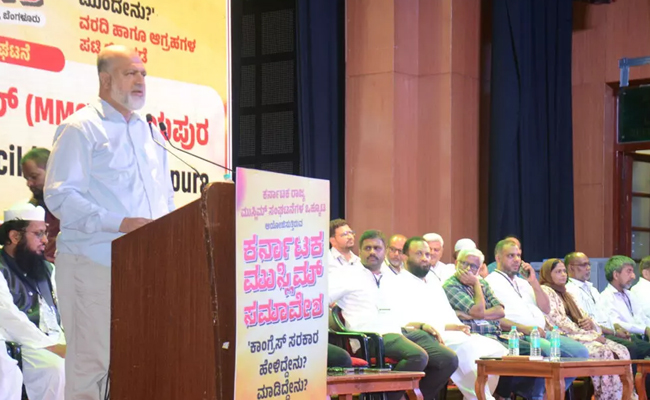
Bengaluru: The Karnataka Rajya Muslim Sanghatanegala Okkoota has placed 10 major demands before the state government at the ‘Karnataka Muslim Convention’, including the restoration of reservation for Muslims under Category 2B of the Other Backward Classes (OBC) and the repeal or amendment of the anti-cow slaughter law and the withdrawal of the anti-conversion law.
Presenting the demands in his keynote address at the convention organised by the federation at Town Hall in Bengaluru on Saturday, social activist Muhammad Yaseen Malpe said the Congress government had promised to withdraw the order issued by the previous BJP government banning hijab for Muslim girl students. He said the restriction remained in force until the date of the convention was announced and thanked the government for withdrawing it.
On reservation, Yaseen Malpe said the Congress government has not restored the reservation for Muslims under Category 2B, which was abolished by the previous BJP government in 2023, despite being in power for three years. He said that although the Supreme Court of India had stayed the order abolishing the reservation, no legislative steps have been taken to restore it, and urged the government to do so at the earliest.
Referring to the anti-conversion law, he said the state cabinet had decided on June 15, 2023 to repeal the legislation introduced by the BJP government. However, he noted that no Bill to withdraw the law has yet been introduced in the Legislative Assembly. He said the law, which he described as intended to harass minorities and curtail religious freedom, continues to remain in force and demanded that it be withdrawn immediately.
On the anti-cow slaughter law, he said the Karnataka Prevention of Slaughter and Preservation of Cattle Act, 2020 had become a “death warrant” for farmers, labourers, meat traders and cattle transporters and alleged that it was enacted with the sole intention of targeting Muslims. He demanded that the law be repealed or amended without delay.
Yaseen Malpe said the Congress had promised in its election manifesto to allocate Rs 10,000 crore annually for minority welfare. However, he pointed out that only around Rs 4,762 crore has been earmarked in the 2026-27 Budget, which he said was less than half of the promised amount. He urged the government to fully implement the commitment in the coming years.
On waqf properties, he alleged that large-scale encroachment, illegal transfers, undervalued leases and weak administration continue to affect waqf assets. He said the government had not done satisfactory work in recovering, developing and ensuring accountability in respect of waqf properties. He also expressed dissatisfaction that the state government had not clearly opposed the Waqf (Amendment) Act, 2025 and called for a concrete plan to protect waqf properties.
Regarding the caste survey, he said neither the caste census report of the Kantharaj Commission nor the report of the survey conducted under the leadership of Madhusudhan R. Naik has been tabled in the legislature. He said this had stalled important reforms relating to reservation and welfare and alleged that the government had caused great injustice and disappointment to backward classes, Dalits, minorities and other weaker sections.
On hate speech, hate crimes and hate campaigns, he said incidents targeting Muslims, including mob violence, moral policing and economic boycotts, continue to occur. He said repeated offenders were not facing effective legal action and urged the government to take necessary steps.
On political representation, Yaseen Malpe said Muslims remain underrepresented in the Legislative Assembly, Legislative Council, corporations and boards, universities, commissions and local bodies. He noted that Muslims constitute around 13 per cent of Karnataka’s population, but only 19 of the Congress party’s 136 MLAs are Muslims. He also said that since this government came to power, only one Muslim had been given an opportunity in the selection to 15 seats in the Legislative Council.
He further stated that not a single Muslim heads any of the state’s major government medical institutions and demanded representation for Muslims in legislative bodies and key government institutions in proportion to their population.
On education, he said the government had undertaken some positive measures for Muslim students and expressed gratitude for them. However, he said substantial work remains to be done in staff recruitment, staff deployment, curriculum coverage, proper disbursal of scholarships and hostel capacity. He also pointed out that the condition of Maulana Azad Schools is highly concerning in several places.
On the Special Intensive Revision (SIR) of electoral rolls, he demanded that the Karnataka Legislative Assembly pass a resolution opposing the exercise, which he said had adversely affected minorities in Bihar and West Bengal. He urged the government to ensure that SIR is not implemented in Karnataka and that no voter is deprived of the right to vote.