JNU rusticates five PhD scholars for vandalising facial recognition gates
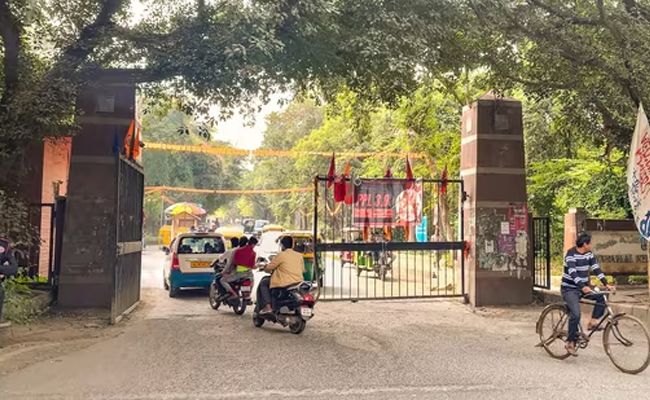
New Delhi: The Jawaharlal Nehru University administration has rusticated five PhD scholars for two academic semesters due to their demonstrations against the installation of facial recognition technology gates at the Dr. B R Ambedkar Central Library. These students include all current JNUSU office bearers and the union's former president.
Proctorial orders issued on February 2 declared JNUSU president Aditi Mishra, vice-president Gopika Babu, general secretary Sunil Yadav, joint secretary Danish Ali, and former JNUSU president Nitish Kumar “out of bounds” from the campus with immediate effect, as reported by Maktoob Media. The order bars them from entering academic spaces, hostels, libraries and other university facilities. Each of the five students have also been fined ₹20,000, payable within 10 days. The administration has also warned other students against providing them shelter on campus which would result in disciplinary action.
The students were rusticated following a disagreement over the installation of facial recognition technology at the central library. Students had protested against the installation in August 2024 and said the move questions the students right to privacy and consultation. They questioned the ₹20 lakh spent on monitoring infrastructure, in contrast to the library's inadequate seats and damaged furniture.
After continous protests, the gates were removed and students were assured that any future decision would be taken by an independent committee with student representation. Without students' consultation, the facial recognition gates were reinstalled during the JNUSU election period in November 2025. The students questioned the move accusing the administration of breaking its earlier promises.
After failing to reach an agreement with the acting chief librarian, student leaders removed the gates on November 21, 2025, disassembling equipment while shouting slogans calling it a form of protest against an imposed and intrusive system. The administration called the act as vandalism and destruction of public property.
Apart from the five students who were rusticated, proctorial inquiries were initiated against others, and at least seven students were fined ₹19,000 each.
In a statement, the JNUSU termed the action a targeted crackdown on elected student representatives and said the rustication orders undermines campus democracy, arguing that disciplinary rules cannot be used to curb the collective voice of students.
Criticising the administration’s decision, the Jawaharlal Nehru University Teachers’ Association called it an attack on democratic rights within the university. In a statement issued on February 3, the association said the punitive action against student leaders was part of a broader pattern of suppressing protest and dissent.
Let the Truth be known. If you read VB and like VB, please be a VB Supporter and Help us deliver the Truth to one and all.
3 held, hunt on for 4 accomplices after they kidnap, assault and urinate on man in Bhopal

Bhopal (PTI): Police have registered a case against seven persons and arrested three of them for allegedly kidnapping, assaulting and urinating on a 22-year-old man in Madhya Pradesh capital Bhopal, officials said on Thursday.
The incident occurred during the intervening night of April 26 and 27 in an area located under the Hanumanganj police station limits, an official said.
One of the accused urinated on the face of the victim and captured a video of the act, which was later circulated on social media to humiliate him, he said.
"A complaint in this connection was lodged by Jaswant Markam (22), a resident of Kamla Nagar, based on which a case was registered against seven persons under sections of Bharatiya Nyaya Sanhita (BNS) and police have arrested three of them, including one Prem Thapa," Bhopal Police Commissioner Sanjay Kumar said.
Three police teams have been formed and the remaining suspects will be apprehended soon, he said.
During the intervening night of Sunday and Monday, Markam was at the local bus stand with a friend when around 4 am, the accused took him away on the pretext of discussing something with him. They asked him about his neighbour and friend Aniket. When he refused to provide any information, they started assaulting him, the police said.
The accused then took him to a forest in Karond area, where he was stripped and severely thrashed, they said.
When the man began to lose consciousness, one of the accused urinated on his face and made a video of the act, which was circulated on social media to humiliate him and spread terror, according to the police.
The accused called Markam's friend around 5 am to inform him about his condition. The victim was subsequently admitted to a hospital, the officials said, adding that the viral video was also being investigated.
Responding to a query, Hanumanganj police station in-charge Awdhesh Bhadoria said if the victim was found to be from the tribal community, then relevant sections will be invoked against the accused.
At present, the police are probing the incident and search is on to arrest the remaining accused, he added.
In 2023, a man had urinated on a tribal youth in Sidhi district of Madhya Pradesh. A video of the incident had gone viral on social media platforms and created a controversy.