
JNU students battle police lathicharge on way to Rashtrapati Bhawan over fee hike
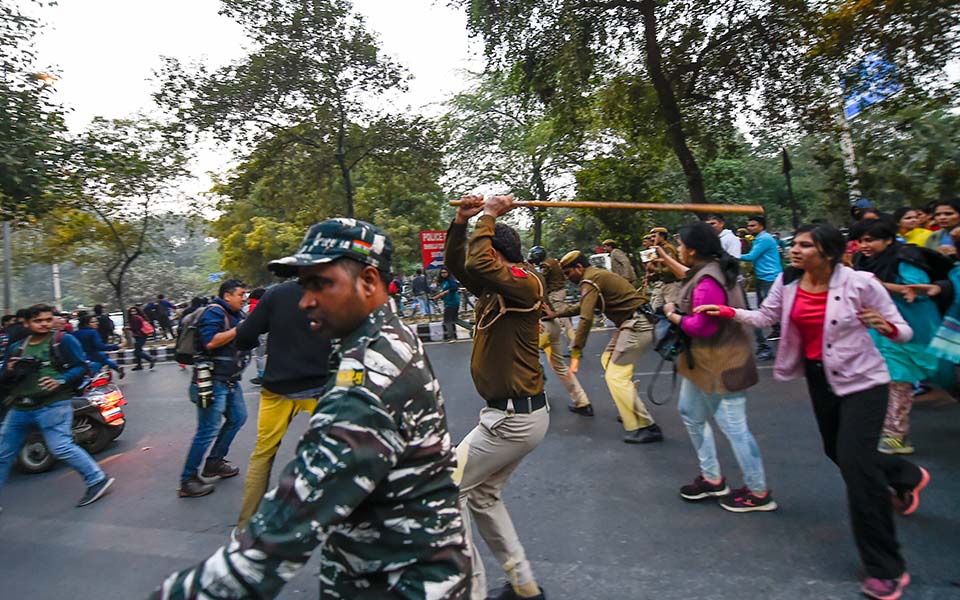
New Delhi, Dec 9: Scores of JNU students were lathi charged by police on Monday and several of them detained when they tried to march towards Rashtrapati Bhawan against the hostel fee hike, throwing traffic out of gear and leaving metro commuters stranded for hours with three central Delhi stations being closed as a precautionary measure.
Amid heavy police deployment and barricades beginning right at the campus, the students began their march but were stopped near Bhikaji Cama Place metro station.
When the students reached a cordoned area, they tried to jump the barricades and were lathicharged by the police.
According to JNU Students Union (JNUSU) president Aishe Ghosh, "Several students, including women, have been detained by police which brutally attacked the protesters, asking us to go back to campus."
"We will not budge from here until our demands are met and a complete rollback in the fee is announced," she added.
The students took to social media to share images and videos of lathicharge by police.
"They first stopped and then attacked us while the march was going on peacefully. Over 30 students were injured. We will anyhow head to Rashtrapati Bhawan," Shreya Ghosh, one of the protesters claimed.
The students wanted to march to the Rashtrapati Bhawan to seek an appointment with the president, the visitor of the varsity, to urge him to intervene and ensure that the hike in hostel fee is rolled back
Traffic movement was slow at various intersections in South Delhi due to the march, prompting the traffic police to issue timely advisories for commuters.
"Due to the demonstration, the traffic movement is affected on the road leading to Dhaula Kuan from AIIMS. The commuters should avoid the route," the Delhi Traffic Police tweeted.
"The traffic movement on Africa Avenue was slow and the route from Bhikaji Cama Place is obstructed. Kindly avoid this stretch," the police said.
Earlier in the day, traffic movement was closed on Baba Gangnath Marg to Sarojni Nagar depot, Africa Avenue road, both carriageway of Sant Nagar depot and Hyatt to Leela Hotel due to the demonstration. Traffic was diverted from Leela Hotel towards INA.
According to police officials, heavy deployment of police was in place ahead of the march from the JNU and roads leading to the campus were shut for traffic and appeals made to students to protest peacefully.
The students circulated photos, claiming police have closed all gates of the university before the start of the march. As they began, they shouted slogans like "Delhi Police go back" and "Education must be free for all".
Entry and exit points at Udyog Bhawan, Lok Kalyan Marg and Central Secretariat metro stations were closed for over four hours by authorities following directions from Delhi police. The stations reopened around 5:20 pm.
"As advised by Delhi Police, entry & exit at Udyog Bhawan, Lok Kalyan Marg and Central Secretariat have been closed. Trains are not halting at Udyog Bhawan and Lok Kalyan Marg," the Delhi Metro Rail Corporation said on Twitter.
The students have been protesting for over a month inside the campus against the hostel fee hike and have also called for a boycott of the upcoming semester exams, despite repeated appeals by the administration asking them to return to classes.
The HRD Ministry had set up a three-member committee to look into ways to restore normal functioning in the JNU and mediate between the agitating students and the administration.
The panel submitted its report to the ministry but no call has been taken yet.
The students' agitation over the hike in hostel fee escalated on November 11 when thousands of them clashed with police outside the All India Council of Technical Education (AICTE) premises, where the university's convocation was held.
Union HRD Minister Ramesh Pokhriyal Nishank was stranded for over six hours at the venue.
The JNU's Executive Council had then announced a partial rollback of the hike for students belonging to the BPL category and not availing any scholarships. However, the protesters dubbed it an "eyewash".
A week later, students staged a march from the JNU campus to the HRD Ministry but were stopped at multiple locations and finally outside the Safdarjung Tomb by police.
The protesters alleged that police personnel baton-charged and manhandled them, including a blind student, a charge which was denied by the force.
Let the Truth be known. If you read VB and like VB, please be a VB Supporter and Help us deliver the Truth to one and all.
Karnataka issues nutrition advisory for govt events; recommends millets, healthier options
_vb_61.jpeg)
Bengaluru (PTI): The Karnataka government on Monday issued a nutrition advisory recommending healthier food and beverage options at meetings, functions, and other official gatherings held in the state.
The advisory has been issued by the Department of Karnataka Health and Family Welfare Services to promote healthy dietary and nutritional habits among officials and staff, noting that food, refreshments and beverages served in government offices and official programmes are "often not aligned with nutrition standards."
The advisory recommends serving snacks such as millet-based, low-fat and low-sugar foods, fresh fruits, vegetable salads, sprouts, roasted nuts and seeds during in-house office meetings and breaks.
Beverages such as green tea, low-fat buttermilk, and locally filtered or boiled water served in glass bottles or steel flasks have also been suggested.
According to the advisory, for larger government events, conferences and exhibitions, departments have been advised to include at least one millet-based item during snacks and a minimum of two millet dishes in meals, along with local cuisine and at least one regional recipe.
It also recommends the use of brown rice instead of white rice, freshly prepared vegetable salads, and fresh fruits or low-sugar fruit juices.
If non-vegetarian food is served, it should consist of well-cooked lean or white meat, the advisory stated.
In eateries operating within government office campuses, the department has recommended millet-based foods, fresh vegetable salads, boiled pulses such as horse gram or chickpeas, and low-fat beverages.
It suggests serving food using reusable metal plates and glasses.
The advisory also recommends avoiding microwave-heated food, industrially processed food, fried snacks, high-fat or heavily spiced dishes, carbonated drinks, high-sugar fruit juices, and alcoholic beverages.
It further discourages serving milk-based tea or coffee and plastic-bottled water during official events.
“Overall, hygiene and cleanliness should be maintained while serving food and water. Local cottage industries, self-help groups, prison kitchens, nutri-gardens and others should be preferred for placing food and beverage orders,” the advisory added.
_vb_54.jpeg)
_vb_07.jpeg)
_vb_34.jpeg)