Johnson & Johnson's single-dose COVID-19 vaccine gets Emergency Use approval in India
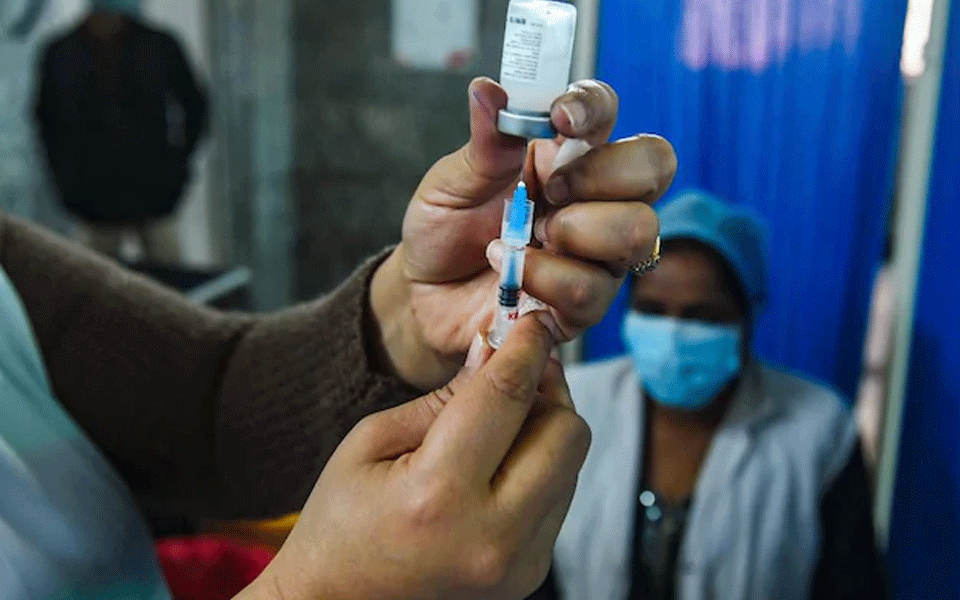
New Delhi: Johnson & Johnson's single-dose COVID-19 vaccine has been given Emergency Use approval in India, Union Health minister Mansukh Mandaviya said on Saturday.
He said this will further boost the country's collective fight against the novel coronavirus infection.
"India expands its vaccine basket! Johnson and Johnson's single-dose COVID-19 vaccine is given approval for Emergency Use in India. Now India has five EUA vaccines. This will further boost our nation's collective fight against #COVID19," the minister tweeted.
The US-based pharmaceutical company had applied for Emergency Use Authorisation for its jab on Friday and was granted the approval the same day by the Drugs Controller General of India (DCGI), a senior official said.
The five vaccines granted Emergency Use Authorisation in India are Serum Institute's Covishield, Bharat Biotech's Covaxin, Russia's Sputnik V, Moderna and now Johnson & Johnson (J&J).
J&J earlier had sought approval to conduct phase-3 clinical trial of its vaccine on approximately 600 participants in two age groups---those aged 18 and below 60 years and those aged 60 years and above---to evaluate the safety, reactogenicity and immunogenicity of the jab in healthy Indian adults.
However, on July 29, the firm withdrew its proposal.
A health ministry official at a recent press conference had clarified that J&J earlier applied for conducting phase-3 clinical trial of its vaccine.
"The application was to undertake clinical trial and when we issued relaxed guidelines in which we said if you had approval from other regulatory bodies of other countries, then exemption would be given from clinical trials, and emergency use authorisation would be granted and trial could be continued later on, so now since they did not need it they withdrew that application," the official had said.
In a bid to fast-track emergency approvals for all foreign produced coronavirus jabs, the central government had announced that COVID-19 vaccines which were approved for restricted use by regulators in the US, UK, Europe and Japan, or which were on the World Health Organisation's Emergency Use Listing, would not have to conduct bridging clinical trials in India.
Let the Truth be known. If you read VB and like VB, please be a VB Supporter and Help us deliver the Truth to one and all.
Trump says EU has until July 4 to approve last year's trade deal or it will face higher tariffs
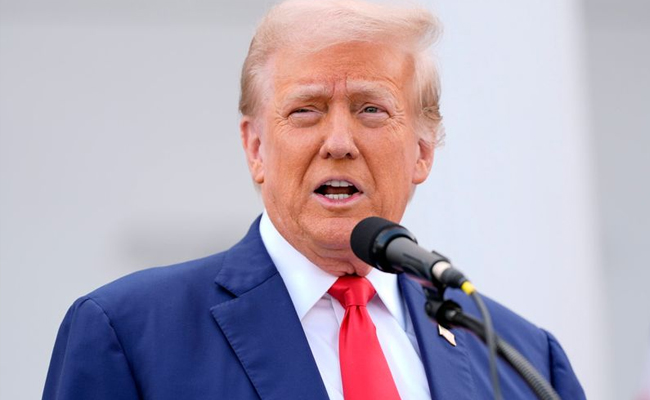
Washington (AP): President Donald Trump has said in a social media post that goods from the European Union would face higher tariff rates if the 27-member bloc fails to approve last year's trade framework by July 4.
The announcement on Thursday appeared to be a deadline extension after the president said last Friday that EU autos would face a higher 25 per cent tariff starting this week. Trump made the updated announcement after what he described as a "great call" with European Commission President Ursula von der Leyen.
Still, the US president was displeased that the European Parliament had yet to finalize the trade arrangement reached last year, which was further complicated in February by the US Supreme Court ruling that Trump lacked the legal authority to declare an economic emergency to impose the initial tariffs used to pressure the EU into talks.
"A promise was made that the EU would deliver their side of the Deal and, as per Agreement, cut their Tariffs to ZERO!" Trump posted. "I agreed to give her until our Country's 250th Birthday or, unfortunately, their Tariffs would immediately jump to much higher levels."
It was unclear from the post whether Trump was implying that the tariff rates would jump on all EU goods or the increase would only apply to autos.
His latest statement indicates he might be backing away from his earlier threat on EU autos by giving the European Parliament several more weeks to approve the agreement.
Under the original terms of the framework, the US would charge a 15 per cent tax on most goods imported from the EU.
But since the Supreme Court ruling, the administration has levied a 10 per cent tariff while investigating trade imbalances and national security issues, aiming to put in new tariffs to make up for lost revenues.