Journey of Viksit Bharat@2047 a 'maritime voyage': Navy chief
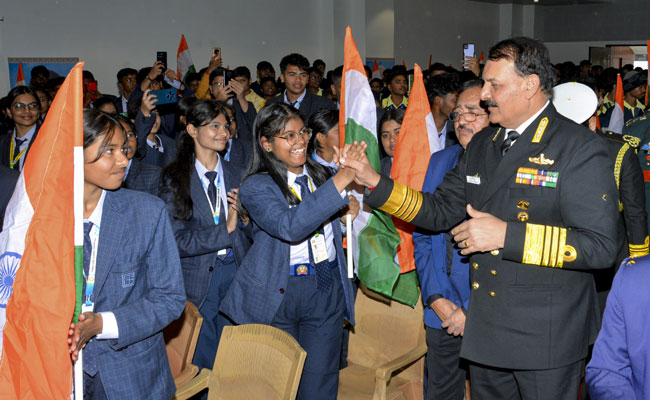
Ranchi (PTI): Navy chief Admiral Dinesh Kumar Tripathi on Friday equated Viksit Bharat @2047 to maritime voyage, emphasising that the world's economies, including India's, rely heavily on oceans for trade and growth.
Addressing students at the CCL's Darbhanga House conference hall, he said that 90 per cent of the world's EXIM trade occurs through the seas, and 95 per cent of India's trade volume is carried by sea routes, making the oceans the primary medium for achieving Viksit Bharat @2047.
"Viksit Bharat @2047 is no longer just a policy; it has now become a reality, and clear milestones have been set to achieve the target. As we know, 95 per cent of our trade occurs via sea routes, and around 90 per cent of the world's trade volume depends on them. We are geographically blessed as our country is surrounded by oceans on three sides, and it is our responsibility to keep them free from any deterrence," he said.
The Indian Navy is the first responder in the Indian Ocean region and is being recognised as such by the world today, Admiral Tripathi said.
"The blue economy currently contributes only 4 per cent to our economy, which is very small, and it should be augmented to double digits to align with the vision of Viksit Bharat," the Navy chief stressed.
Another important fact is that 88 per cent of our energy requirements come from seas, and if crude oil prices increase by USD one per metric tonne, India ends up paying an extra Rs 10,000 crore, he said, adding this is the kind of impact that makes maritime domain security so important.
He said, "When an earthquake struck Myanmar, we were the first to reach there with 500 tonne of relief material. Similarly in Sri Lanka, we had delivered 1,000 tonne of relief material."
The main role of the Indian Navy is warfighting, but deterrence comes first before reaching that point, Admiral Tripathi said.
He further said that even a small disruption in sea routes can have a massive impact.
The Navy chief underscored the critical importance of maritime security, warning that even minor disruptions in sea routes can have far-reaching economic and strategic consequences for India and the world.
Citing the ongoing Israel-Hamas conflict, he said actions by Yemen's Houthis in the Red Sea severely disrupted global cargo movement, forcing shipping companies to avoid the Suez Canal, Asia's shortest route to Europe, and resulting in a nearly 700 per cent rise in shipping costs on some alternative routes.
The Navy chief also pointed out that modern digital life depends heavily on secure seas, noting that nearly 99 per cent of global internet data travels through undersea fibre-optic cables.
"If oceans are central to India's development, then the responsibility of keeping them open, safe, and secure lies with the Indian Navy," he said.
Urging students to focus on skill development, character, civic sense, and lifelong learning, he cited World Economic Forum projections that skills will matter more than degrees in the future.
He emphasised that Viksit Bharat @2047, which targets USD 30 trillion economy can only be achieved through collective effort and people's participation.
"The vision of Viksit Bharat@2047 has many milestones apart from an economy of USD 30 trillion. It includes the goals of 100 per cent literacy, access to universal healthcare facilities, quality education for all, leadership in the field of innovation, and complete self-reliance," he said.
Admiral Tripathi said security and development go hand in hand, describing India's journey as one from dependence to confidence and from imports to innovation.
On operational matters, he said the Navy's primary role is deterrence and added that Operation Sindoor is continuing.
He added that emerging technologies such as artificial intelligence and cyber warfare have already been integrated into naval operations, given the technology-intensive nature of modern maritime warfare.
Let the Truth be known. If you read VB and like VB, please be a VB Supporter and Help us deliver the Truth to one and all.
Man arrested with Rs 2.54-crore heroin in Mumbai

Mumbai (PTI): Police have arrested a man and seized over 500 grams of heroin worth Rs 2.54 crore in the illicit market from him in Mumbai, officials said on Friday.
The police's Anti-Narcotics Cell (ANC) made the drug seizure in Santacruz in the western suburbs. The operation was conducted by the Kandivali unit of the ANC on Thursday as part of a special crackdown against drug trafficking in the area, they said.
Acting on specific inputs, an ANC team conducted a raid in Santacruz (East) and intercepted a man. During a search, the team recovered 508 grams of high-grade heroin from his possession, an official said.
The seized contraband, a highly addictive, opioid drug derived from morphine, is estimated to be worth Rs 2.54 crore in the international market, he informed.
Following the seizure, a case was registered against the man under relevant sections of the Narcotic Drugs and Psychotropic Substances (NDPS) Act, 1985, and he was formally placed under arrest in the early hours of Friday.
The police are currently investigating the source of the drug and trying to identify the intended recipients of the consignment, he said.