Judgement in rape-murder of R G Kar doctor on Saturday
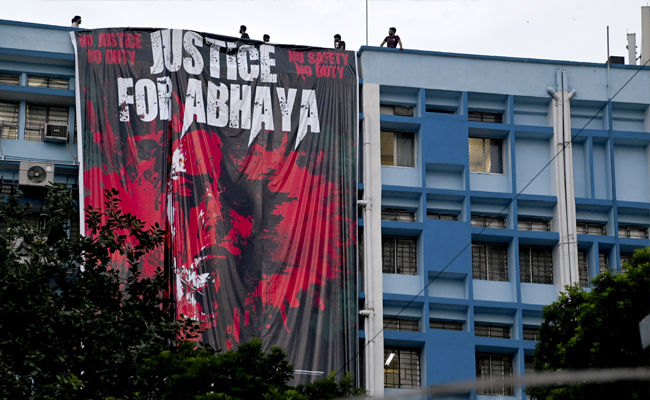
Kolkata (PTI): The much-awaited judgement in the brutal rape and murder of an on-duty doctor at R G Kar Medical College and Hospital, which led to nationwide outrage and prolonged protests, will be delivered on Saturday.
Sanjay Roy, who was a civic volunteer with the city police, was charged with committing the crime on the postgraduate trainee at the state-run hospital in north Kolkata on August 9 last year.
The judgement will be delivered on Saturday, 57 days after the trial commenced before the court of additional district and sessions judge, Sealdah court, Anirban Das.
The Kolkata Police which was investigating the case initially arrested Roy on August 10, a day after the medic's body was recovered from the seminar room of the hospital.
The Calcutta High Court later transferred the case to the Central Bureau of Investigation (CBI) and the agency has sought the death penalty for the accused.
The in-camera trial in the rape and murder of the doctor commenced on November 12 and 50 witnesses were examined.
Hearing in the trial of Roy was concluded on January 9.
Maintaining that other persons were also involved in the crime, the parents of the victim have said that they expect that they will also be arrested and tried before the court.
They have also filed an application before the court seeking further investigation into the case.
The crime led to nationwide outrage and prolonged protests by junior doctors in Kolkata, demanding justice for the victim and stronger security arrangements in state-run hospitals.
Opposition political parties, including the BJP and the CPI(M), protested the gruesome crime, but apolitical movements demanding justice for the victim were more visible with members of the civil society being at the forefront.
Members of the civil society in Kolkata and some other cities of the state took out midnight rallies terming those as "Reclaim the night" to demand justice for the victim doctor, whom some named "Abhaya", while others called her "Tilottama".
Disclosing the identity of a rape victim is prohibited by the law.
Supporters of archrival clubs of Kolkata - East Bengal, Mohun Bagan and Mohammedan Sporting - also took to the streets of the metropolis demanding justice for the victim.
The Supreme Court, which suo motu took up the matter concerning the rape and murder at R G Kar hospital, had formed a National Task Force (NTF) for suggesting a protocol for the safety of doctors and other medical professionals across the country.
The NTF filed a report before the apex court in November last year.
Let the Truth be known. If you read VB and like VB, please be a VB Supporter and Help us deliver the Truth to one and all.
Massive turnout in assembly polls across states, women voters outnumber men: EC data
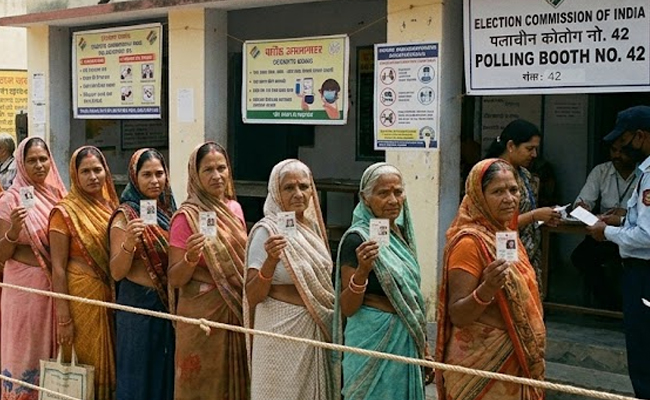
New Delhi (PTI): The recently-concluded assembly elections witnessed exceptionally high voter participation across states, with women voters outnumbering men in turnout percentages, according to Election Commission data.
West Bengal recorded the highest voter turnout among states, with 93.71 per cent polling in 293 constituencies where counting has been completed. The state saw over 6.38 crore votes cast, including postal ballots, against a total of more than 6.81 crore electors.
Women voters recorded a turnout of 93.8 per cent in the West Bengal Assembly polls, slightly higher than the 92.06 per cent participation among men.
The data for West Bengal does not include the figures for the Falta assembly constituency, which is scheduled for repolling.
Tamil Nadu registered an 85.01 per cent turnout, with nearly 4.8 crore votes polled from an electorate of 5.74 crore. Women voters recorded a turnout of 86.2 per cent, higher than the 83.77 per cent among men.
Assam also witnessed robust participation, with the final turnout touching 85.74 per cent. More than 2.15 crore votes were cast in the state, while female turnout at 86.53 per cent marginally exceeded the 84.95 per cent recorded among male voters.
Kerala registered a turnout of 78.11 per cent, with over 2.12 crore votes polled. Female voter participation stood at 81.17 per cent against 74.9 per cent among men.
Puducherry recorded a turnout of 89.82 per cent, with women voters again leading participation at 91.39 per cent. More than 8.5 lakh votes were polled in the Union territory.
Yet, women's representation among elected candidates remained modest.
Tamil Nadu elected 23 women MLAs (9.83 per cent) out of 234 members, West Bengal elected 37 women legislators (12.62 per cent) out of 293, while Kerala returned only 11 women MLAs (7.85 per cent) in the 140-member House.
Only two third-gender candidates contested the elections - one each from Tamil Nadu and Kerala, and both lost, forfeiting their deposits.
The elections also reflected extensive electoral mobilisation infrastructure. West Bengal had the highest number of polling stations at 85,092, followed by Tamil Nadu with 75,064 and Assam with 31,490.
In terms of candidates, Tamil Nadu saw the largest contest with 4,023 candidates in the fray across 234 constituencies, averaging 17 candidates per seat and peaking at 79 contestants in one constituency.
West Bengal pitted 2,920 candidates for 293 constituencies, while Kerala had the fewest contestants among the major states, with 883 candidates for 140 seats.
The data also showed relatively low NOTA votes across states. Tamil Nadu recorded the lowest NOTA share at 0.4 per cent of total votes polled, while Assam recorded the highest at 1.23 per cent. In West Bengal, 0.78 per cent of the total votes polled were NOTA, while it 0.77 per cent and 0.57 per cent of the electorate opted for None of the Above (NOTA) in Puducherry and Kerala, respectively.