Judges have to deal with the problems of judiciary, can't hide heads like Ostrich: Justice Gupta
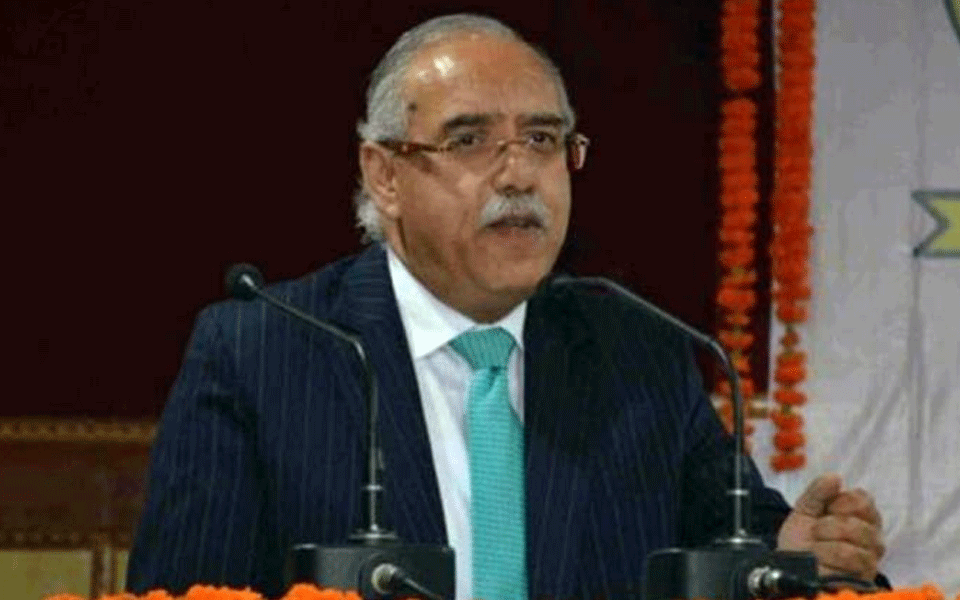
New Delhi: Judges cannot hide their heads like an Ostrich and say nothing is happening to the judiciary as integrity of the institution cannot be put at stake under any circumstances, Justice Deepak Gupta said on Wednesday.
Justice Gupta, who superannuated on Wednesday became the first judge in the history of the Supreme Court to be given farewell through video conferencing due to the lockdown amid the coronavirus pandemic, said that judges have to identify the problems and deal with them.
You see, the country has great faith in the judiciary. I mean, we say it time and time again but at the same time, we cannot hide our heads like an Ostrich and say that nothing is happening to the judiciary. We must identify our problems ourselves and deal with them. The integrity of the institution is something which cannot be put at stake under any circumstances, Justice Gupta, who served as apex court judge for more than three years said.
He said though he has been called as an activist judge and also an activist lawyer but he had never stepped beyond the boundaries of the law as he knew his limit.
He said that when a judge sits in the court, he has to decide cases strictly in accordance with the law and the Constitution of India is the "Gita, Bible, Quran, Guru Granth Sahib" and other such holy books for a judge.
He added that under the Constitution, a very important role of protecting the rights of the citizen lies with the superior courts and the Supreme Court under Article 32, has its duty to ensure that every citizen of this country has a life of dignity and he is not deprived of right to life, guaranteed to him under Article 21.
In times of crisis, especially a crisis like this it is not you and I, whose constitutional rights will be violated. It's the poorest of the poor, whose constitutional rights are always violated. It is these people who have no voice, who suffer. And therefore, if someone who raises the voice for them, I think the courts should at least hear them. Give them a patient hearing, and then if something can be done for them, please do it, if something can't be done, then the petition has to be dismissed but we must make an attempt to help the poor , he said.
I am sure under the guidance of my Chief Justice S A Bobde, and the guidance of my brother and sister judges, the judiciary will rise to the occasion and ensure that people get what is due to them under the constitution, Justice Gupta said during the farewell organised by Supreme Court Bar Association.
Addressing the lawyers, in a webinar, he said that according to him, the most important attributes of both judges and judiciary are independence, fearlessness and impeccable integrity.
There can be no independent judiciary, no independent judges, if you lack one of these. In a country, which professes to follow the rule of law and the principles of separation of power, there is no alternative to independent and fearless judiciary. The concept of separation of powers envisages that there is a system of checks and balance and when there is a system of checks and balances, we must ensure that we remain within our boundaries but also ensure that other persons remain within their boundaries , he said.
Justice Gupta said that whether it's a politician or a bureaucrat or judges, all take an oath to uphold the constitution and rule of law and have to work to serve the people.
He voiced concern over many of the petitions filed recently in the apex court and said, I am sorry to say that in last one month, some of the writ petition being filed, I mean they were so poorly drafted and they expect the court to start laying policy etc. You see, what happens is that it damages the cause. If too many petitions like this are filed, then the cause of PIL gets damaged .
So my request to the lawyers is not to just jump the gun and file the petition everytime. Think about it, sent it to the government, see their response and then you can do it he said.
At the outset, Justice Gupta said today he is hanging his robes after around 42 years in legal profession, both as an advocate and judge, and though he is ending his relationship with the court, his relationship with the bar can never end.
Justice Gupta, who hails originally from Kangra district in Himachal Pradesh obtained his law degree from Delhi University in 1978 and later in 2004, he was elevated as a judge in Himachal Pradesh High Court.
Recalling an incident of Tripura High Court, he said, One day one of the senior members mentioned that the scales of justice were not even and the eyes of the Goddess of Justice were not blindfolded. I told him, I had purposely done this because of my strong views that in the present day and age Judges cannot live in ivory towers but must be aware of what is happening in the world around them. The scales of justice to be really equal, just, in fact, are balanced in such a way that the poor and the underprivileged are not denied justice
Justice Gupta during his tenure as an apex court judge has been part of several notable judgements and orders including 2017 verdict, in which it was held that sex with minor wife despite consent is rape and prison reforms, air pollution, sealing, welfare of widows in Vrindavan.
Thanking his seniors and family members for the support extended to him throughout his career, he said that during the lockdown, his wife had given him the haircut for the today's function.
Let the Truth be known. If you read VB and like VB, please be a VB Supporter and Help us deliver the Truth to one and all.
Rajasthan CM Sharma invites Karnataka to partner in agritech transformation
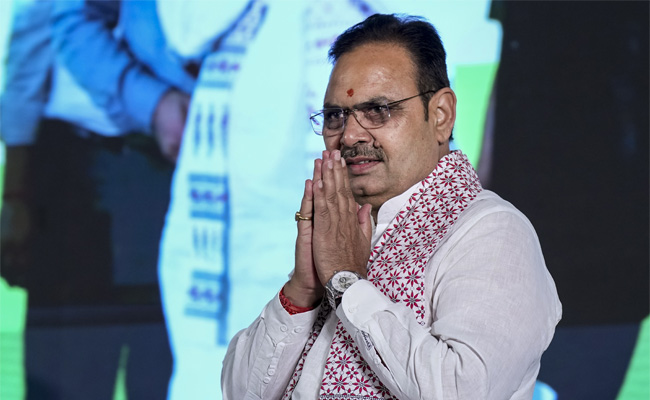
Bengaluru (PTI): Asserting that Rajasthan is evolving and embracing progressive change, Chief Minister Bhajanlal Sharma on Sunday invited Karnataka and industry stakeholders present in Bengaluru to partner with the state in shaping a “new agricultural revolution.”
The CM was speaking at an investor meet organised in Bengaluru under the ‘Global Rajasthan Agritech Meet (GRAM)–2026’, aimed at positioning Rajasthan as a leading hub for agricultural innovation, agritech investment, and global partnerships.
“Rajasthan is moving toward building a strong agritech-driven economy by integrating its traditional agricultural strengths with modern technology. The state government is creating an investor-friendly environment,” Sharma said.
“Out of the Rs 35 lakh crore MoUs signed during the 2024 Rising Rajasthan Global Investment Summit, Rs 9 lakh crore worth of investments have already been grounded, and we welcome all stakeholders to be part of this transformative journey,” he added.
Emphasising the synergy between the two states, he said, “Rajasthan is growing, evolving and embracing progressive change, and together with Karnataka, we can further strengthen our farmers by equipping them with the latest technologies and building a future of shared prosperity.”
Highlighting the shared vision between the two states, he added, “Bengaluru and Rajasthan share a long-standing, cordial relationship built on innovation and progress.”
“As Rajasthan advances steadily toward becoming a Viksit Rajasthan, we invite Bengaluru and Karnataka to partner with us in shaping a new agricultural revolution,” he said.
The event was hosted by the Agriculture Department, Government of Rajasthan, in collaboration with the Federation of Indian Chambers of Commerce and Industry (FICCI) and the Rajasthan Foundation.
The investor meet witnessed participation from key stakeholders across agriculture, agritech, industry, and investment sectors.
The CM said that through GRAM 2026, the government is committed to ushering in a new era of agricultural transformation by modernising farming practices, enhancing farmers’ incomes, and connecting them with cutting-edge technologies such as AI and agritech innovations, while expanding access to food processing and global markets.
“This landmark initiative will bring together thousands of farmers, experts and investors on a single, dynamic platform,” he said.
He further noted that the government is integrating key departments—including agriculture, electricity, cooperatives, animal husbandry and fisheries—to create a unified ecosystem for holistic farmer development.
“Our goal is to harness technology to drive sustainable growth and empower our farmers with the tools and opportunities they need to thrive,” he added.
Highlighting progress in the agriculture sector, Rajasthan Agriculture and Horticulture Minister Kirodi Lal Meena said the state government is strengthening the agritech ecosystem through policy support, infrastructure development and innovation, creating a conducive environment for investors and entrepreneurs.
During the event, a film on GRAM 2026 was showcased, highlighting opportunities in Rajasthan’s agriculture and agritech sectors, an official release said.
Extensive deliberations on agriculture, agritech, investment and partnership opportunities were held during the meet, with participants exploring collaborative pathways to strengthen the sector.
The main event, GRAM 2026, is scheduled to be held from May 23 to 25, 2026, in Jaipur, with expected participation from investors, industry leaders and policymakers from across India and abroad.
As part of the preparatory outreach, roadshows have already been conducted in Jaipur and New Delhi, with more planned across major cities to further expand the reach of the initiative, the release added.