“Just a loving person who’s intelligent”: Rahul Gandhi shares his thought about marriage, partner
New Delhi: Often described as India’s most eligible bachelor, Congress leader Rahul Gandhi is open to marriage “when the right girl comes along” and is not fussy about food apart from peas and jackfruit.
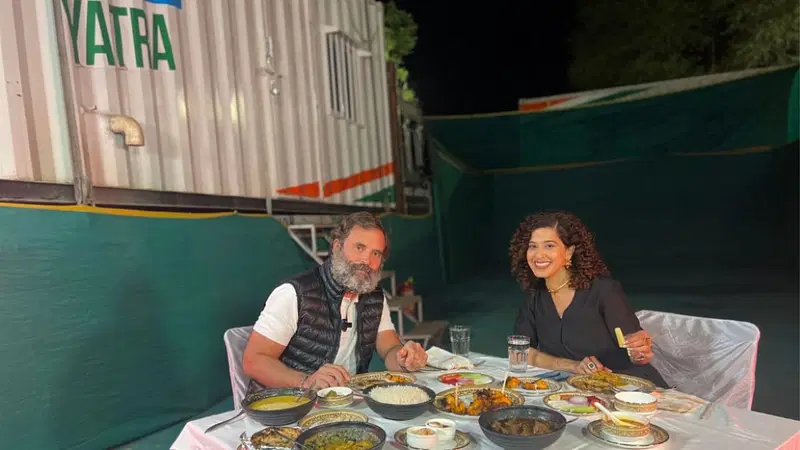
Taking time off from his busy schedule in the ongoing Bharat Jodo Yatra, Rahul spoke candidly about food, travel, marriage plans, first paycheck & other facets of his life in an interview with Kamya Jani, Editor-in-chief of the food and travel platform, Curly Tales, over dinner.
While the Bharat Jodo Yatra is in its final week in Jammu and Kashmir at the moment, the interview was conducted in December when the walkathon was in Dausa, Rajasthan.
Jani mentions in the interview video that the ‘Brunch’ from where her flagship show ‘Sunday Brunch’ gets its name from couldn’t be organised due to Rahul’s tight schedule and that they had to settle for dinner outside his container at the Yatra campsite. The duo are served their meal on a round table with white covers by an uniformed waiter.
“Just a loving person who’s intelligent,” Rahul says when asked what kind of girl he’d like to marry.
During the course of the interview, Rahul further talks about his solo biking trip across Spain, and being a scuba diver. He also talks about his schooling, early life, ‘fights’ with his sister and more. He reveals that he meditates while walking during the Yatra which began in September.
A social media influencer, Jani is recognised for her YouTube show ‘Sunday Brunch’. Her platform Curly Tales has a YouTube channel with about 2 million subscribers, own website and an Instagram page. It largely produces content around food and travel, along with other lifestyle content.
‘Hate Jackfruit & Peas’
The interview begins with Jani asking what he likes to eat and Rahul says that he eats “jo bhi mil jata hai (have anything that is served)” during the Yatra but hates “matar and kathal” (peas and jackfruit).
He clarifies that he’s “very strict” with his food at home and doesn’t eat a lot of things. He calls his diet “boring” and “controlled”. “But here I don’t have much choice.” Rahul says Telangana, for example, was a “little bit spicy” for his palate. “The chillies were a bit over the top. I don’t eat that much chillies.”
Rahul also says that he “tends to be non-vegetarian” and likes all kinds of meat including chicken, mutton and seafood. At home, he has desi food for lunch and dinner is “some sort of continental stuff”.
In Delhi, his favourite restaurants are Moti Mahal, Sagar and Sarvana Bhavan. He also likes tandoori food and a “good omelette”, does not like rice or roti and usually drinks just one cup of coffee in the morning.
Homeschooled after Indira’s death
While explaining where he comes from, Rahul says that he’s a “Kashmiri Pandit who moved to Uttar Pradesh.”
“Our family was from Kashmir but they moved to Allahabad. My grandfather-papa’s papa- was Parsi. So I’m a complete mix,” he says.
He then says that he had to be homeschooled after his grandmother, former PM Indira Gandhi, was assassinated and he was taken out of boarding school due to security concerns.
“It was a big shock to me as I was in boarding school. Then one day before Dadi’s (Indira’s) death, we were taken out of there. When Dadi died, they didn’t allow us to go back.”
In school, Rahul reminisces, some teachers were “overly nice” to him while some were “really nasty”, because of the family he came from.
“The political position that my family used to take was quite a pro-poor position. And so a lot of the people who were teachers, I don’t think they appreciated that. But there were others who were sort of nice. So it was a balance,” he says.
Jani then says that there are a lot of colleges listed against his name on the Internet and asks him for details.
Rahul says that he went to St. Stephen’s for a year and studied history, and then entered Harvard University where he studied international relations and politics. After that, he says, he had to transfer from there following his father’s death, again due to security concerns. Thereafter, he went to a college in Florida, Rollins College, where he studied international relations and economics. He also has a Masters degree in development economics from Cambridge University, UK.
Unlike in school, Rahul says, he received a “neutral perspective” in college.
Giving details of his first paycheck, he says that he had a corporate job in London at the age of 24-25 with a strategic consulting company called Monitor. He got paid about 2,500-3,000 pounds a month, Rahul said, adding that he felt “strange” about it since it was “a lot” of money.
Apart from his college life, Rahul says that the death of his father also changed his relationship with his younger sister, Priyanka Gandhi Vadra, now Congress general secretary.
“We grew up with a whole bunch of violence around us. A lot of that was internally causing stress and stuff. So, we used to fight a lot. Then after Papa died, it just stopped.”
The Beard
Jani also goes on to ask Rahul a question about his “new look” that everyone has been seeking an answer to. She was referring to Rahul’s beard that has been a political and comical talking point since the Yatra began.
“I just felt like I shouldn’t shave my beard or cut my hair during the Yatra. It’s nice. It’s a bit big now, it’s getting bigger. It makes life a little complicated when you’re eating,” Rahul jokes.
He also says that many within the party have asked him to shave it off but he’s not relented. “It’ll change,” he says when asked if he likes the look.
(Edited by Tony Rai)
Courtesy: theprint.in
Let the Truth be known. If you read VB and like VB, please be a VB Supporter and Help us deliver the Truth to one and all.
4 held for sexually assaulting woman, girl on moving bus after social media alert in UP's Agra

Agra (UP) (PTI): Four people were arrested, after a prompt response by police following a social media alert, for allegedly sexually assaulting a woman and a girl inside a moving bus here, officials said on Tuesday.
According to an official police statement, at 12:27 am on April 27, information was received on the social media platform X about an incident of sexual assault on a bus travelling from Kanpur to Ahmedabad, which was approaching Namner crossing in Agra.
Acting under the direction of Police Commissioner Deepak Kumar, the Agra Police social media team immediately alerted the Rakabganj police station within minutes and coordinated with the victims to confirm the incident and obtain the exact location, it stated.
Police teams launched intensive checking at Namner crossing and intercepted the bus as it reached the spot. The four accused involved in the incident were apprehended on the spot, and legal action was initiated against them, the statement said.
The police said the swift response and coordination between the social media team and field units ensured timely action, bringing relief to the victims and other passengers, who expressed gratitude towards the police, it added.