Justice A K Sikri retires as SC judge
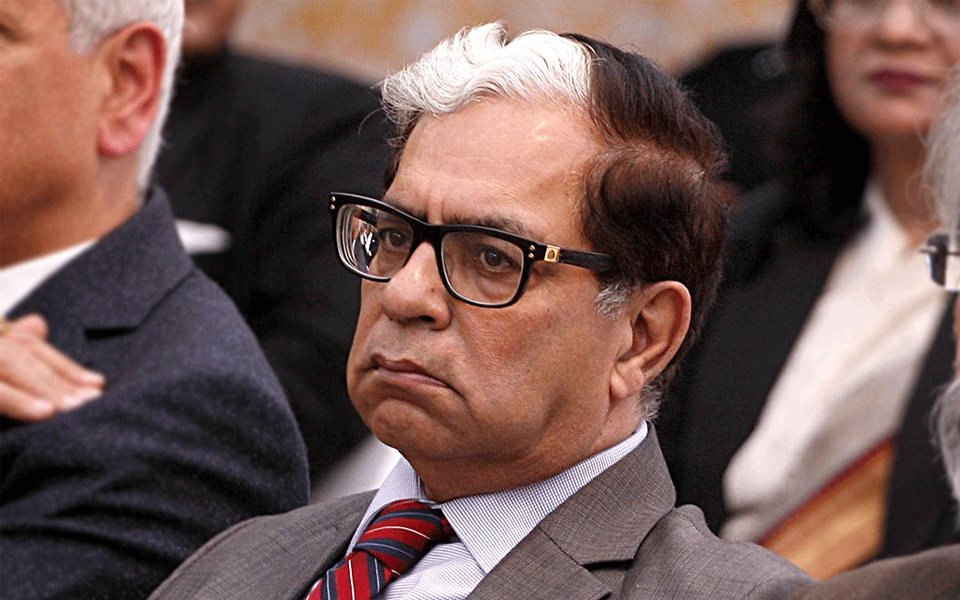
New Delhi, Mar 6: Justice A K Sikri, who was part of a high-powered committee headed by the prime minister which decided to oust senior IPS officer Alok Kumar Verma as CBI director in January, on Wednesday retired as a judge of the Supreme Court.
Three days after his vote on January 10, as a representative of CJI Ranjan Gogoi on the panel also, helped decide Verma's removal, a controversy had broken out over his nomination for president/member in the London-based Commonwealth Secretariat Arbitral Tribunal.
Stung by the controversy, Justice Sikri withdrew his consent to the government offer.
He later said he wants the controversy to "die".
On Wednesday, during the farewell function organised by the Supreme Court Bar Association in the apex court lawns, Justice Sikri said every judge should possess "some element of femininity" to do complete justice.
He got emotional and thanked the judiciary and lawyers for their help throughout his career.
His eyes were moist earlier in the day too when he sat on the bench along with Chief Justice Ranjan Gogoi and Justice S A Bobde as lawyers thanked him and wished him.
"Thank you all," he told the lawyers, wiping his tears before rising from the dais.
During the function in the evening, Justice Sikri said, "By nature, a part of me is feminine. Going by the quality this gender possesses, I am of the opinion that every judge, in order to do complete justice, should possess some element of femininity."
"After all, symbol of justice is a goddess. No doubt she is shown blindfolded, but however, her heart is not shut from where emanates the qualities of impartial justice," he said.
CJI Gogoi said the conduct and sensitivity displayed by Justice Sikri as a judge will continue to inspire the young.
He said judiciary, as an institution, grows on the faith reposed in it by people.
"Judiciary as an institution is among a few that have direct interface with the citizenry and judges and lawyers are like the face of the institution. As an institution grows along with other instrumentalities of our young nation, the need for goodness by the people, for the people and among the people is being felt more than any time in the past," the CJI said.
"In an era where reckless and rash narrative of a few threaten to slow down the journey and the progress of institutions, Justice Sikri has endeared himself to all of us around him by his benign demeanour and warmth," Justice Gogoi said.
Justice Sikri said even at the age of 65, there was a child in him.
"That kept the innocence alive and ensured that there is no malice, which helps in fair judging," said Justice Sikri.
Talking about whether a judge should smile, he said it was not about how many times a judge smiles but how many times the judge has brought a smile to helpless people.
Attorney General K K Venugopal, who was present at the function, was described by Justice Sikri as "Bhishma Pitamaha" of legal profession.
Justice Sikri was appointed as a judge of the Delhi High Court on July 7, 1999 and became its acting chief justice on October 10, 2011.
He was elevated as Chief Justice of Punjab and Haryana High Court on September 23, 2012, and to the Supreme Court as a judge on April 12, 2013.
Let the Truth be known. If you read VB and like VB, please be a VB Supporter and Help us deliver the Truth to one and all.
Austrian police detain suspect in case of rat poison found in baby food jars on supermarket shelves

Vienna (AP): Police in eastern Austria say a 39-year-old suspect has been arrested after rat poison turned up in some HiPP baby food jars on supermarket shelves in central Europe.
HiPP, which recalled some of its baby food jars in Austria, Slovakia and the Czech Republic after the case came to light last month, said in a statement Saturday it was “greatly relieved” by the arrest, and would provide further updates as verified details come in.
The Burgenland State Criminal Police Office, under the direction of prosecutors, said a probe was launched after poison turned up in a baby food jar purchased at a supermarket in the city of Eisenstadt on April 18.
It said the suspect was being questioned, and that no further details would be immediately provided. The Burgenland public prosecutor's office has announced an investigation into suspected “intentional endangerment of the public.”
The Austrian Press Agency reported that an expert report on the toxicity of the poison was pending. A total of five tampered baby food jars were seized before they could be consumed, APA reported.
Authorities said previously they believe the tampering occurred in 190-gram (6.7-ounce) jars of baby food made with carrots and potatoes for 5-month-olds that were sold from SPAR supermarkets in Austria.
HiPP responded by recalling all of its baby food jars sold at SPAR supermarkets — which include SPAR, EUROSPAR, INTERSPAR and Maximarkt stores — in Austria as a precaution. Vendors in Slovakia and the Czech Republic also removed all of the brand's baby jars from sale.
The company said the recall was not due to any product or quality defect on its part, and said the jars left its facility in “perfect condition.”
Police said a customer at the time of the discovery had reported that a jar appeared to have been tampered with, but no one had consumed the baby food.