Justice Sanjiv Khanna takes oath as 51st CJI
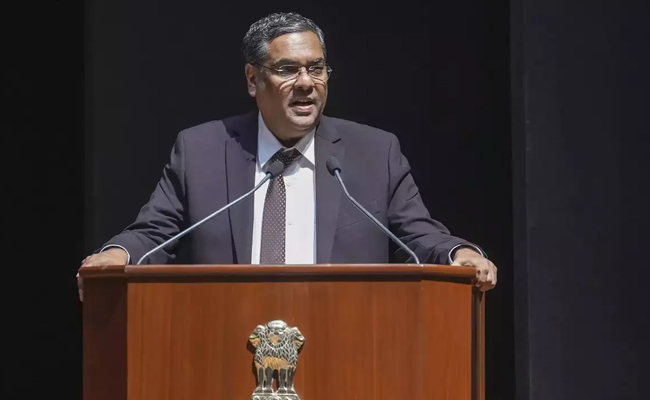
New Delhi (PTI): Justice Sanjiv Khanna was on Monday sworn in as the 51st Chief Justice of India.
President Droupadi Murmu administered the oath of office to him at a brief swearing-in ceremony held at the Rashtrapati Bhavan.
Justice Khanna took the oath in English in the name of god.
Born on May 14, 1960, Justice Khanna will serve as the CJI for a little over six months and demit office on May 13, 2025, on attaining the age of 65 years.
He succeeds Justice D Y Chandrachud, who demitted office on Sunday.
Vice President Jagdeep Dhankhar, Prime Minister Narendra Modi, Defence Minister Rajnath Singh, Union Law Minister Arjun Ram Meghwal and former CJI J S Khehar were among those present on the occasion, besides Justice Chandrachud.
Justice Khanna, who served as a Supreme Court judge since January 2019, has been part of several landmark judgments such as upholding the sanctity of EVMs, scrapping the electoral bonds scheme, upholding the abrogation of Article 370 and the granting of interim bail to former Delhi CM Arvind Kejriwal.
Hailing from an illustrious Delhi-based family, Justice Khanna is the son of former Delhi High Court judge Justice Dev Raj Khanna and the nephew of prominent former apex court judge H R Khanna.
Justice Sanjiv Khanna, who was elevated as a judge of the Supreme Court on January 18, 2019, was a third-generation lawyer before being appointed as a judge of the high court. He is driven by the zeal to reduce pendency and speed up justice delivery.
Justice H R Khanna, the uncle of Justice Sanjiv Khanna, hit the headlines by resigning in 1976 after he wrote a dissenting verdict in the infamous ADM Jabalpur case during the Emergency.
The majority verdict of a Constitution bench, upholding the abrogation of fundamental rights during the Emergency, was considered a "black spot" on the judiciary.
Justice H R Khanna declared the move unconstitutional and against the rule of law and paid a price as the then central government superseded him and made Justice M H Beg the next CJI.
Justice H R Khanna was part of the landmark verdict propounding the basic structure doctrine in the Kesavananda Bharati case of 1973.
Among the notable judgments of Justice Sanjiv Khanna in the Supreme Court is upholding the use of electronic voting machines in elections, saying the devices were secure and eliminated booth capturing and bogus voting.
A bench headed by Justice Khanna, on April 26, termed the suspicion of the manipulation of EVMs "unfounded" and rejected the demand for reverting to the old paper ballot system.
He was also part of the five-judge bench that declared the electoral bond scheme, meant for funding political parties, as unconstitutional.
Justice Khanna was a part of the five-judge bench, which upheld the Centre's 2019 decision abrogating Article 370 of the Constitution which granted a special status to the erstwhile state of Jammu and Kashmir.
It was the Justice Khanna-led bench, which for the first time, granted interim bail to Kejriwal, the then chief minister, in the excise policy scam cases till June 1 to campaign in the Lok Sabha election.
Born on May 14, 1960, he studied law at the Campus Law Centre of Delhi University.
Justice Khanna was the executive chairman of the National Legal Service Authority (NALSA).
He enrolled as an advocate with the Bar Council of Delhi in 1983 and initially practised in the district courts at the Tis Hazari complex here, and later, in the Delhi High Court.
He had a long tenure as the senior standing counsel for the Income Tax Department. In 2004, he was appointed as the standing counsel (Civil) for the National Capital Territory of Delhi.
Justice Khanna had also argued in a number of criminal cases at the Delhi High Court as an additional public prosecutor and as an amicus curiae.
Let the Truth be known. If you read VB and like VB, please be a VB Supporter and Help us deliver the Truth to one and all.
Nitish Kumar's son Nishant among 32 to take oath as Bihar ministers
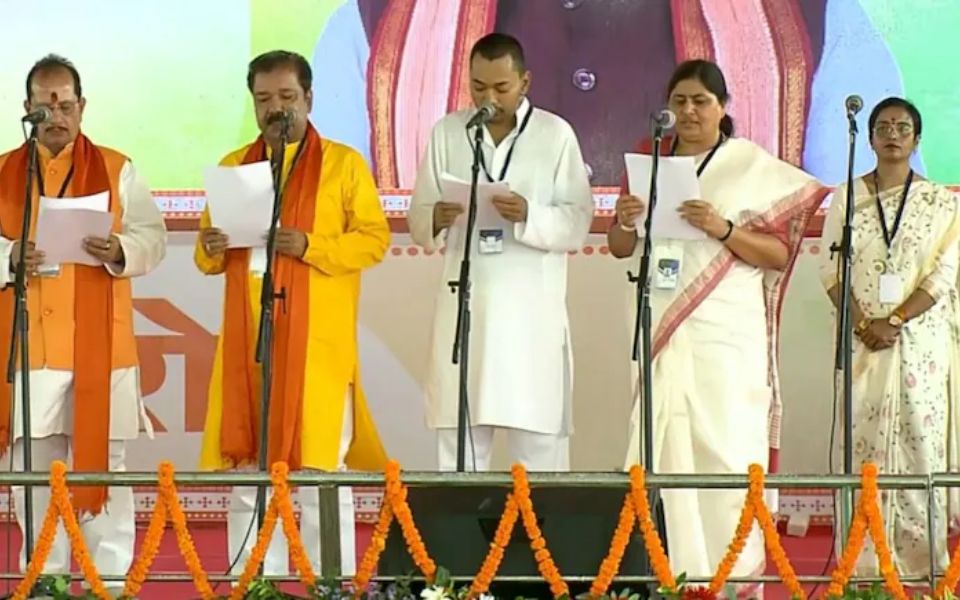
Patna (PTI): In a major expansion of the Cabinet of Bihar's first BJP-led government, JD(U) supremo Nitish Kumar's son Nishant Kumar and 31 others took oath as ministers on Thursday in the presence of Prime Minister Narendra Modi and Union Home Minister Amit Shah.
Altogether 32 leaders, drawn from all constituents of the five-party NDA in the state, were administered the oath of office by Governor Lt Gen (Retd) Syed Ata Hasnain at a grand ceremony that was also attended by Defence Minister Rajnath Singh and Union Health Minister J P Nadda and BJP president Nitin Nabin.
Prominent inductees included Nishant Kumar, the son of JD(U) president Nitish Kumar, who stepped down as chief minister last month to enter the Rajya Sabha.
The BJP, which is the single largest party in the 243-member assembly with 89 MLAs, has 15 ministers, who took oath on Thursday.
Most of the inductees were those who were part of the Nitish Kumar cabinet formed in November last year after the NDA stormed back to power in the assembly polls.
The JD(U) is represented by a total of 15 ministers, 13 of whom took the oath at the Gandhi Maidan on Thursday. Vijay Kumar Chaudhary and Bijendra Prasad Yadav had taken oath in April along with Samrat Choudhary and were designated as deputy chief ministers.
Sanjay Kumar Singh and Sanjay Kumar Paswan, both from the Lok Janshakti Party (Ram Vilas) headed by Union minister Chirag Paswan, are back as ministers, and so are Santosh Kumar Suman and Deepak Prakash, sons of Union minister Jitan Ram Manjhi of the Hindustani Awam Morcha and Upendra Kushwaha of the Rashtriya Lok Morcha, respectively.