Justice must be seen to be done: Kejriwal on refusal to appear in excise case before HC judge
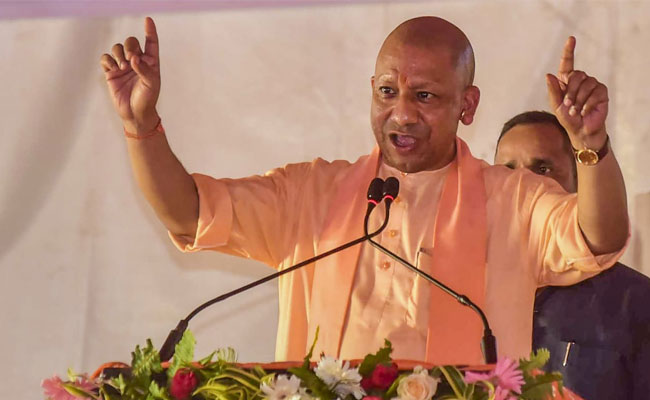
New Delhi (PTI): Aam Aadmi Party chief Arvind Kejriwal has written to Delhi High Court Justice Swarana Kanta Sharma, saying he will not appear in the excise case personally or through a lawyer before her, the party said on Monday.
Pointing to a "grave miscarriage of justice", Kejriwal, in a four-page letter, said he has "serious and unreconciled" concerns regarding the matter.
"I have decided that I shall not participate in the further proceedings in this matter, either in person or through counsel. I do not take this step lightly," Kejriwal added.
In his letter, Kejriwal further said that "justice must not only be done, but must also be seen to be done".
"The principle that justice must not only be done, but must also be seen to be done, is among the most sacred assurances that a court gives to a citizen in a democracy," he said.
The assurance cannot be dishonoured by asking the citizen to ignore what "anyone can plainly see" in a case like this, he added in the letter.
The letter also invoked the principles of Satyagraha and the teachings of Mahatma Gandhi, with Kejriwal saying that his intent is "strengthening of judiciary and prevent its weakening".
He added that he has given the authority an opportunity to consider and correct what he perceived to be a grave miscarriage of justice.
His earlier plea seeking the recusal of Justice Sharma, which was rejected on April 20, was interpreted as a personal attack, the AAP chief claimed.
"After the said judgment, I am left with the painful and inescapable impression that what I had urged as a lawful plea of apprehension was received and answered as a personal attack upon Your Ladyship and as an assault on the institution itself.
"Those are not, with respect, answers to the case I had brought. They show me that my plea of apprehension has been judicially understood as a personal and institutional affront," he said in the letter.
The letter further noted the leader's belief that it was now "impossible to receive an impartial hearing" in Justice Sharma's court.
Kejriwal also reiterated two grounds cited earlier in his recusal plea.
"First, the issue of Your Ladyship's repeated public association with the RSS's legal front, the Akhil Bharatiya Adhivakta Parishad (ABAP) -- an organisation belonging to the ideological ecosystem of the ruling dispensation," he wrote, further pointing out that Justice Sharma's children "are professionally engaged on multiple advocates' panels of the Union government which happens to be the opposite party in this case".
Reflecting on his personal experience during the proceedings, the former Delhi chief minister expressed concern over the broader implications of his case on public trust in the judiciary, while he said he maintains respect for the institution.
ALSO READ: ED raids in case against former Punjab Police DIG Bhullar, linked entities
"When I appeared before Your Ladyship to argue my case, the question in my heart was simple: Will I get justice? Today, with the deepest respect, I must say that the same question has become graver and deeper in my conscience," he said.
This case has now become a matter of widespread public discussion. It is being discussed not merely in legal and political circles, but in homes across the country, the letter read.
Addressing potential criticism, Kejriwal clarified that his remarks should not be interpreted as opposition to the judiciary.
"As I write this, I am also cognisant of the fact that some might portray me as someone 'against' the judiciary. But how can that ever be the case when I have personally received relief from the judiciary, including orders of bail and the present discharge?
"Today, I walk free because of the judiciary. Let there exist no figment of imagination that my present stand is against the institution," he asserted.
Kejriwal further said his respect for the judiciary "remains intact" and he has "unwavering faith" in the Constitution of India.
"My objection is not to the institution of the High Court or the larger judicial system, but only to the continuance of this matter before Your Ladyship (Sharma) under a cloud of grave and unresolved questions and circumstances that have generated grave public doubt in your ability to dispense impartial justice," Kejriwal further wrote in the letter.
He also clarified that his "personal inability" is confined to just this matter.
"I shall continue to appear in matters where these serious and unreconciled concerns do not arise, including matters in which the solicitor general does not appear and matters unconnected with the Union government, the BJP or the RSS," the letter added.
He further said he has made the decision by listening to the voice of his conscience and that he is prepared to bear the consequences.
"I may prejudice my own legal interests. I understand that I may lose the opportunity to advance submissions before this Hon'ble Court and that adverse consequences in law may follow. I am prepared to bear those consequences," the AAP chief said.
He added that he will reserve the right to approach the Supreme Court to appeal against Justice Sharma's decision.
Let the Truth be known. If you read VB and like VB, please be a VB Supporter and Help us deliver the Truth to one and all.
India, New Zealand ink free trade agreement
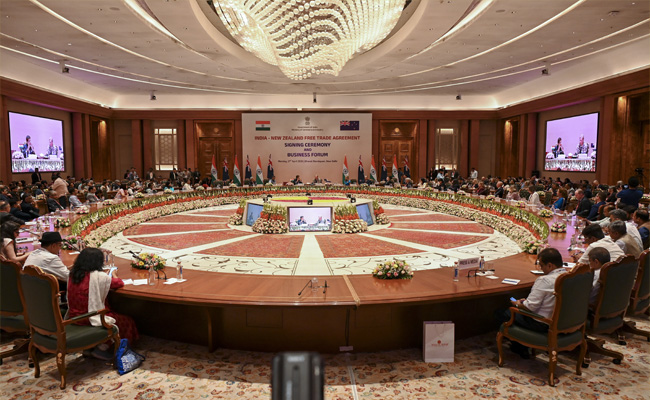
New Delhi (PTI): India and New Zealand on Monday inked a free trade agreement, aimed at boosting two-way commerce and investments.
The pact was signed by Commerce and Industry Minister Piyush Goyal and visiting New Zealand's Trade and Investment Minister Todd McClay.
The FTA provides duty-free access for 100 per cent of India's exports to New Zealand, covering all tariff lines or produce categories, and is expected to significantly boost MSMEs and employment by enhancing competitiveness in labour-intensive sectors such as textiles, apparel, leather, footwear, gems and jewellery, engineering goods, and processed foods.
Earlier, New Zealand maintained peak tariffs of up to 10 per cent on key Indian exports, including ceramics, carpets, automobiles, and auto components.
With zero-duty market access from entry into force as New Zealand's other trade partners, Indian products will be fully competitive in that country, enjoying a level playing field.
ALSO READ: Cal HC urges EC to dispose of TMC complaint over police observer's meeting with BJP nominee
Significantly, India also secured duty-free inputs for its manufacturing sector, including wooden logs, coking coal, and waste and scraps of metals, lowering production costs and enhancing the global competitiveness of the Indian industry.
On the other hand, India has offered tariff liberalisation on 70.03 per cent of tariff lines covering 95 per cent of bilateral trade value, while keeping 29.97 per cent of tariff lines excluded to protect India's sensitive sectors.
The products that are kept in exclusion are mainly -- dairy (milk, cream, whey, yoghurt, cheese etc.), animal products (other than sheep meat), agricultural products (onions, chana, peas, corn, almonds), sugar, artificial honey, animal, vegetable or microbial fats and oils, arms and ammunition, gems and jewellery, copper and articles thereof (cathodes, cartridges, rods, bars, coils), aluminium and articles thereof (ingots, billets, wire bars) among others.
On 30 per cent of tariff lines of New Zealand, India will provide duty elimination on goods such as wood, wool, sheep meat, and leather-raw hides.
Similarly, 35.60 per cent of tariff lines are subject to phased elimination over 3, 5, 7, and 10 years, including petroleum oil, malt extract, vegetable oils, selected electrical and mechanical machinery, and peptones.
New Zealand products which enjoy tariff reductions include wine, pharmaceutical drugs, polymers, aluminum, iron and steel articles, and goods that only 0.06 per cent fall under tariff rate quotas, including Manuka honey, apples, kiwi fruit, and albumins, including milk albumin.
The FTA also includes a commitment to facilitate USD 20 billion in investment into India.
A rebalancing clause is incorporated into the Agreement to provide a framework for addressing any shortfall in investment delivery, thereby ensuring robust and tangible economic outcomes.
Total bilateral trade in goods and services reached USD 2.4 billion in 2024.