Kanchanjunga accident: Probe finds lapses at multiple levels, says incident was waiting to happen
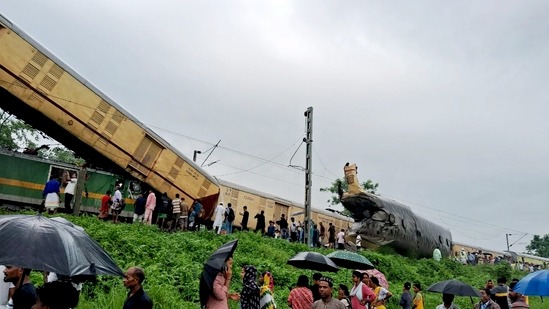
New Delhi (PTI): The Commissioner of Railway Safety has said the Kanchanjunga Express accident involving a goods train was "waiting to happen" due to lapses at multiple levels in managing train operations in automatic signal zones, and "inadequate counselling" of loco pilots and station masters.
In its probe report into the June 17 accident in West Bengal's Darjeeling district that left 10 persons dead, including the loco pilot of the goods train, the Commissioner of Railway Safety (CRS) also recommended implementation of the Automatic Train-protection system (KAVACH) on top priority.
The CRS said wrong paper authority or T/A 912 to cross defective signals was issued to the loco pilot of the goods train involved by authorities concerned. Further, the paper authority didn't mention the speed that the goods train driver was supposed to follow while crossing the defective signal.
Considering various lapses on part of the rail administration, the CRS said, "Due to improper authority and that too without adequate information, such an incident was an "accident-in-waiting".
The CRS, in its probe, found that besides the Kanchanjunga Express and the goods train, five other trains entered the section from when the signals turned defective until the accident happened on that day.
"In spite of issuing the same authority, different speed pattern was followed by loco pilots," it said.
The CRS noted that only the Kanchanjunga Express followed the norm of moving at a maximum speed of 15 kmph and stopping for one minute at each defective signal while the rest of the six trains, including the goods train involved in the accident, didn't follow this norm.
This shows that "action to be taken when T/A 912 is issued to them is not clear. Some of the loco pilots have followed the 15 kmph rule while most of the loco pilots did not follow this rule. The absence of proper authority and that too without adequate information created misinterpretation and misunderstanding about the speed to be followed."
PTI had first reported that the T/A 912 didn't mention speed restriction which the CRS has also flagged in its report as a major reason for the accident.
Classifying the accident under the "Error in Train Working" category, the CRS said there was "inadequate counselling of loco pilots and station masters about train operation in automatic signalling territory creating misinterpretation and misunderstanding of rules."
It said the large number of signalling failures in automatic signalling territory is a cause of concern and should be taken up with those concerned to improve the reliability of the system.
"The occurrence of as many as 208 cases of Signal Passing at Danger (red signal overshooting) from 1.4.2019 to 31.03.2024, out of which 12 cases resulted in collision, highlights the limitations of preventive measures taken by zonal railways (counselling of loco pilot/assistant loco pilot, safety drives, etc.)," the CRS said.
"This underscores the need for implementation of the Automatic Train-protection system (KAVACH) on top priority. Use of non-signalling-based systems such as Artificial intelligence-based detection of the RED aspect of the signal and providing an early warning to the loco pilot/GPS-based anti-collision systems shall be explored for provision in locomotive cabs across Indian Railways in non-ATP (automatic train protection) territory," it said.
The CRS also said that there was a shortage of walkie-talkies in the Northeast Frontier Railway (NFR) Zone under whose jurisdiction the accident took place and hence the goods train crew was not issued the "critical safety equipment".
In case of multiple signal failures, the CRS said there were three options left with the rail administration but they followed none of them in total.
The first option was to let the drivers follow the general rule under which the loco pilot has been instructed to stop the train for one minute at the defective signal and then proceed with great caution till the next stop signal.
The second option was that the drivers should have been issued a T/A 912 form with a caution order (mentioning the speed that the driver should have maintained). In the Kanchanjuga tragedy, the T/A 912 issued to the goods train crew didn't mention the speed aspect.
The third option was that authorities should have treated that as a "major signal failure" and followed Automatic Block System. Under the provision, only one train is allowed to enter between two stations and till the time the proceeding train crosses the next station, no train is permitted to enter from the first station.
According to the CRS, the control office at the divisional level has to be manned by one Senior Section Engineer, one Junior Engineer and one helper round-the-clock in an 8-hour shift.
However, on the night of June 16 and June 17, "signalling control office was manned by a technician. It is not possible to manage such a major signalling failure by a staff of technician level. The response of higher officials of the signalling department at the divisional level posted at Katihar has been found lackluster as despite being informed about this serious failure, none of them went to the control office to manage and coordinate with other departments for timely attention of signalling failures," it said.
The CRS said since the automatic signalling was introduced in January 2023, it was necessary that all rules applicable to automatic signalling are implemented at the field level. The widespread misinterpretation of rules indicates there was no system of checks and balances at the headquarter level, it added.
Let the Truth be known. If you read VB and like VB, please be a VB Supporter and Help us deliver the Truth to one and all.
4 workers die after being buried under coal slurry in Jharkhand's Dhanbad
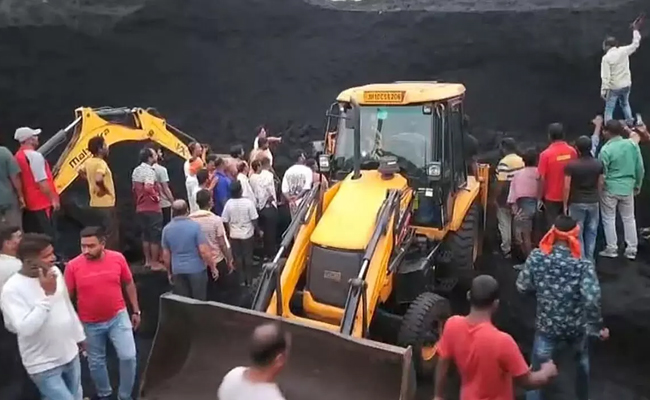
Dhanbad (Jharkhand) (PTI): At least four workers died after being buried under coal slurry in Jharkhand's Dhanbad district on Saturday, a police official said.
The incident took place at Moonidih coal washery in the command area of Bharat Coking Coal Limited (BCCL).
"Bodies of all four workers were dug out of debris during a rescue operation," Putki police station in-charge Waqar Hussain told PTI.
The incident took place when coal slurry was being loaded into trucks by workers, during which a large chunk of slurry fell and trapped several workers underneath, officials said.
The deceased have been identified as Manik Bauri, Dinesh Bauri, Deepak Bauri, and Hemlal Gope.
Meanwhile, the family members of the deceased and local villagers placed the bodies in front of the washery gate and began a protest.
They demanded compensation, jobs for dependents and action against those responsible for the incident.
Police and administration officials are trying to pacify the protesters, an official said.