Kannada film 'Shivamma' bag major award at Busan Film Festival
Another Indian film 'The Winter Within' also among awards
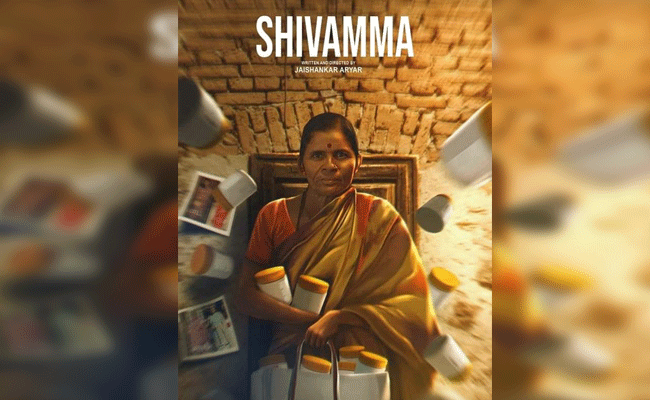
New Delhi (PTI): Kannada movie "Shivamma" and actor-director Aamir Bashir's "The Winter Within" have won trophies at the 2022 Busan International Film Festival.
"Shivamma", directed by first-time filmmaker Jaishankar Aryar, won the New Currents Award along with the Korean title "A Wild Roomer".
Bashir's "The Winter Within" was adjudged the winner of KB New Currents Audience Award during the festival's closing ceremony on Friday.
"Shivamma" chronicles the story of a poor, middle-aged woman sales representative for an energy drink company. It features Sharanamma Chetti and Chennamma Abbegere, and is produced by "Kantara" star-filmmaker Rishab Shetty.
According to festival organisers, the New Currents Award is given to the two best feature films selected from the first or second feature of new Asian directors introduced in the New Currents section of the festival. It carries a grand prize of USD 30,000 for each film.
"We appreciated the originality and intensity with which the director was able to tell this very contemporary story. Here documentary and fiction meet in an organic and spirited way of making cinema.
"The generosity of the actors and the scenes create a closeness with this universal story that takes place in an Indian village," the jury, which included world-renowned film experts, said in a note shared on the festival website.
Aryar, who hails from Bengaluru, celebrated his debut film's win in a post on Instagram.
"Delighted to share the wonderful news that the new currents award of 27th Busan film festival goes to 'Shivamma'. The first Kannada film to win this honour," the filmmaker said.
Bashir's "The Winter Within" is his second directorial effort after he made his debut with 2010's National Award-winning Urdu movie "Harud".
It took home the KB New Currents Audience Award, which is given to the title that is most highly rated by festival audiences from the New Currents section.
The award carries a prize of USD 18,000 for the director.
"The Winter Within" is set in Bashir's native Kashmir, where small and big skirmishes and terrorist activities occur frequently due to the long conflict between India and Pakistan, as well as the border dispute with China, as per the official description on the website.
The story follows a domestic helper, named Nargis, who looks everywhere to find out whether her husband Manzoor, who was arrested after joining the armed rebellion, is dead or alive.
"She is fired when her employer learns that Manzoor is a militant. She returns to her hometown, and Yaseen, who has feelings for her, offers help. Then one day, Manzoor comes home, and the three of them experience subtle emotional changes," the official synopsis read.
Bashir, known for appearing in films and shows such as "A Wednesday", "Haider" and "Sacred Games", penned the movie's screenplay with filmmaker Shanker Raman. The two had earlier collaborated on Raman's 2017 acclaimed directorial "Gurgaon".
Earlier, filmmaker Vinay Shukla's documentary While We Watched , featuring news anchor Ravish Kumar, won the Cinephile Award at the film gala. The honour is given to the best Korean and Asian documentary film presented in the Wide Angle documentary showcase section.
While We Watched , which had its Asia premiere at Busan, is described as a turbulent newsroom drama that intimately chronicles the working days of broadcast journalist Kumar as he navigates a spiralling world of truth and disinformation.
The 27th edition of the Busan International Film Festival was held from October 5 to 14.
Let the Truth be known. If you read VB and like VB, please be a VB Supporter and Help us deliver the Truth to one and all.
NEET student hangs self in Rajasthan's Sikar
Jaipur (PTI): A student preparing for the NEET examination allegedly committed suicide by hanging himself in a rented room in Rajasthan's Sikar on Friday, police said.
According to the police, the student allegedly hanged himself from a ceiling fan using his sister's scarf while one sister was attending coaching classes and the other was in the bathroom.
He had appeared in the NEET UG exam 2026, which was cancelled due to paper leak, they said.
Udyog Nagar SHO Rajesh Kumar said that the deceased, identified as Pradeep Meghwal, was a resident of Kanika ki Dhani village in Jhunjhunu's Gudha Gaudji area.
He had been living in a rented room in Sikar's Jaldhari Nagar area with his two sisters while preparing for NEET over the last three years.
His elder sister later found him hanging and informed the landlord and police after bringing him down, officials said.
The SHO said the body was kept at SK Hospital mortuary, and a postmortem had not been conducted.
The student's father, Rajesh Kumar Meghwal, told police that Pradeep's NEET examination had gone well and the family was expecting him to score around 650 marks.
Former Rajasthan deputy chief minister Sachin Pilot expressed grief over the incident and linked it to anxiety among students after reports of irregularities and paper leaks in NEET 2026.
Pilot said repeated paper leak incidents and cancellation of examinations were affecting students' mental health and demanded a time-bound investigation and strict action against those responsible.