Kapil Sibal raises concerns over erosion of democratic values in India
Says country under undeclared emergency
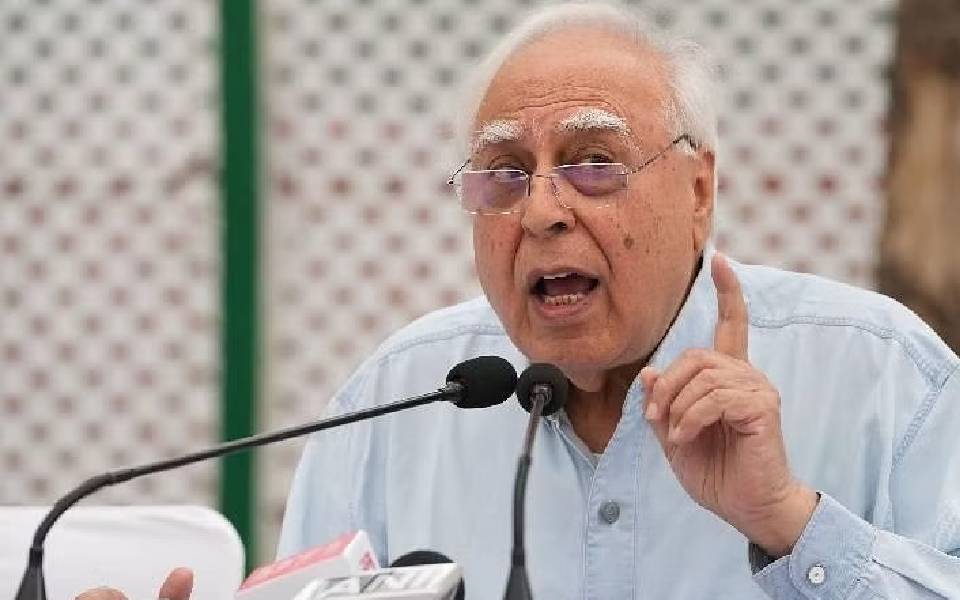
In a recent op-ed for The New Indian Express, Kapil Sibal, a prominent politician and legal luminary, has voiced his concerns about the state of democracy in India. Drawing parallels between the dark days of the Emergency in 1975 and the present, Sibal argued that the country is experiencing an "undeclared Emergency," where fundamental rights are being transgressed without the explicit suspension of constitutional provisions. This article urged the judiciary to play a proactive role in upholding democratic values.
Sibbal noted that during the emergency declared by the then PM Indira Gandhi in 1975, fundamental rights were suspended, and citizens found it challenging to protect their liberties under Article 21 and 226. In a provocative assertion, Sibal contends that the individuals targeted during this period were not on trial; it was the courts themselves that were on trial.
The op-ed highlights a moment in the legal history of India when the Madhya Pradesh High Court declared the suspension of fundamental rights unconstitutional. However, Sibal laments that the Supreme Court did not follow suit. He paid homage to Justice H R Khanna, the lone dissenter in the Supreme Court, who, in Sibal's words, became a beacon for generations to come, standing up for the cause of liberty and the fundamental values of the Constitution.
Transitioning to the present, Sibal asserted that what the country is witnessing today is an undeclared Emergency, drawing parallels between the suspension of rights in the 1970s and the current transgressions happening without a formal suspension of constitutional provisions. He expressed disbelief at the erosion of institutional independence, citing instances where citizens who oppose government policies are allegedly being targeted. Sibal noted a concerning trend of 'jail not bail' in cases deemed 'sensitive,' involving individuals critical of the government, including journalists, students, academics, and grassroots activists.
“We are watching in disbelief the way institutional independence is being jeopardised. Citizens who choose to oppose policies and diktats of this government are being targeted. ‘Jail not bail’ seems to have become the norm in certain ‘sensitive’ cases where individuals are critical of the government and its policies. They include journalists, students, academics and those working at the grassroots and espousing the cause of the underprivileged and the marginalised,” he noted
While Sibal refrained from mentioning specific cases, he expressed deep concern about the abandonment of basic legal principles to deny people their liberty. He questioned how a judge can justify admitting evidence obtained by police officers and using it to convict the accused. Sibal highlighted cases where students face extended incarceration under draconian laws simply for expressing dissent, and journalists are prosecuted under the Unlawful Activities (Prevention) Act through questionable investigative processes.
The op-ed shed light on the alleged misuse of provisions like the Gangsters Act to exploit victims and protect those involved in communally charged incidents. Sibal expressed dismay at the lauding of fake encounters and the loss of public representatives' membership in bodies due to defamation cases filed in jurisdictions where the complainant hopes to succeed. He pointed out instances where procedures and fundamentals of law seem to have been discarded in controversial cases and publications perceived as anti-government are targeted, and NGOs working at the grassroots find their accounts frozen.
A significant portion of Sibal's critique revolves around the selective prosecution of public functionaries based on their political affiliations. He contended that public servants facing allegations are often shielded if they belong to the ruling party or its allies. Sibal challenged the judiciary, arguing that it cannot be oblivious to this reality. He urged the judiciary, including the legal fraternity, to uphold the rule of law and ensure the flourishing of democratic institutions.
“Those involved in communally charged public humiliation of minorities and Dalits, instead of being prosecuted, are protected. Apparently, fake encounters are lauded. Public representatives lose their membership in public bodies when defamation cases are filed in jurisdictions where the complainant hopes to succeed. The procedures and fundamentals of law are discarded in highly controversial cases. Publications perceived to espouse anti-government narratives are targeted. NGOs working at the grassroots find their accounts frozen. In some matters, law and justice seem to have lost their way,” he further added.
In matters of criminal proceedings against public functionaries, Sibal called for a fair and unbiased approach, emphasizing that such prosecutions should not be selectively launched against individuals based on their political alignment. He raised concerns about the delay in deciding cases related to defection, citing instances where the Supreme Court kept a matter pending while awaiting the decision of the Speaker, contrasting this with cases where issues of defection remain undecided for years.
Sibal's op-ed concluded with a critical examination of the practice of transferring sensitive cases to benches that did not hear the matter initially. While acknowledging the discretionary power of the Chief Justice of the Supreme Court or a High Court, Sibal expressed concern about the established practice being disregarded. He raised the alarm about the gradual erosion of fundamental features of democracy in contemporary India and questions the silence of the courts during crucial moments.
“I am sure that the judiciary, of which the legal fraternity is an integral part, is committed to upholding the rule of law. I have no doubt that judges wish to see our democratic institutions flourish and work independently. In matters where chargesheets stand filed, where the nature of offence is not in the category of heinous offences, and where allegations of corruption are yet to be proved, individuals are entitled to bail without being held in custody for years.
“We have witnessed cases where the Supreme Court, in a case involving defection, kept the matter pending while awaiting the decision of the Speaker. The proceedings in the process were over in a month. In other cases, issues of defection are not decided for years, with adjournments being sought and granted. While the Supreme Court rightly espouses the cause of liberty for sustenance of our democracy, in reality, individuals languish in prison for long periods without a hearing and without relief,” he added.
In his closing statement, Sibal asserted that, in the current state of affairs, it is not the prosecuted individuals who are on trial; it is the courts themselves that are under scrutiny. He urged the judiciary to stand as a bulwark against the erosion of democratic values and to ensure that justice prevails impartially, irrespective of political considerations.
“These days, the fundamental features of our democracy are emasculated day in and day out. In the most crucial of moments, courts are silent. In a state of undeclared Emergency, those prosecuted are not on trial, courts are,” he concluded.
Let the Truth be known. If you read VB and like VB, please be a VB Supporter and Help us deliver the Truth to one and all.
Karnataka School Edu Dept prohibits children from being made to dance to obscene songs
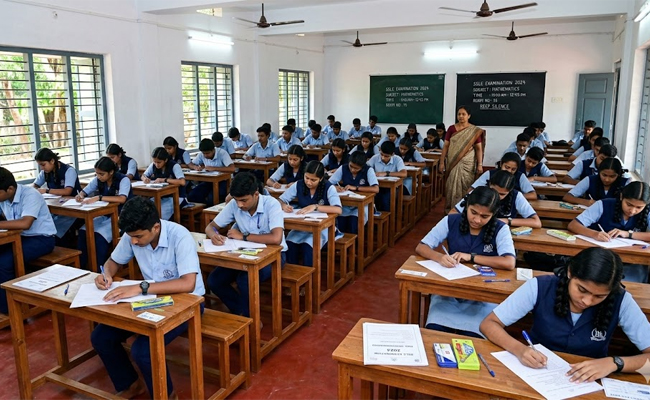
Bengaluru (PTI): The Karnataka School Education Department has issued a circular strictly prohibiting children from being made to dance to obscene songs in educational and cultural programmes.
It stated that such dances would negatively impact students' mental health and moral values. It will create indiscipline and harm the sanctity of education.
"All the Deputy Directors (Administration) of the state's School Education Department have been asked to take strict measures to prevent children or students from dancing to obscene songs in all government, aided and unaided schools in the state," the office of the commissioner of the School Education Department said in a recent circular.
"If it is found that children are being made to dance to obscene songs, appropriate action will be taken against the headmaster or management of such school," it added.
The department also listed certain measures in this regard, which include: strictly prohibiting children from being made to dance to obscene songs during educational and cultural programmes; selecting songs that are inspiring, positive, instilling national pride in children and reflecting the greatness, dignity, values, culture, and morality of the state.
Stating that the school headmaster and management are responsible for selecting songs and dances for cultural programmes, it said, they should also ensure that students wear decent clothes in dance or cultural programmes.