Karnataka Hijab ban: Not very fair to compare with practices in Sikhism, says Supreme Court
New Delhi, Sep 8: It is "not very fair" to compare the practices in Sikhism as they are well engrained in the culture of the country, the Supreme Court said on Thursday while asking the petitioners in the Karnataka Hijab ban matter not to draw a parallel between Muslim and Sikh religious practices.
Hearing arguments on a batch of pleas challenging the Karnataka High Court verdict refusing to lift the ban on hijab in educational institutions of the state, the apex court observed the five Ks in Sikhism -- Kesh, Kara, Kanga, Kaccha and Kirpan -- are well established.
A bench of Justices Hemant Gupta and Sudhanshu Dhulia observed this after an advocate, appearing for one of the petitioners in the case, gave an example of Sikhism and turban.
"It is not very fair to compare the rights or the practices in Sikhism. The five Ks are well established," the bench observed.
The top court referred to Article 25 of the Constitution and said it provides for carrying of Kirpan by Sikhs.
Article 25 of the Constitution deals with freedom of conscience and free profession, practice and propagation of religion.
"Don't compare these practices because they have been recognised for over 100 years," the bench said.
Advocate Nizam Pasha, arguing for one of the petitioners, said Article 25 mentions only Kirpan and not the other Ks.
"What we are saying is, please do not draw any parity with Sikhism. That is all. That is what we are saying," the bench said.
Observing that arguments were advanced about Kara and turban, the bench said the practices in Sikhism are well established and well engrained in the culture of the country.
During the arguments, Pasha said the high court verdict had referred to certain verses of the Holy Quran as well as some commentaries.
He said the Holy Quran, as it stands, is perfect for all times to come and to say that verses of Quran have become obsolete, is "bordering on blasphemy".
Senior advocate Devadatt Kamat, who appeared for one of the petitioners, told the bench that the state of Karnataka has said if the students would come in a head scarf, other people will get offended but this cannot be the reason for banning it.
Kamat argued that Article 25 has three restrictions -- public order, morality and health.
"Wearing a head scarf is a part of the religious belief apart from it being a part of (Articles) 19 and 21 rights," he said.
Kamat argued that every religious practice or religious observance is not essential to the religion but that does not mean that the State will keep on restricting it because it is not essential.
"As long as I do not violate public order, I do not fall foul of morality and I do not affect the health of others, I am entitled," he said.
Giving an example that one of the senior advocates wears a 'namam' (a divine mark put on forehead), Kamat said it may not be an integral part of religion of the Hindu faith.
"How does it harm discipline in the court? Does it harm public order?" he asked.
The bench observed there is a particular uniform for the lawyers to appear in court.
Justice Gupta said people in Rajasthan wear Pagdi as a matter of routine because of the climatic condition and in Gujarat also people wear it.
On the arguments about public order, the bench said this issue may arise when one is on the street.
The bench observed that wearing Hijab on the street does not affect anybody.
"But once you are talking about a school building, school premises, then the question is what kind of a public order the school want to be maintained there," it said.
Kamat said public order is the responsibility of the state and the school has nothing to do with it.
He asked, "In our constitutional scheme, is heckler's veto permitted?" (Heckler's veto is suppression of speech by the government when necessary to prevent possible violent reactions).
The senior advocate said it is the duty of the State to create an atmosphere where people can exercise their rights in accordance with Article 25.
"If I wear a head scarf, whose fundamental rights am I violating?" he said.
The bench observed it is not a question of violating other's fundamental rights.
"The question is what kind of fundamental right do you have which you want to exercise," it observed during the arguments which would continue on September 12.
Kamat said the state's argument is that if it will permit wearing of a head scarf, which the petitioners regard as a part of their faith, some other students will wear orange shawl.
"Wearing of an orange shawl, I do not think it is an innocent display of faith. It is a belligerent display of religious jingoism," he said, adding, "Article 25 only protects an innocent display of faith".
Kamat had earlier referred to the state government's order of February 5, 2022, by which it had banned wearing clothes that disturb equality, integrity, and public order in schools and colleges which some Muslim girls had challenged in the high court.
Several pleas have been filed in the top court against the March 15 verdict of the high court holding that wearing of hijab is not a part of the essential religious practice which can be protected under Article 25 of the Constitution.
The high court had dismissed the pleas filed by a section of Muslim students from the Government Pre-University Girls College in Udupi, seeking permission to wear hijab inside the classroom.
Challenging the February 5 order of the government, the petitioners had argued before the high court that wearing the Islamic headscarf was an innocent practice of faith and an essential religious practice and not a display of religious jingoism.
Let the Truth be known. If you read VB and like VB, please be a VB Supporter and Help us deliver the Truth to one and all.
Bihar: Over 150 children fall ill after consuming 'mid-day meal' in Saharsa
Saharsa (PTI): More than 150 children were taken ill after allegedly consuming food that was part of the mid-day meal in a school in Bihar’s Saharsa district, a senior official said on Thursday.
The incident occurred at a middle school in Baluaha village of the district.
The official said that 115 children were undergoing treatment at the Sadar Hospital, while around 50 students were admitted to Mahishi Public Health Centre.
“We received information that several children fell ill after consuming the mid-day meal in Baluaha. The children were initially treated at the primary health centre, but later, many were referred to the Sadar Hospital,” Saharsa District Magistrate Deepesh Kumar told reporters.
“According to doctors, the health condition of the children has improved, but they will be kept under observation for some time. There is no need to panic. Some kids are having mild fever. They are being treated accordingly,” Kumar said.
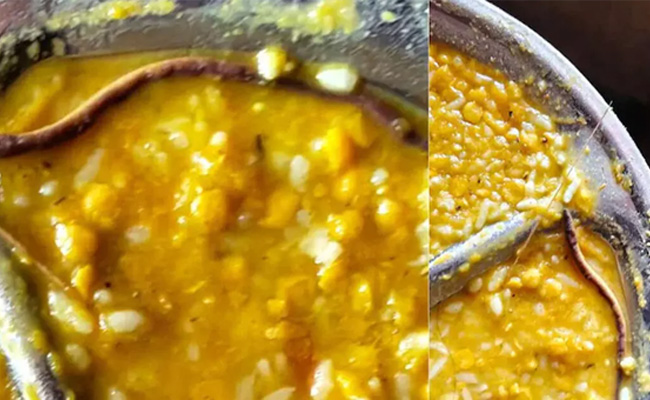
Meanwhile, family members of some children claimed that a snake was found in the container in which cooked pulses was stored at the school.
Of the 545 students present in the school, 200 had already eaten their meals by the time the snake was spotted, and later complained of stomach ache and vomiting, they said.
Regarding the claims, the DM said food samples have been collected from the school.
“We will be able to comment on this only after the results of the tested samples arrive,” he said.