Karnataka Hijab ban: Supreme Court asks about authentic figure on dropout of students

New Delhi, Sep 14: The Supreme Court Wednesday asked whether there is any authentic figure regarding dropping out of students from educational institutions in Karnataka because of the Hijab ban and the subsequent judgement by the high court on the issue.
"Do you have those authentic figures that because of this Hijab ban and the subsequent judgement of the high court, 20, 30, 40 or 50 students have dropped out?," a bench of Justices Hemant Gupta and Sudhanshu Dhulia asked after the counsel appearing for one of the petitioners raised the issue of students, especially girls, dropping out of school.
Senior advocate Huzefa Ahmadi, representing one of the petitioners, referred to a report and said it has testimonies of several students.
"My friend (one of the lawyers) informed me that 17,000 students had really abstained from the exams after this particular judgement," he said to the bench hearing arguments on a batch of pleas challenging the Karnataka High Court verdict refusing to lift the ban on hijab in educational institutions of the state.
Ahmadi said the effect of the government order in the matter would be that girls, who were earlier going and taking secular education in schools, will be forced to go back to Madrasas.
"Why should someone feel that one religious observance will obstruct in any manner legitimate or secular education or unity? Why should anyone get provoked if someone wears a Hijab and goes to school? Why should other students have a problem?" he said.
Senior advocate Rajeev Dhavan, appearing for another petitioner, argued that one of the most important parts of this case is that a person wearing a hijab cannot be discriminated against on the grounds of religion and sex.
"The reason why this case is important is when it was decided, the headlines were not that dress code was upheld, the headlines were hijab has been struck down by the Karnataka High Court," he said.
The bench observed that it does not go by what is written in the newspapers.
Dhavan argued that across India and in the entire world, whether it is an Islamic state or otherwise, Hijab is recognised as valid.
He said if according to the tenets of the faith, something is being done in a particular way and it is bona fide, then that has to be followed.
"We do not have to go back to the text. We have to examine whether the practice is prevalent or not prevalent. If the practice is prevalent and it is not mala fide As long as it is bona fide and exists as long as practice, that is enough," he said.
Arguing that this is not a simple case of discipline, Dhavan said what is the justification, ocular or otherwise, to say that Hijab is opposed to public order.
"There is none," he said, adding that there is a campaign that hijab must go.
"This is not a 'yes', 'no' issue. This is not an issue where you say we have a disciplinary code, follow it. What are the obligations on the authority concerned to bring a measure of inclusiveness as far this is concerned and to apply the least restrictive approach," he said?
"It is probably targeting Muslims and Muslim women in particular and therefore contrary to Articles 14 and 15. And this kind of targeting without any sensitivity is contrary to law and the Constitution," Dhavan said.
When he said that today, there is a lot of discontent in the majority community to knock down whatever comes by way of a claim in the name of Islam and cited the example of cow lynching, the bench observed, "You will be well advised to confine to this case rather than others."
Ahmadi said if a woman chooses to wear a Hijab, why should that provoke anyone else?
"And if it does, you have to actually address that. Because otherwise, you are effectively allowing someone to be bullied," he said.
Ahmadi argued that to say, one would not tolerate someone wearing Hijab, is completely contrary to the spirit of fraternity as enshrined in the preamble.
"The GO (government order) does not say no Hijab," the bench observed.
When Ahmadi argued about the dropout of students, the bench said this argument has been raised at this stage and it was not part of the petition filed earlier before the high court.
"It is not a legal question, it is a factual question. Whether there is a dropout, . drop out rate of girls or the boys. What is the age group? These are all factual," the bench said.
Ahmadi said, "We all know why a person wears a Hijab. There is a level of conservativeness in those families".
Referring to the National Education Policy, he said the legitimate state interest should be to promote education.
"Does public interest lie in enforcing discipline or does it lie in promoting education? And what is the degree of discipline which is compromised by allowing someone to hear a Hijab," he said.
"It is that balance that your lordships will have to strike and the state will also have to strike," he told the bench during the arguments which would continue on Thursday.
The state government's order of February 5, 2022, by which it had banned wearing clothes that disturb equality, integrity, and public order in schools and colleges, was referred to in the apex court.
Several pleas have been filed in the top court against the March 15 verdict of the high court holding that wearing of hijab is not a part of the essential religious practice which can be protected under Article 25 of the Constitution.
Let the Truth be known. If you read VB and like VB, please be a VB Supporter and Help us deliver the Truth to one and all.
Noida airport to begin ops next month with IndiGo flights to Lucknow, Bengaluru
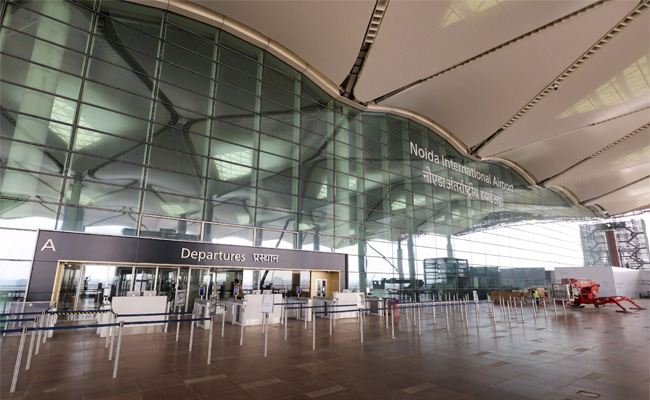
Noida (PTI): IndiGo on Thursday announced that it will start commercial flight operations from the Noida International Airport in Jewar from June 15, becoming the launch carrier for the greenfield airport in western Uttar Pradesh.
The first day flights will be to and fro Lucknow and Bengaluru, the airline said in a statement.
Noida International Airport was inaugurated by Prime Minister Narendra Modi on March 28.
IndiGo said it will be the first carrier to start commercial services from the airport, the third in the National Capital Region (NCR).
According to the airline, inaugural flights on June 15 will operate on the Lucknow-Noida-Bengaluru-Noida-Lucknow sector.
As per the announced schedule, flight 6E 2278 will depart from Lucknow at 7.05 am and arrive in Noida at 8.05 am before departing for Bengaluru at 8.35 am and landing there at 11.05 am.
The return flight, 6E 2279, will leave Bengaluru at 3.45 pm and reach Noida at 6.20 pm before departing for Lucknow at 6.55 pm and arriving there at 8 pm.
IndiGo said it will gradually introduce direct flights connecting Noida International Airport to more than 16 destinations across the country, including metro cities such as Bengaluru and Hyderabad, besides tier-2 and tier-3 cities like Amritsar, Chandigarh, Dharamsala, Jaipur, Lucknow, Navi Mumbai, Pantnagar and Srinagar.
The airline said bookings for the flights are being opened in phases through its website, mobile application and authorised travel partners.
Aloke Singh, Chief Strategy Officer of IndiGo, said the airline was pleased to announce the launch of operations from Noida International Airport.
"Strategically positioned on the Yamuna Expressway, Noida International Airport will be the new gateway for western Uttar Pradesh alongside the NCR. As we continue to expand our operations, we remain committed to delivering affordable, on-time and hassle-free travel experiences," Singh said.
IndiGo said the airport is expected to emerge as a major domestic aviation hub and will strengthen connectivity between Delhi-NCR and western Uttar Pradesh through integrated road and rail infrastructure.