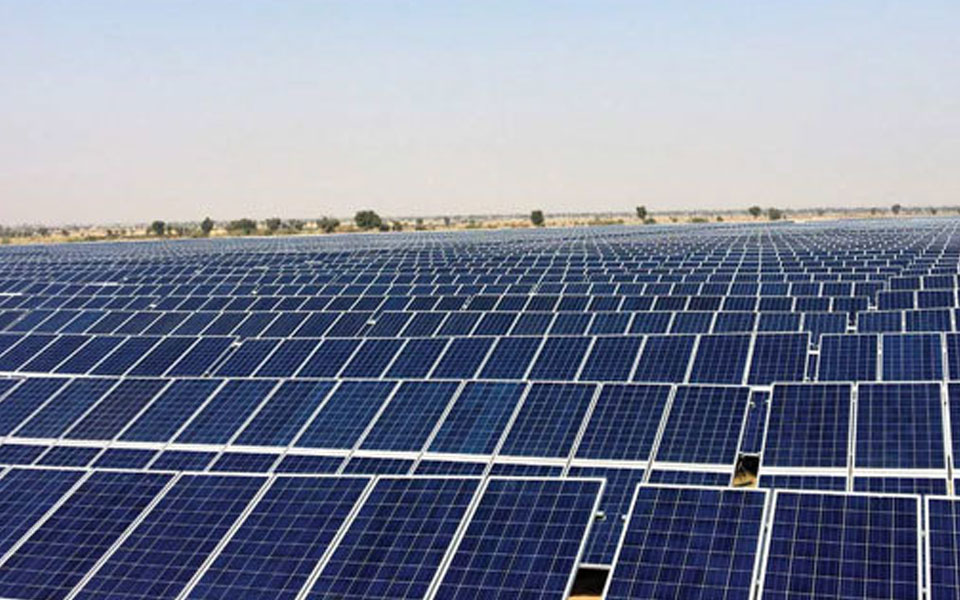
New Delhi, July 24 : Karnataka is the new national leader in renewable energy generation, US-based Institute for Energy Economics and Financial Analysis (IEEFA) said on Tuesday. It has overtaken Tamil Nadu that had long been India's top renewables market.

With a population of more than 60 million, Karnataka has a total of 12.3 gigawatts (GW) of renewable capacity installed till March, after having added five GW in 2017-18 alone, it said.

IEEFA's report "Karnataka's Electricity Sector Transformation", talks about a trend driven by state and national energy policies that have encouraged less reliance on imported energy and how declining costs have helped build momentum around the uptake of renewables, especially solar.

"Tamil Nadu until this year was the frontrunner in the race to renewables and still leads in wind energy capacity," IEEFA's Director of Energy Finance Studies Tim Buckley told IANS.

The report notes that solar tenders in Karnataka have seen near record low bids of Rs 2.82-3.06 per kilowatt-hour (kWh) ($41-44/MWh), materially less than the average Rs 3-5/kWh for domestic thermal power tariffs and the Rs 5-6/kWh tariffs required for imported coal fired power.

And it points out that in June, Karnataka introduced reverse auctions for wind-powered electricity, with an upper cap of Rs 3.45/kWh, following the success of similar auctions in Gujarat and Tamil Nadu in 2017, when tariffs fell by as much as 50 per cent to as low as Rs 2.43/kWh.

In a "likely pathway" for Karnataka, based on IEEFA modelling through 2028, the report says Karnataka is set to move from being a net importer of electricity to having a net balance, and it could become a net exporter, a possibility currently constrained only by insufficient interstate grid capacity.

Renewables will account for 23 GW or 60 per cent of capacity (43 per cent of generation), up from 12.3 GW or 46 per cent in 2017/18.

Hydro, which accounts for 3.6 GW or 13 per cent of current capacity, continues to provide much-needed dispatchable energy to balance the state's growing, but variable wind and solar.

Thermal power's market share, currently at 10 GW (38 per cent of capacity and 49 per cent of generation), will remain steady, but "needs to better incorporate more flexible, peaking capacity".

IEEFA conducts research and analyses on financial and economic issues related to energy and the environment.

Let the Truth be known. If you read VB and like VB, please be a VB Supporter and Help us deliver the Truth to one and all.


Bengaluru (PTI): India is planning to collect samples from the Moon and bring them back to Earth under Chandrayaan-4, while Chandrayaan-5 will involve a heavier lander with a longer mission life, ISRO Chairman V Narayanan said on Wednesday.

He also spoke about ISRO's future missions including the one to study Venus and the other on Mars landing mission. 

"Now we are working on the continuation of the Chandrayaan programme. In Chandrayaan-4, we plan to collect samples and bring them back. Chandrayaan-5 will involve a heavier lander with a longer mission life," he said at the inaugural ceremony of ISRO's fourth edition of the Space Science and Technology Awareness Training (START 2026) programme here. 

He recalled that in Chandrayaan-3, the lander's mission life was only 14 days. 

"In the future mission, we are talking about a life of around 100 days. The rover will also be heavier. Chandrayaan-3 had a rover of about 25 kg, while the future mission will have a rover of about 350 kg," Narayanan said. 

Referring to ISRO's future programmes like the Venus Orbiter Mission, he said, "We have already accomplished the Mars Orbiter Mission, and now we are working on a Mars landing mission."

"These are some of the projects being discussed for government approval. So there is a lot of interest in the science area." 

He noted that under Prime Minister Narendra Modi, the vision of the space programme has been expanded and said, "We are currently working on the Gaganyaan programme and are planning to send our own astronauts into space and bring them back safely, possibly within the next two years." 

"We are also planning to build our own space station by 2035. Additionally, we are working on landing Indians on the Moon and bringing them back safely by 2040. Brainstorming activities have already begun. So there are many activities happening in the space sector. Apart from application-related activities that ensure food security, water security, communication, and safety for citizens, there are many initiatives planned in the science area as well," he added. 

Narayanan noted that India's space programme has accomplished 10 scientific missions so far, including AstroSat, which recently completed a decade in orbit and was still functioning very well.

He also highlighted India's various lunar exploration missions -- Chandrayaan-1, Chandrayaan-2, and Chandrayaan-3 -- saying they led to many scientific discoveries. 

"We are progressing in a big way," he added.

Highlighting the successful Chandrayaan-3 mission in the year 2023, the ISRO chairman said that India became the first country to successfully achieve a soft landing near the south pole of the Moon.

"Not only did we achieve the landing, but many discoveries were made. Around eight minerals were identified, seismic activity was studied, and the thermal profile of the Moon's surface was understood. Electron clouds were also studied. So many discoveries have come from that mission," he added. 

Referring to the launch of Aditya-L1, the ISRO chairman said, "India is the fourth country to successfully place a satellite to study the Sun, and a large amount of data has already come out, and we have released the data as well." 

Emphasising India's Space Vision 2047, he recalled that the country, which started with very humble beginnings, has developed significant capabilities.

"Today, we have the capability to conceive, design, and build our own launch vehicles, as well as conceive, build, and place satellites in orbit. Fifty years ago, we did not have this capability. Today, we can build satellites and the payloads required for them," Narayanan said.

Citing an example, he said that earlier optical cameras used lenses that were only about one inch in diameter. 

"But today, in ISRO, cameras with optics of about 1.7 metres in diameter and almost one foot in thickness are being developed. These optics are being built at the LEOS (Laboratory For Electro Optics Systems) laboratory in Bengaluru for space observation. Many such activities are happening in the space sector," he noted. 

He pointed out that the US, after 1969 and almost after 50-55 years, has again shown interest in landing on the Moon. 

"The Artemis programme is already a very vibrant programme, with many activities going on. An accord was signed in 2023, and India is also a signatory to that accord," he said. 

Speaking about China and Russia leading efforts to build the International Lunar Research Station (ILRS), the ISRO chairman noted, "When we talk about such space stations, one aspect is technology development. The second aspect is the large number of scientific experiments that will take place there. There is also a lot of competition today." 

"There was a time when only government organisations across the world carried out space activities. Today, companies like SpaceX have advanced significantly. In fact, they have overtaken many others in terms of launches," he added. 

He said that the main idea behind programmes like START 2026 is to encourage the next generation of youngsters to develop interest in this field and to build scientific temper so that they can become great leaders in building the nation.