Kashmir economy suffered losses of Rs 15000 crore since August: Trade body
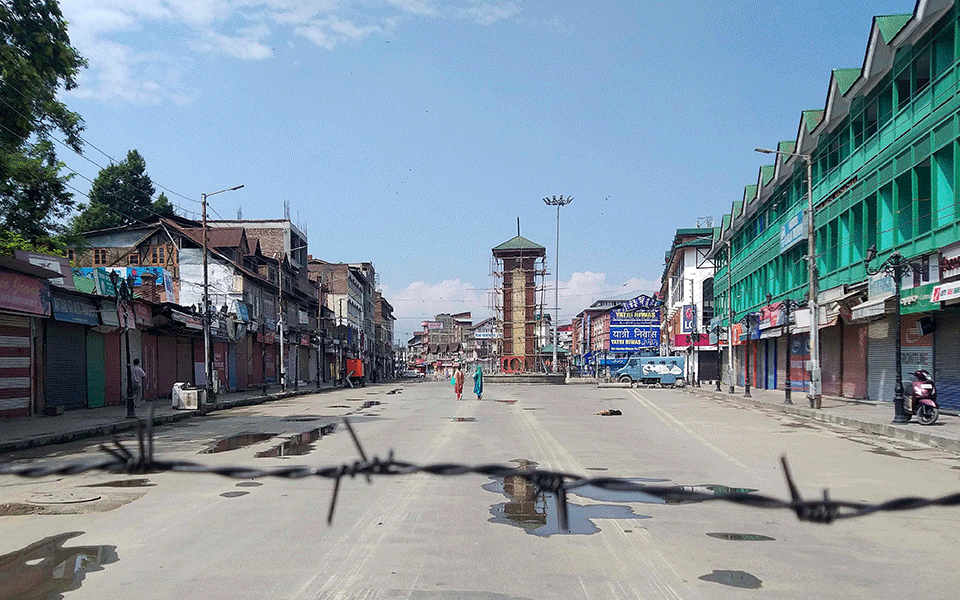
Srinagar: The economy of Kashmir has suffered losses of Rs 15,000 crore since August 5, when the government abrogated Article 370 provisions, a commerce body has claimed, saying that this is just a "conservative estimate".
The Centre had repealed provisions of the article that gave special status to the erstwhile state of Jammu and Kashmir, and bifurcated it into union territories of Ladakh, and Jammu and Kashmir.
"Our conservative estimates put the losses to the Kashmir economy due to the situation after August 5 at Rs 15,000 crore. We will be coming up with comprehensive data about the losses within a week," Kashmir Chamber of Commerce and Industry (KCCI) president Sheikh Ashiq Hussain told PTI.
More than the losses to the economy, job loss due to clampdown on internet services, protests and strikes was more worrying, he said.
The handicraft, tourism and e-commerce sectors were the worst hit by the situation post the Centre's decision, Hussain said.
Though most restrictions have been lifted, the clampdown, which started on August 5, on internet services across all platforms and prepaid mobile phone still remains.
Postpaid cellphones and landlines are working in the Valley. SMS on postpaid phones are shut.
"The handicraft sector alone has witnessed over 50,000 people losing their jobs. The artisans were not getting any fresh orders in the absence of communication facilities.
"Even, the highly skilled artisans have been forced to look for odd jobs to meet their daily needs," he said.
Hussain claimed that the hotel and restaurant industry has seen more than 30,000 people losing their jobs. The e-commerce sector, which includes courier services for purchases made online, has seen 10,000 people losing their jobs, he said.
"The Information Technology industry got some relief after the internet lease lines were restored for this sector but the overall situation of trade in Kashmir is dismal," he said.
In Kashmir, markets open earlier than usual but close down by 1 pm as part of an undeclared protest programme against the stripping of the erstwhile state's special status.
The tourism sector suffered the most as the J-K government issued an advisory to all non-locals, including tourists, to leave the Valley ahead of the August 5 announcement.
Though the advisory was revoked, tourists have by and large stayed away from Kashmir, even though there was early snowfall in Kashmir this November, which is a major attraction.
Let the Truth be known. If you read VB and like VB, please be a VB Supporter and Help us deliver the Truth to one and all.
'Ab kya hoga, ye rab jane...': Tharoor takes dig at failed US-Iran talks in Pakistan
 (3)_vb_24.jpeg)
New Delhi (PTI): Senior Congress leader Shashi Tharoor on Monday took a swipe at the "failed" US-Iran peace talks in Pakistan with an Urdu couplet, saying only god knows now what will happen.
"Ab kya hoga, ye rab jane; Na woh mane, na ye mane (only god knows what will happen now as both sides did not agree)," Tharoor said on X, tagging a post-talks video clip of US Vice President J D Vance, who led the American delegation at the negotiations in Islamabad.
The United States and Iran failed to reach a peace deal at their historic 21-hour talks in Pakistan, leaving the fate of a tenuous two-week ceasefire in doubt, with both sides attempting to hold each other responsible for the collapse of the negotiations.
अब क्या होगा, ये रब जाने
— Shashi Tharoor (@ShashiTharoor) April 13, 2026
ना वो माने, ना ये माने https://t.co/DYrXpa7C8h
Vance said the Iranian side did not accept Washington's terms for ending the war even as the US presented its "final and best offer".
Hours after the talks collapsed, US President Donald Trump said on social media that the negotiations with Tehran failed as "Iran is unwilling to give up its nuclear ambitions".
Trump said the US Navy will actively interdict any vessel in international waters found to have paid tolls to Iran for transiting through the Strait of Hormuz, a critical shipping route that handles roughly 20 per cent of global oil and LNG (Liquefied Natural Gas).
Iranian Parliament Speaker Mohammad Bagher Ghalibaf, the head of the Iranian negotiation team, said it is for the US to decide whether it can "earn our trust or not".
The Iranian foreign ministry, without elaborating, said the US side resorted to "excessive" and "illegal demands".
The failure to reach an agreement has dimmed the prospect of reopening the Strait of Hormuz to stabilise the global energy marke