Kauravas claims: Govt has no role in deciding ISC speakers, says principal scientific advisor

New Delhi, Jan 6: The principal scientific advisor to the government, K VijayRaghavan, has termed as "scientifically untenable" the Andhra University vice chancellor G Nageswara Rao's claims, made at the Indian Science Congress, that the Kauravas were test tube babies.
He also said the government has no role in deciding the speakers or the agenda of the event.
The Indian Science Congress Association (ISCA) does not have a filter and the government "rightly has no role in the matter", he said. "Once a speaker is chosen, there is no censorship on what the person actually speaks."
VijayRaghavan said the chancellor of the Andhra University should file a formal complaint against Vice Chancellor Rao.
"Scientists say what they say, and if they talk nonsense, they will feel the heat from the community. It is indeed unfortunate that a sitting Vice-Chancellor of a great state university, a biologist to boot, says something that is scientifically completely untenable," VijayRaghavan said in a blog.
On Friday, Rao in his presentation at the ISC in Jalandhar, had made several "preposterous" claims: Kauravas were test-tube babies, Dashavtar gave a better logic than the Darwin's Theory of Evolution, Ravan had 24 aircraft and several airports and Ram and Vishnu used guided missiles technology.
Another presenter sought to debunk Albert Einstein's Theory of Relativity.
This was met with a volley of criticism from the scientific community.
"Someone, concerned and well-intentioned, asked, how one (presumably the government) could give a platform to such preposterous talks at the Science Congress. Well, the organisers rightly don't have a filter and the government rightly has no role in the matter," he said.
VijayRaghavan said the ISCA does get some support from the Department of Science and Technology, Ministry of Science and Technology.
The ISCA raises funds for its activities, such as for the holding of the Congress, from other sources, he noted.
"Yet (like the Indian National Science Academy, for example) the ISCA decides the agenda, the venue and selects the speakers. The government has no role whatsoever in these matters.
"The Science Congress has an overall theme each year. There is a wide range of topics that are covered in the talks. A group of scientists, chosen by the ISCA, requests applications to speak and chooses speakers. Once chosen there is no censorship on what the person actually speaks," he said.
Let the Truth be known. If you read VB and like VB, please be a VB Supporter and Help us deliver the Truth to one and all.
Rickelton's ton in vain as SRH beat MI by 6 wickets
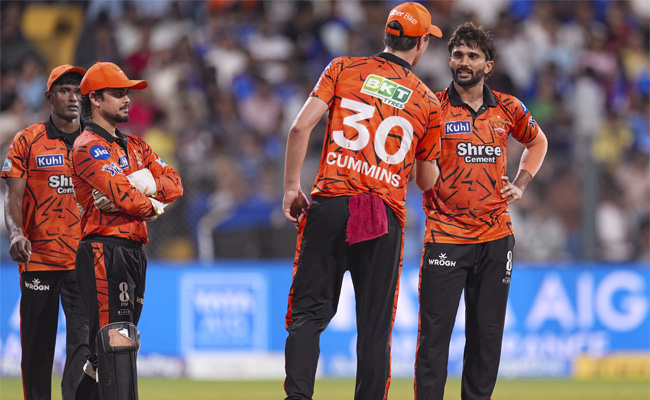
Mumbai (PTI): Ryan Rickelton's whirlwind unbeaten ton was overshadowed by Heinrich Klaasen's unbeaten 65 as Sunrisers Hyderabad defeated Mumbai Indians by six wickets in an IPL match here on Wednesday.
Chasing an imposing 244-run target, Travis Head (76 off 30) and Abhishek Sharma (45 off 24) shared 129 runs for the opening wicket to set the platform for SRH.
Klaasen (65 not out off 30 balls) then displayed his all-round hitting abilities to guide SRH home with the help of Nitish Kumar Reddy (21) and Salil Arora (30 not out off 10) in 18.4 overs.
Earlier, Rickelton's knock powered MI to 243 for five.
MI rode on a 93-run stand between Rickelton (123 not out off 55 balls) and Will Jacks (46 off 22) in 7.1 overs for the opening stand to power the side.
MI skipper Hardik Pandya scored a valuable 31 off 15 balls before being dismissed.
Praful Hinge (2/54), Eshan Malinga (1/29), Sakib Hasan (1/39) and Nitish Kumar Reddy (1/31) were the wicket-takers for SRH.
Brief Scores:
Mumbai Indian: 243 for 5 in 20 overs (Ryan Rickelton 123 not out; Praful Hinge 2/54).
Sunrisers Hyderabad: 249 for 4 in 18.4 overs (Travis Head 76, Heinrich Klaasen 65 not out; AM Ghazanfar 2/51).