KCR to boycott NITI Aayog meeting, says institution useless
Hyderabad, Aug 6: Telangana Chief Minister K Chandrashekar Rao on Saturday told Prime Minister Narendra Modi that he would be boycotting the 7th Governing Council meeting of NITI Aayog scheduled to be held on August 7, as a mark of strong protest against the present 'discriminating' trend of the Centre towards States.
In a letter to Modi, KCR, as Rao is also known, said the country can develop only when States develop. Strong and economically vibrant States alone can make the nation strong, he said.
In view of these facts, I do not find it useful to attend the 7th Governing Council meeting of NITI Aayog scheduled to be held on August 7, 2022 and I am staying away from it as a mark of strong protest against the present trend of Central government to discriminate against the States and not treating them as equal partners in our collective effort to make the nation strong and developed, Rao said in the letter, narrating a host of reasons for the boycott.
Alleging that recent unpleasant happenings have given rise to a realisation that the federal structure is being systematically eroded by some "deliberate actions" by the Centre, Rao said it is needless to say these developments are very much discouraging to "trail-blazing" States like Telangana.
The blatant discrimination against some States even in the legitimate functions assigned to them in the Constitution leaves much to be desired, he said.
He reminded Modi that though in the beginning NITI Aayog had constituted a group of Chief Ministers to give recommendations on developmental issues, it was kept aside and on the contrary the Centre is micromanaging the schemes giving a go-by to State-specific needs which are best left to individual States.
It is not just in case of such schemes but Centre has also turned a Nelson's eye even to the recommendations of NITI Aayog itself... KCR said.
He alleged that though there were recommendations from NITI Aayog for a grant of Rs 5,000 crore to Mission Kakatiya and Central assistance of Rs 19,205 to Mission Bhagiratha, the NDA government ignored them and did not release any money for the schemes. However, the State government has completed both the projects on its own.
These examples are sufficient to say that the institution of NITI Aayog is rendered useless, he said.
He alleged that the Centre had claimed credit for Telangana's achievements as it is one of the States which provides drinking water to every household under the banner of Jal Jeevan Mission, a Central scheme.
He lambasted the Centre for including the borrowings of State PSUs as State government borrowings, saying that it was not only done suddenly but with a clause of retrospective implementation which put brakes on the progress of the States.
I may affirm that Niti Aayog has started with an objective of cooperative federalism, recognising that strong States make a strong nation. But, after seven years of functioning, it is now clear that this (cooperative federalism) was observed more in breach. The Centre's actions show that the initiative has gone astray as States are not included as equal partners in the national developmental agenda, KCR said.
According to him, when the Planning Commission was in place earlier it used to have detailed interactive sessions with the States on the Annual Plan. Now there is neither a Plan nor any involvement of States and NITI Aayog and its meetings serve no constructive purpose.
KCR said as there was no planning and no spirit of cooperative federalism, the country is passing through a most difficult phase with unprecedented problems of falling rupee value, inflation, skyrocketing prices and increasing unemployment coupled with low economic growth.
He said the Centre has become a silent spectator to the problems and is resorting to playing on people's emotions.
According to him, statements from some of the leaders in high positions are disrupting the communal harmony and the social fabric of the nation besides inviting international criticism.
The propensity of the Centre to levy cess as an indirect tax is depriving States of their legitimate share in tax revenues and such unilateral and irresponsible of the Centre without taking into consideration the State's interests have nudged the country away from the development trajectory, he further alleged.
This, I feel is not good for the future of 140 crore Indians, he added.
Let the Truth be known. If you read VB and like VB, please be a VB Supporter and Help us deliver the Truth to one and all.
KMES Institutions shine in SSLC result, continue four-decade legacy of education in rural Karkala
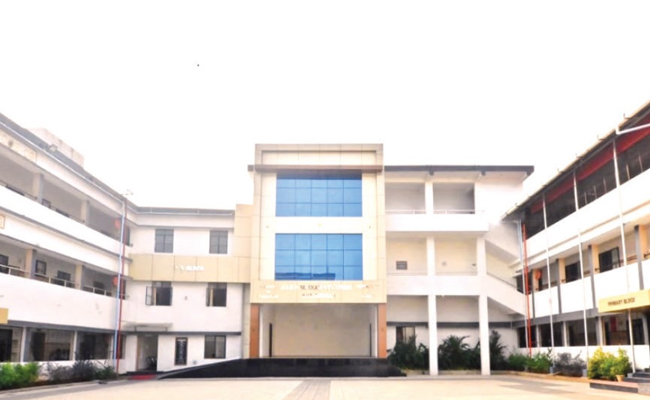
Karkala: KMES Institutions of Education at Kukkundooru in Karkala taluk has recorded outstanding results in the 2025-26 SSLC and PUC examinations, continuing a four-decade educational journey that began with just 22 kindergarten students and no building of its own.
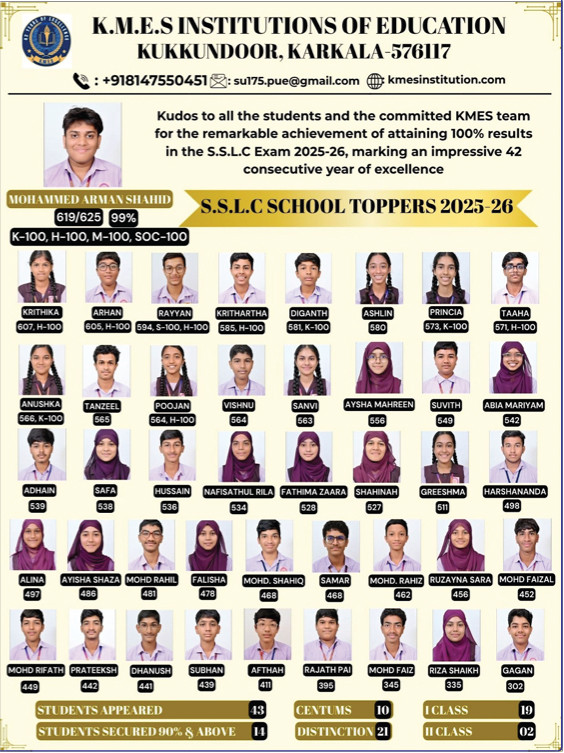
The institution secured a 100 per cent result in the SSLC examinations, with all 43 students passing the examination this year.
Muhammad Arman Shahid emerged as the school topper by scoring 619 marks out of 625, securing 99 per cent and also ranking sixth at the state level. He scored full marks in Kannada, Hindi, Mathematics and Social Science.
Krithika V. Nayak secured the second position in the school with 607 marks and 97.12 per cent, while Arhan stood third with 605 marks and 96.8 per cent.
Out of the 43 students, 21 passed with distinction, 19 secured first class, two students obtained second class and one student passed in third class. Fourteen students scored above 90 per cent.
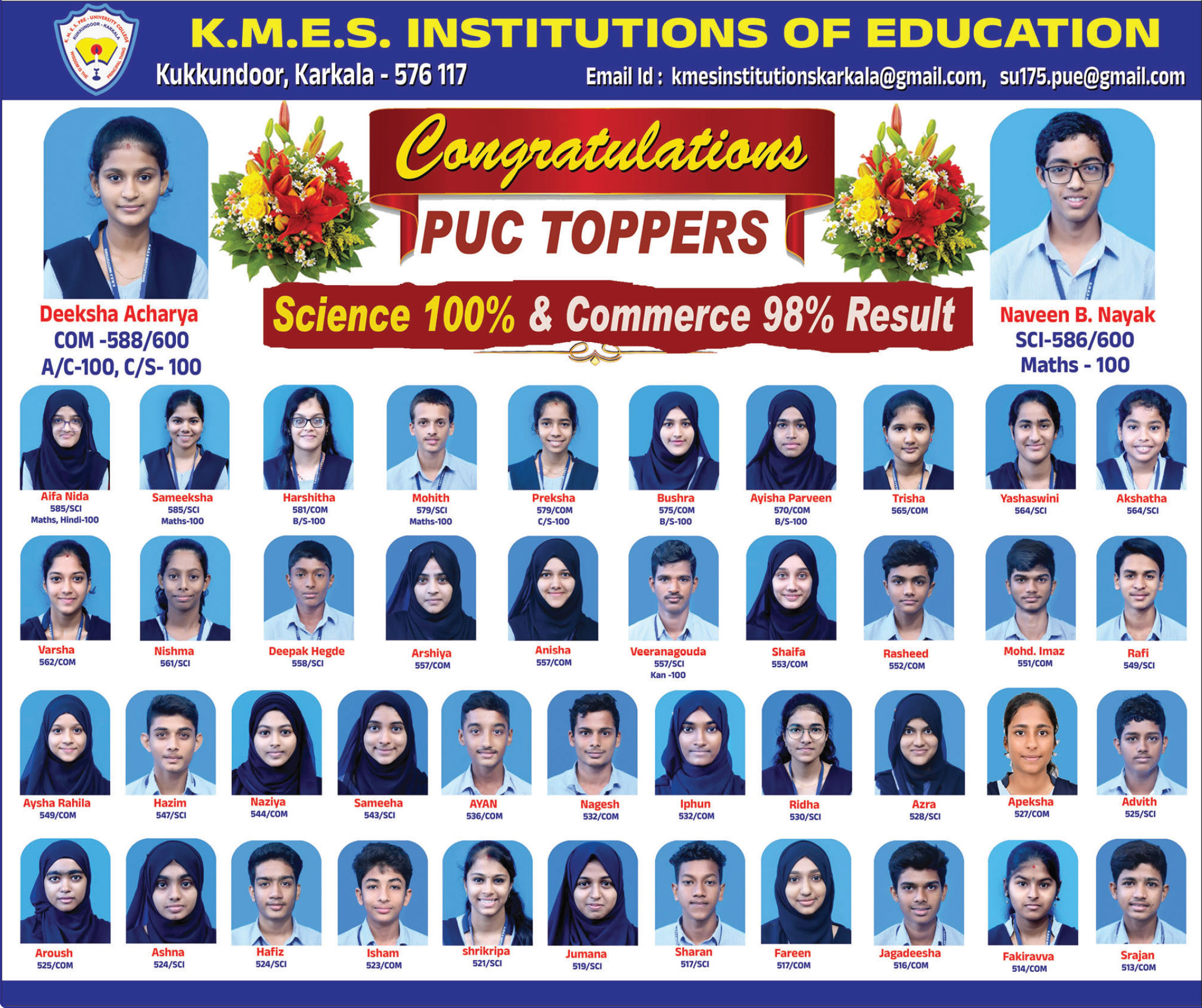
The institution also performed strongly in the PUC examinations. The Science stream recorded a 100 per cent result, with all 44 students passing, while Commerce secured a 98 per cent pass percentage.
Twelve students scored full marks in different subjects, including Mathematics.
In Commerce, Deeksha Acharya topped the college with 588 marks, while Harshitha H. Kini secured the second position with 581 marks.
In Science, Naveen B. Nayak emerged as topper with 586 marks, followed closely by Sameeksha Moily and Aifa Nidha, who both secured 585 marks.
Speaking about the achievement, High School head teacher Shrimati Patkar said the institution has always focused on supporting academically weak students through affordable education and free special classes.
“Our ambition is to provide quality education even to students who struggle in studies. The fees are very low, and free coaching classes are conducted. I have worked here for 28 years and have always found the atmosphere supportive of education,” she said.
Primary School head teacher Lolita Zeena D’Silva appreciated the dedication of the teaching staff and said the school encourages students not only to achieve high marks but also to become role models.
PU College Principal Balakrishna Rao said the institution focuses on value-based education and overall personality development.
“The aim is to help students succeed not only academically but also in cultural activities, sports and leadership. We encourage qualities such as patience, tolerance and discipline,” he said.
Rao also credited the institution’s growth to the support of founders K.S. Mohammed Masood and K.S. Nissar Ahmed, along with President K.S. Imtiaz Ahmed.
Speaking on the occasion, Imtiaz Ahmed said the institution was built on the dream of making quality education accessible to financially backward families in rural areas.
He said the guidance and encouragement of his elder brothers, Mohammed Masood and Nissar Ahmed, along with the contribution of teachers, students and parents, helped transform the institution into a model educational centre.
The KMES Institutions trace their roots back to 1984, when they were founded by senior social activists Haji P.M. Khan, K.S. Nazeer Ahmed and Haji A.S. Rashid Haider.
The institution initially functioned from the Government Urdu School premises as it did not have a building of its own. Classes began with only 22 students in lower kindergarten and two teachers.
Later, under the leadership of K.S. Mohammed Masood and with continuous financial and moral support from non-resident businessman K.S. Nissar Ahmed, the institution gradually expanded.
In 1993, the school shifted to its own building and began conducting classes from LKG to Class 5.
As student admissions increased, Nissar Ahmed personally funded the construction of three additional classrooms to address infrastructure shortages.
The institution’s new school building was completed in 1997, while the PU College building was constructed in 2001.
From humble beginnings in a borrowed building to producing state-level rank holders and consistent academic results, the KMES Institutions have grown into one of the prominent educational centres in the Karkala region.