Kejriwal, urges Modi, to ask Delhi IAS officers, to end 'strike'
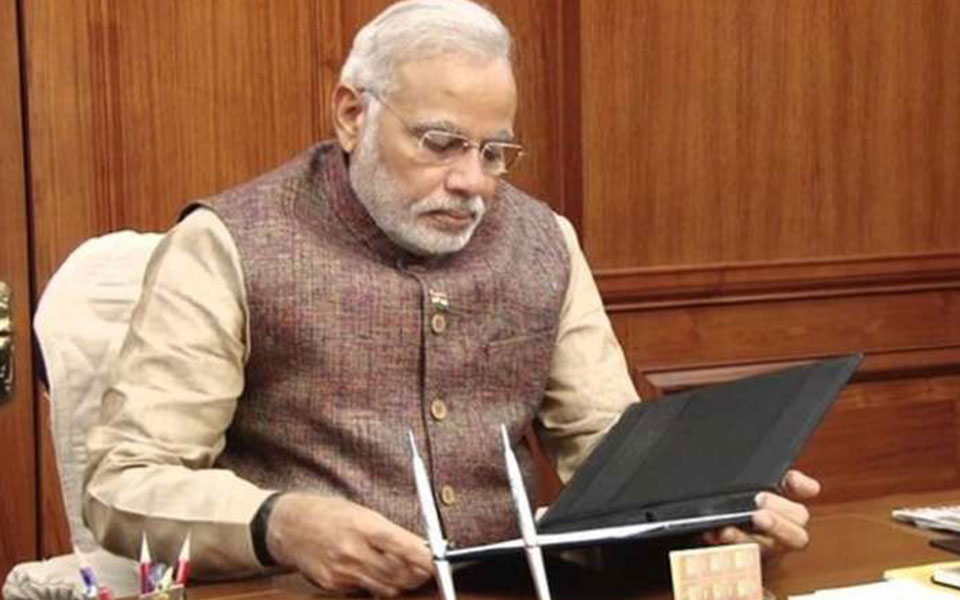
New Delhi, June 15: Delhi Chief Minister Arvind Kejriwal on Friday yet again urged Prime Minister Narendra Modi to direct the IAS officers in the Delhi administration to end their strike before June 17 in order to enable him to attend the NITI Aayog meet.
"The IAS officers in Delhi have been on strike for the last three months and this had badly affected several (administrative) works. In order to get this strike ended, my three ministers and I have been camping in the Lt Governor office for the last five days, but your Lt Governor is not taking any action", Kejriwal wrote in the letter.
The Delhi Chief Minister said since the IAS officers in the Delhi administration are directly under the Central government's control, he had written to the Prime Minister on Thursday also over the issue but got no response from his side.
"The issues to be discussed in the NITI Aayog meet scheduled on June 17 will have to be executed by these IAS officers only... These IAS officers have been barred (by the Centre) to come to meeting called by Delhi Ministers. Tell me, would you be able to do any work if IAS officers stop coming to the meetings called by you?," Kejriwal said.
"I hope the IAS officers' strike would be ended before June 17 so that I can attend the NITI Aayog meet on that day," he added.
Kejriwal, along with Deputy Chief Minister Manish Sisodia and Cabinet ministers Satyendar Jain and Gopal Rai, has been camping in the Raj Niwas -- the official accommodation-cum-office of Lt Governor Anil Baijal -- since Monday evening. They continued for a fifth consecutive day on Friday.
They have been demanding a direction to the IAS officers working in the Delhi administration to end their undeclared strike, action against officers who have struck work and approval to his government's proposal for doorstep delivery of ration to the poor.
Earlier, in a video released from the Lt Governor's office, Kejriwal asked the party workers to launch a campaign similar to the one they did over electricity bills.
"After Sunday, if there is no response on our demands, go door-to-door and bring sign of at least 10 lakh families. We will forward it to the Prime Minister. He is not responding on my demands, so the people of Delhi will ask him," Kejriwal had said.
Let the Truth be known. If you read VB and like VB, please be a VB Supporter and Help us deliver the Truth to one and all.
Bodies of wall collapse victims handed over to families
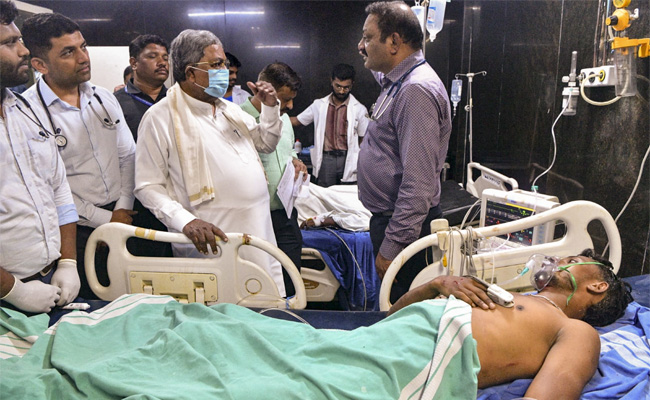
Bengaluru (PTI): Bodies of seven people, who were killed when the compound wall of a hospital collapsed due to heavy rains, were handed over to their families on Thursday after the postmortem, police sources said.
Among those who lost their lives, three were from Bengaluru, two from Kerala and one each from Bihar and Assam.
The victims from Kerala had come here as part of a study tour while the others were street vendors.
ALSO READ: Huge turnout amidst SIR shadow caps ballistic battle for Bengal
The deceased included a child, who is said to be the daughter of a street vendor.
"Last night the autopsy was performed on the bodies and handed over to the families," a police officer said.
The tragedy occured when heavy rains, coupled with strong winds and a hailstorm, battered the area.
The victims took shelter near a wall and were trapped when it suddenly collapsed.
These victims were killed on the spot.
Chief Minister Siddaramaiah has announced a solatium of Rs five lakh to the next to the kin of the victims and instructed officials to provide free treatment to the seven injured.