Kejriwal's arrest big blow to AAP before LS polls
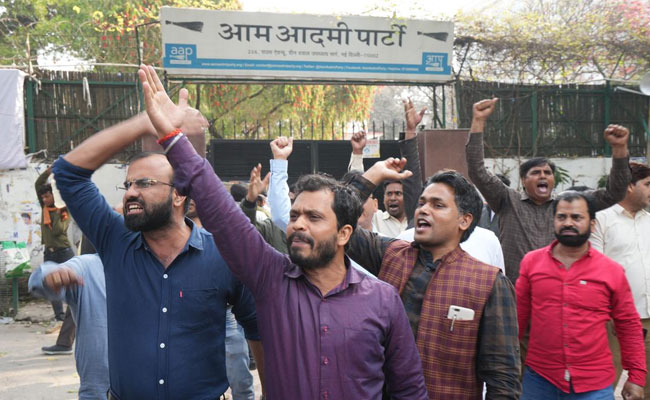
New Delhi (PTI): From leading the 'India Against Corruption' movement to becoming the chief minister of Delhi thrice in a row, Arvind Kejriwal, arrested by the Enforcement Directorate on Thursday, has had a chequered career as a bureaucrat-turned-activist-turned-politician.
Kejriwal's arrest comes at a time when his Aam Aadmi Party (AAP) is making a serious foray into electoral politics through a tie-up with its opposition INDIA bloc partner Congress for the Lok Sabha polls in Delhi, Haryana and Gujarat.
The 55-year-old AAP national convener's arrest may have serious repercussions on the poll fortunes of the party since he has been at the centre of its plans and strategy for the Lok Sabha election.
In his absence, the party stares at uncertainty as many of its other senior leaders are either in jail or in political obscurity.
His trusted aides - Sanjay Singh and Manish Sisodia - are in prison in connection with the excise policy case, while another trusted aide Satyendar Jain is in jail in a separate money laundering case.
An IIT graduate, Kejriwal first led AAP to form the government in Delhi in 2013 with outside support from the Congress. He faced off with former Delhi chief minister Sheila Dikshit in the New Delhi constituency and defeated her by a margin of 22,000 votes in his poll debut.
But the Aam Aadmi Party-Congress government lasted only 49 days as Kejriwal resigned since he was unable to pass the Jan Lokpal Bill in the Delhi Assembly.
Buoyed by the party's electoral gains in its first-ever elections in Delhi, Kejriwal announced his decision to face off with the BJP's Narendra Modi in the 2014 Lok Sabha elections from Varanasi, only to face a crushing defeat.
The next year, Kejriwal led AAP to victory on 67 seats in the national capital, restricting the BJP, which was riding the Modi wave, to only three seats while the Congress drew a blank.
In the run-up to the 2015 Assembly polls, he had constantly apologised for his actions during the 49-day tenure in 2013 and promised not to quit again.
Emerging from the anti-corruption movement of 2011, AAP was founded in the national capital by Kejriwal and his closest associates on Gandhi Jayanti (October 2) the next year.
Within a short span of 12 years, Kejriwal has single-handedly led AAP's rise as the third largest national party of the country, following the BJP and the Congress, having its footprints not only in Delhi and Punjab but also in faraway Gujarat and Goa.
Kejriwal, who was challenged by politicians during his 'India Against Corruption' days to take a plunge into active politics to taste realpolitik, managed to keep issues like health, education, water and electricity supply as the core of his politics and governance, even as his detractors slammed him for giving up on his promise for Lokpal.
Kejriwal, who rose to prominence as an activist riding on the widespread public anger over big-ticket corruption charges on the then Congress-led UPA regime in 2011, still maintains the streak, slamming politicians over the dilapidated condition of health and education in the country.
In his over a decade-long political journey, Kejriwal has shown a variety of moves, be it joining the INDIA bloc of opposition parties, whose leaders he earlier slammed over corruption issues, or adopting a "soft Hindutva" approach exemplified by his free pilgrimage scheme and the recent chanting of "Jai Sri Ram" slogans in the Delhi Assembly.
Once he had demanded to put photos of Ganesha and Lakshmi on currency notes for the economic prosperity of the country.
AAP's claim of pursuing corruption-free governance and alternative politics receives a big dent as Kejriwal goes to jail in connection with the liquor scam case.
While defending Sisodia, Singh and Satyendar Jain, Kejriwal used to call corruption "treason" and assert that AAP follows the path shown by Bhagat Singh.
The arrest of Kejriwal in a corruption case is indeed a big departure from his earlier persona as an AAP leader holding a 14-day fast in 2013 to put pressure on the then Sheila Dikshit government for action over "inflated" water and electricity bills.
Having positioned himself among the top politicians in the country, Kejriwal has come a long way in a relatively short span of his political journey that began as a thin, bespectacled, muffler-clad leader of a fledgling party around 2014-15 that earned him the "mufflerman" nickname.
Let the Truth be known. If you read VB and like VB, please be a VB Supporter and Help us deliver the Truth to one and all.
Justice must be seen to be done: Kejriwal on refusal to appear in excise case before HC judge
New Delhi (PTI): Aam Aadmi Party chief Arvind Kejriwal has written to Delhi High Court Justice Swarana Kanta Sharma, saying he will not appear in the excise case personally or through a lawyer before her, the party said on Monday.
Pointing to a "grave miscarriage of justice", Kejriwal, in a four-page letter, said he has "serious and unreconciled" concerns regarding the matter.
"I have decided that I shall not participate in the further proceedings in this matter, either in person or through counsel. I do not take this step lightly," Kejriwal added.
In his letter, Kejriwal further said that "justice must not only be done, but must also be seen to be done".
"The principle that justice must not only be done, but must also be seen to be done, is among the most sacred assurances that a court gives to a citizen in a democracy," he said.
The assurance cannot be dishonoured by asking the citizen to ignore what "anyone can plainly see" in a case like this, he added in the letter.
The letter also invoked the principles of Satyagraha and the teachings of Mahatma Gandhi, with Kejriwal saying that his intent is "strengthening of judiciary and prevent its weakening".
He added that he has given the authority an opportunity to consider and correct what he perceived to be a grave miscarriage of justice.
His earlier plea seeking the recusal of Justice Sharma, which was rejected on April 20, was interpreted as a personal attack, the AAP chief claimed.
"After the said judgment, I am left with the painful and inescapable impression that what I had urged as a lawful plea of apprehension was received and answered as a personal attack upon Your Ladyship and as an assault on the institution itself.
"Those are not, with respect, answers to the case I had brought. They show me that my plea of apprehension has been judicially understood as a personal and institutional affront," he said in the letter.
The letter further noted the leader's belief that it was now "impossible to receive an impartial hearing" in Justice Sharma's court.
Kejriwal also reiterated two grounds cited earlier in his recusal plea.
"First, the issue of Your Ladyship's repeated public association with the RSS's legal front, the Akhil Bharatiya Adhivakta Parishad (ABAP) -- an organisation belonging to the ideological ecosystem of the ruling dispensation," he wrote, further pointing out that Justice Sharma's children "are professionally engaged on multiple advocates' panels of the Union government which happens to be the opposite party in this case".
Reflecting on his personal experience during the proceedings, the former Delhi chief minister expressed concern over the broader implications of his case on public trust in the judiciary, while he said he maintains respect for the institution.
ALSO READ: ED raids in case against former Punjab Police DIG Bhullar, linked entities
"When I appeared before Your Ladyship to argue my case, the question in my heart was simple: Will I get justice? Today, with the deepest respect, I must say that the same question has become graver and deeper in my conscience," he said.
This case has now become a matter of widespread public discussion. It is being discussed not merely in legal and political circles, but in homes across the country, the letter read.
Addressing potential criticism, Kejriwal clarified that his remarks should not be interpreted as opposition to the judiciary.
"As I write this, I am also cognisant of the fact that some might portray me as someone 'against' the judiciary. But how can that ever be the case when I have personally received relief from the judiciary, including orders of bail and the present discharge?
"Today, I walk free because of the judiciary. Let there exist no figment of imagination that my present stand is against the institution," he asserted.
Kejriwal further said his respect for the judiciary "remains intact" and he has "unwavering faith" in the Constitution of India.
"My objection is not to the institution of the High Court or the larger judicial system, but only to the continuance of this matter before Your Ladyship (Sharma) under a cloud of grave and unresolved questions and circumstances that have generated grave public doubt in your ability to dispense impartial justice," Kejriwal further wrote in the letter.
He also clarified that his "personal inability" is confined to just this matter.
"I shall continue to appear in matters where these serious and unreconciled concerns do not arise, including matters in which the solicitor general does not appear and matters unconnected with the Union government, the BJP or the RSS," the letter added.
He further said he has made the decision by listening to the voice of his conscience and that he is prepared to bear the consequences.
"I may prejudice my own legal interests. I understand that I may lose the opportunity to advance submissions before this Hon'ble Court and that adverse consequences in law may follow. I am prepared to bear those consequences," the AAP chief said.
He added that he will reserve the right to approach the Supreme Court to appeal against Justice Sharma's decision.