Kerala becomes first state to mandate robotics education for all class 10 students
Thiruvananthapuram, May 18 (PTI): In a pioneering initiative, Kerala has emerged as the first state in the country to make robotics education mandatory for all 4.3 lakh students of class 10, starting from the upcoming academic year on June 2.
The integration of robotics into the tenth-grade ICT textbook, specifically the sixth chapter titled "The World of Robots" in the first volume, will empower students to explore fundamental robotics concepts through engaging activities, an official statement said on Sunday.
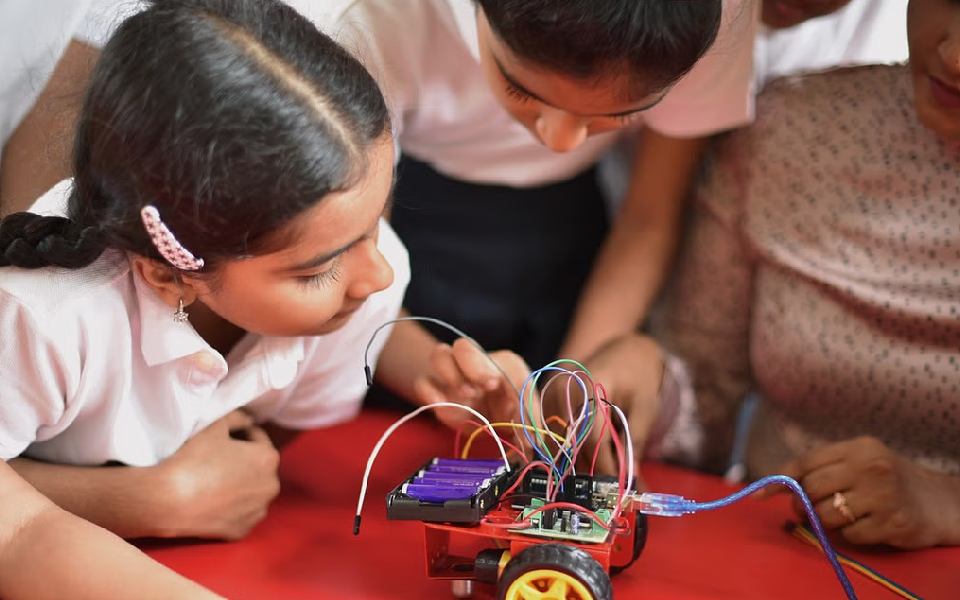
These include circuit construction, utilising sensors and actuators, and controlling electronic devices using computer programming, K Anvar Sadath, CEO of KITE and Chairman of the ICT Textbook Committee, said in a statement.
KITE is the technical arm of the General Education Department of the Kerala government.
It has already distributed 29,000 robotic kits to high schools across the state to ensure the effective implementation of this curriculum.
"This ambitious initiative builds upon Kerala's prior success in making Artificial Intelligence (AI) learning accessible to all seventh-grade students, another national first achieved in the previous academic year," Sadath said.
Demonstrating a continued commitment to future-ready skills, AI learning has now been incorporated into the ICT textbooks for grades 8, 9, and 10 as well.
The practical experience gained from the robotics curriculum piloted for Little KITEs (Kerala's IT club for students) has been instrumental in shaping this comprehensive rollout for all class 10 students, the statement further said.
The initial hands-on activity in the textbook challenges students to utilise components from the provided robotic kits – such as Arduino breadboards, IR sensors, servo motors, and jumper wires – to construct an automated sanitiser dispenser that activates upon detecting a hand, it said.
Progressing further, students will also delve into creating AI-powered smart home automation systems, including face-recognition-enabled smart doors.
To facilitate this, they will utilize the 'Face Detection Built-in Model' within the Pictoblocks software's programming IDE, leveraging webcams on laptops and Arduino kits supplied by KITE to program door-opening mechanisms.
KITE's innovative robotics learning approach is designed to equip students with the skills to address a wide range of practical problems through cutting-edge technologies.
KITE has already conducted the first phase of training on the new tenth-grade ICT textbook for 9,924 teachers.
Sadath said dedicated robotics training for teachers will be organised in July.
Furthermore, KITE will ensure the availability of additional robotic kits, extending support to unaided schools following the state syllabus that may require them.
The ICT textbook is being provided to all students in Malayalam, English, Tamil, and Kannada mediums, the official added in the statement.
Let the Truth be known. If you read VB and like VB, please be a VB Supporter and Help us deliver the Truth to one and all.
Cong performed better in Kerala, anti-incumbency trends influenced WB, TN: CM Siddaramaiah
Bengaluru (PTI): Karnataka Chief Minister Siddaramaiah on Monday said the Congress had largely met or exceeded expectations in several States, even as results in some regions reflected shifting voter sentiments.
Speaking to reporters in Bengaluru, he said the party accepted the mandate in Assam while performing better than anticipated in Kerala.
He also pointed to possible anti-incumbency trends influencing outcomes in West Bengal and Tamil Nadu.
“In Assam, we got the expected result, and we accept the people’s mandate. In Kerala, we have won more seats than expected. We anticipated around 76 to 80, but we have gone up to around 95,” Siddaramaiah said.
In West Bengal and Tamil Nadu, there may have been an anti-incumbency trend, and that could have influenced the results, he added.
Siddaramaiah also extended his congratulations to a new political entrant in Tamil Nadu, noting the emergence of a different electoral dynamic in the State.
“I congratulate the new entrant who has achieved success there,” he added.
Deputy Chief Minister D K Shivakumar said electoral outcomes in some States had diverged from the party’s internal assessments, reflecting evolving voter expectations.
“We expected a certain trend, but the results have been different. Political reading was wrong in some places,” he said.
“People were looking for change in some States, and that has been reflected in the results,” Shivakumar, who is also the Congress Karnataka unit president, said.
Referring to Kerala, he said the Congress-led alliance had benefited from public sentiment.
“There was already an expectation based on local body elections, and people had shown confidence in us. That has translated into a strong result,” the Deputy Chief Minister said.
On Tamil Nadu, he acknowledged that the scale of political shift had come as a surprise.
“We expected to secure around 30 to 40 per cent of the vote share, but such a major shift was not anticipated. It shows that voter expectations were different,” he said.
Shivakumar added that electoral outcomes underscored the need for better political assessment in future.
“We have to understand these changes carefully. Political reading cannot go wrong like this,” he said.