Kerala cabinet clears draft bill to allow killing of dangerous wild animals
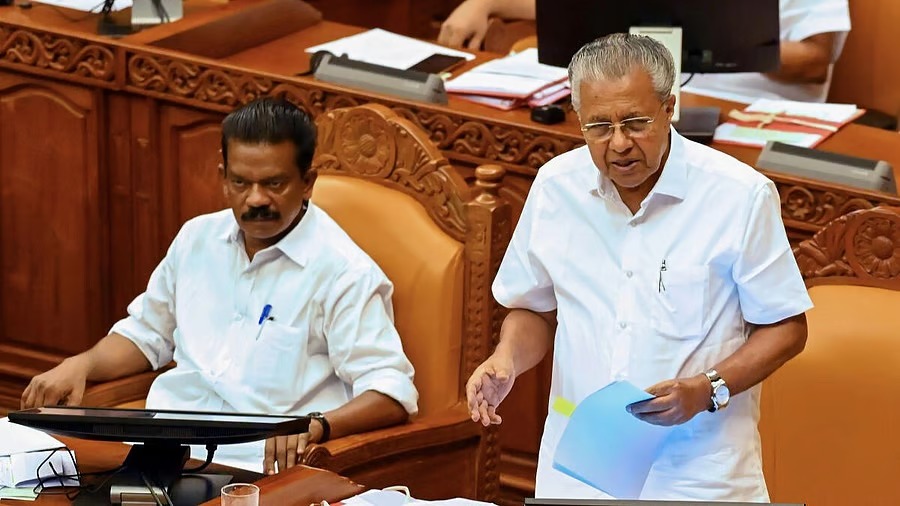
Thiruvananthapuram (PTI): The Kerala government on Saturday approved a draft bill to amend the Wildlife Protection Act with the objective of reducing the increasing human-animal conflicts in the state.
A special cabinet meeting, chaired by Chief Minister Pinarayi Vijayan, gave a nod to the draft legislation that empowers the Chief Wildlife Warden to order the immediate killing of any wild animal that enters an inhabited area and attacks and injures a person, official sources said.
This is the first time that a state has brought such an amendment to the central law, a CMO statement said.
"The draft of the Wildlife Protection (Amendment) Bill, 2025 has been approved by the Cabinet. The bill seeks to amend the central Wildlife (Protection) Act. This is the first time in India that a state is bringing such an amendment to a central law," it said.
State Forest Minister A K Saseendran later said the provisions in the Bill help to avoid impractical and time-consuming procedures in the central law and in the standard operating procedures issued by the union government.
However, the minister said that there is no legal obstacle to protecting those wildlife species that need to be protected, as per the draft bill.
If someone is seriously injured in a wildlife attack and the matter is reported to the chief wildlife warden, he can take necessary action, including killing the wild animal, without wasting time on other procedures, the minister said, quoting the provisions in the draft bill.
At present, central law has the authority to declare any wild animal in Schedule II as a vermin if its numbers are found to have increased uncontrollably, Saseendran said.
A provision has been added to the present draft bill to give this authority to the state government, he explained.
Once declared as a vermin, anyone can kill that particular wild animal in any way they want, Saseendran further explained the provisions of the draft bill.
There is no obstacle to eating its meat as well, the minister added.
The Kerala cabinet cleared the draft bill to amend the Wildlife (Protection) Act months after CM Vijayan called for amending the central law citing challenges faced by the state government in dealing with instances of wild animals encroaching into human habitats.
He had said that even in emergency situations, the central laws pose a major obstacle to dealing with encroaching wild animals.
The CM had also said that the state government places paramount importance on safeguarding both human lives and preventing conflicts with wildlife.
The state has been witnessing increasing instances of human-animal conflicts in recent days.
The bill also assumes political significance in view of upcoming local body and Assembly elections as a permanent solution to address the menace that has been a long-pending demand of high range people in the state.
Let the Truth be known. If you read VB and like VB, please be a VB Supporter and Help us deliver the Truth to one and all.
AI, IndiGo, SpiceJet seek ATF price relief; say airline industry on verge of 'stopping operations'

Mumbai (PTI): Air India, IndiGo and SpiceJet have told the government that the country's airline industry is under extreme stress and on the verge of "stopping operations", as they sought revision in ATF pricing and financial support.
The West Asia turmoil has pushed up oil prices, and airspace restrictions have increased airlines' operating costs, especially on long-haul routes. Aviation Turbine Fuel (ATF) accounts for around 40 per cent of a carrier's operational expenses.
Against this backdrop, the Federation of Indian Airlines (FIA) has written to the civil aviation ministry, seeking steps to extend the same fuel pricing mechanism uniformly across both domestic and international operations as was done in the past with the establishment of the crack band.
ALSO READ: Tharoor junks Rijiju's claim that he agreed Cong is 'anti-women'; hails his party
With an unprecedented rise in jet fuel prices and exorbitant crack/differential between crude and ATF, the federation said the operation of airlines is being challenged in totality.
"... any ad hoc pricing (domestic vs international) and/or irrational increase in the price of ATF will result in unsurmountable losses for airlines and will lead to grounding of aircraft, resulting in cancellation of flights," the federation, which represents Air India, IndiGo and SpiceJet, said.
"In order to survive, sustain and continue operation, we request your urgent intervention for immediate and meaningful financial support to tide over the current situation," it said in a letter on April 26.
Also, the airlines have sought temporary deferment of excise duty on ATF, which is at 11 per cent.
"With the abnormal increase in ATF prices from the pre-crisis period, adding rupee depreciation to the increased prices, the 11 per cent excise duty also increases manifold for the airlines and adds to the ATF price as a big impact on airlines," they said.
Last month, the government limited the hike in ATF price to Rs 15 per litre for domestic operations, but for international operations, the price rose by Rs 73 per litre.
The airlines said the situation has practically made international operations, along with domestic operations, completely unviable and resulted in significant losses for the aviation sector in April.
Seeking urgent intervention on the current ATF ad hoc pricing, FIA said the current situation is creating a severe imbalance in domestic and international operations and rendering airline networks unviable and unsustainable.
"The airline industry in India is under extreme stress and is on the verge of closing down or of stopping its operations."
The federation has pitched for a transparent pricing framework under the crack band mechanism (USD 12–22/BBL) that was implemented in October 2022, saying there was a fair and reasonable margin for Oil Marketing Companies (OMCs).
According to FIA, the country's largest aviation hub Delhi has the second-highest value-added tax (VAT) of 25 per cent on jet fuel, while the highest rate is 29 per cent levied in Tamil Nadu.
"The other major aviation cities, viz. Mumbai, Bangalore, Hyderabad, and Kolkata range between 16 per cent and 20 per cent. These 6 cities cover more than 50 per cent of airlines' operations within India," the federation said.