Kerala CM Pinarayi Vijayan rings opening bell at London Stock Exchange as KIIFB lists masala bonds
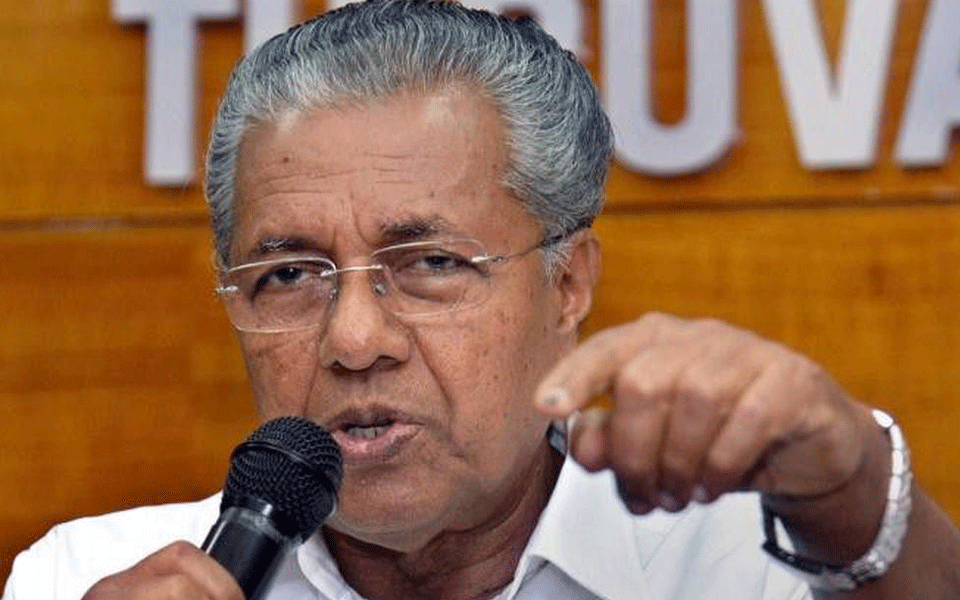
Thiruvananthapuram: Kerala Chief Minister Pinarayi Vijayan rang the opening bell at the London Stock Exchange (LSE) Friday to mark the listing of masala bonds sold by Kerala Infrastructure Investment Fund Board (KIIFB), according to an official statement.
KIIFB, a state government agency, had raised Rs 2,150 crore through its debut masala bond issue. KIIFB plans to raise Rs 5,000 crore through masala bonds to fund large and critical infrastructure projects in Kerala.
Indian Rupee denominated overseas bonds are popularly known as masala bonds.
"This was not only the first-ever offshore capital market issuance from a state-level entity from India, but also the largest dual currency issue by a sub-sovereign backed entity from the entire emerging markets and Asia," the KIIFB had said.
The transaction was priced on March 26, 2019 and saw strong participation from a wide spectrum of investors which included asset managers, insurance companies, pension funds, banks as well as private wealth managers, it had said in the statement.
"With a view to establishing its credit profile and market standing, KIIFB had undertaken a detailed rating exercise through two international credit rating agencies - Standard and Poor's and Fitch Ratings," the state agency had said in a statement.
The masala bond market till date had seen issuance only from large Indian corporates and public institutions such as National Highways Authority of India (NHAI) and NTPC which are all rated AAA in the domestic market.
Vijayan, who is on a 13-day trip to Europe from May 8, has participated in various programmes, including the United Nations (UN) World Reconstruction Conference in Geneva, Switzerland.
The 2018 Kerala flood, which ravaged the state and claimed 483 lives, was among the major disasters reported globally last year, including the California wildfire and the floods in Japan.
The Post Disaster Needs Assessment (PDNA) report prepared by a UN team said Kerala would need Rs 31,000 crore for rebuilding.
Let the Truth be known. If you read VB and like VB, please be a VB Supporter and Help us deliver the Truth to one and all.
UP man gets life term for electrocuting mentally challenged wife to death in Bareilly
Bareilly (UP) (PTI): A local court here has sentenced a man to life imprisonment for murdering his mentally challenged wife by repeatedly electrocuting her while she was tied to a cot, lawyers said on Thursday.
Additional district government counsel Harendra Singh Rathore said Additional Sessions Judge Avinash Kumar Singh on Wednesday convicted Vinod Kumar (45) for killing his wife, Satyavati, in Chaina village of Bareilly district and imposed a fine of Rs 15,000 on him.
According to the prosecution, he was allegedly frustrated with his wife Satyavati's mental illness and often assaulted her.
Rathore said the prosecution examined nine witnesses to establish the charges against him.
As per court records, on the night of May 1-2, 2022, when Satyavati was asleep, Vinod tied her hands and legs to a cot using ropes and then connected an aluminium cable to an electric board to repeatedly administer electric shocks to her.
"She writhed in pain, but the accused continued to electrocute her until she died," the prosecution said.
The court observed that the murder was carried out in an inhuman manner.
After committing the crime, the accused threw the rope and cable on the roof and left for work at a brick kiln around 2 am to create a false alibi.
He later tried to mislead the police and the victim's family by claiming that Satyavati, whose mental condition was unstable, had accidentally died by suicide after grabbing a live electric wire.
However, the victim's brother, Sanjeev, a resident of Shahjahanpur district, suspected foul play and lodged an FIR under sections 498A (husband subjecting wife to cruelty) and 302 (murder) of the Indian Penal Code at Nawabganj police station.
During the trial, the prosecution relied on the post-mortem report prepared by Dr Faraz Anwar, who stated that multiple electrocution marks found on different parts of the victim's body could not have been self-inflicted.
The police also recovered the rope and electric wire used in the crime on the accused's identification, officials said.