Kerala college students break taboo surrounding sex education

Thiruvananthapuram (PTI): Why is consent so important in sex, asked Nirmal, a second year BA student at a prominent college in Kerala during a sexuality education programme held on the campus.
The 19-year-old wanted to know if there is anything wrong in being honest about his sexual feelings towards a girl on the campus.
"If I have feelings towards a girl, why should I be ashamed about expressing it?" asked the teenager, matter-of-factly.
At a time when talking openly about sex is still considered taboo, around 100 students at the famous University College Thiruvananthapuram, sharing seats with the opposite sex, showed that talking about sex was as much a part of their well-being as much as their right.
The event was organised by the National Service Scheme (NSS) of the college in association with Vvox, a sexual health platform backed by Harvard-trained and ASSECT-certified sexologists from India and the United States. ASSECT is the American Society of Sex Educators, Counselors and Therapists, which is a body that certifies and provides training to doctors.
The session comes little over a week after the Kerala High Court observed that boys should not touch a girl or a woman without her explicit consent.
The highlight of the event held here on Saturday was high participation of female students. Some of the topics discussed at the two-and-a-half-hour long session included, masturbation, virginity, pornography and the importance of eating right in sexual health.
Responding to the teenager's query on consent, Sangeeth Sebastian, sexuality educator and founder of Vvox, said it is important to avoid any unpleasant situations by ensuring that the other person is comfortable with his sexual advances in the first place.
"Whether your feelings will make someone else uncomfortable or not, is something which you cannot control," said Sebastian.
Sebastian said Vvox in association with Pixstory, a hate speech fighting social media platform, Kerala House, a Thiruvananthapuram-based restaurant and Kanal, a gender sensitisation platform, is on a mission to provide medically accurate, scientific and reality-based sexuality education in campuses across the state.
According to Thapasaya M, a final year BA Political Science student, the session helped them in clarifying a lot of myths and misconceptions about sex, especially those relating to masturbation and virginity.
"Sex is not a dirty word, but an integral part of an individual's healthy living," Thapasya told PTI.
Her view was also shared by Maya, a second year Geology student, who felt the session connected well with the current generation. "I never had sex education in my school. Today, I learned that there is nothing to be ashamed about sex. It's something that should be understood with responsibility and respect," she said.
Sheeba S, assistant professor, Zoology and NSS programme officer, said internet porn has become the de facto sex education for most youngsters.
"Learning about sex from porn can give you distorted and exaggerated ideas about sex, which is why providing the younger generation with medically accurate sexuality education is so important," Sheeba told PTI.
Titled 'Eat, Play, Love, responsibly', the session explored the link between food and fitness on sexual health, through interactive sessions, Powerpoint presentations and contests.
"Nearly 80 per cent of sexual difficulties can be addressed easily without any medication or medical intervention, if you have just the right information," said Sebastian.
"And that's what we are providing through our campaign. Our campaign module has been vetted by a team of top doctors from India and the US, including Dr Lawrence I Sank, one of the most cited sex researchers on male sexual dysfunctions in the world," Sebastian further said.
He hoped that in the coming months, the campaign would be expanded to campuses across the state.
Annu K Kunchappan, managing partner, Kerala House restaurant and a campaign partner, talked about how junk food can impact sexual health by clogging the penile arteries.
"Most of us don't realise that the immediate impact of eating junk food is how it can adversely affect our sexual function, even before it can cause heart trouble," she said.
Taking note of the rise in sexual harassment cases in the society, the Kerala High Court had recently observed that the lessons in good behaviour and etiquette must be part of the curriculum at least from the primary school level.
It said boys should understand the phrase "no" means "no" and urged the society to teach them to be selfless and gentle, rather than selfish and entitled.
The court said this while considering a plea challenging the order of the Internal Complaints Committee and the order passed by the Principal of a College in connection with a harassment matter.
It said showing respect and honour towards a woman was not old fashioned, but a virtue for all times.
The session at the University College was also organised at a time when a significant section of Kerala society was up in arms against the Left government's bid to introduce gender-neutral uniforms, mixed seating in schools or changing school timings, as suggested by an expert panel.
Senior Muslim League leader Abdurahiman Randathani had recently alleged that as part of the Left government's gender-neutral initiatives, students were being made to sit together and taught about masturbation and homosexuality.
"Just imagine what will happen if teenagers are made to sit together and taught about masturbation and homosexuality. What will happen to the culture of this land?" the IUML leader had said during a Congress-led United Democratic Front (UDF) protest march against the Left government over various issues in Kannur last month.
The protest had forced the Kerala government to inform the State Assembly that it has not taken any decision on the expert panel's recommendation.
Let the Truth be known. If you read VB and like VB, please be a VB Supporter and Help us deliver the Truth to one and all.
Make Bridesmaid Cards: 3 Creative Ways to Invite Your Best Friends Elegantly
There is something extraordinary about requesting your best buddies to be at your side on the most important day of your life. It is not only an inquiry but also an occasion, one that needs to be both thought-provoking and memorable. Rather than sending out a straightforward message, consider transforming your bridesmaid invites into items that will last a lifetime.
With the help of technology such as Dreamina and its free AI art generator, making lovely and unique bridesmaid cards has never been easier or more inventive. From romantic to quirky, anything is possible when it comes to visuals.
Here, you will find three methods for crafting exquisite bridesmaid cards using clever artificial intelligence software.
Romanticism, powerful declarations, and playfulness: pick your card motif
Before beginning your project, consider the mood you wish to convey via your designs. Your bridesmaid cards can be customized to match your wedding themes or relationships.
Below are some potential styles for inspiration:
- Romantic soft designs
This includes using pastel colors, floral prints, delicate textures, and warm lighting. Such cards tend to be classic and emotionally charged.
- Statement bold invitations
Use strong typographic elements, stark colors, and editorial-style compositions. They tend to stand out and convey modernity.
- Personal and playful styles
Use personal visual gags, illustrated representations of yourself and friends, or themed visuals. They add a touch of humor and individuality.
Regardless of the style you prefer, AI makes creating stunning visuals quick and easy.
Adding personality with AI-based characters
Another interesting way to add some flair to your bridesmaid cards is through personalized character designs. Instead of using stock images, you can generate stylized representations of you and your bridesmaids.
The best tool for this purpose would be a professional-quality AI avatar generator. You could create illustrations of yourself and your friends dressed up for the wedding.
Consider these options:
- A watercolor bride surrounded by bridesmaids in themed dresses
- An editorial-styled illustration of friends posing
- A cartoon character illustration of you and your friends
These visuals will instantly make your invitations appear personalized.
Designing your bridesmaid vibe into your card's unique logo
Every bridesmaid's invitation card conveys an emotion before delivering any message. It is not just paper; it is the visual promise of happiness, fun, and memories made together before the grand day arrives. Hence, personalizing your bridesmaid invitation card with an emblem or a monogram-style logo will instantly transform it from an ordinary piece of paper to a memorable one.
Imagine creating a small but unique identity for your bridal team through your card's design. Whether it is a floral insignia, interlocking initials, or even a line art image, it can serve as your signature touchpoint throughout your wedding invitation cards. In such cases, using Dreamina's AI logo generator can work magically. Rather than taking hours or days to create logos on your own, it helps you develop your signature logo in minutes.
After completing your design creation process, you can include it as your card's header, watermark, or wax seal style imagery.
Exploring artistic textures and handcrafted aesthetics
There is another option for creating unique and elegant bridesmaid cards. In case you decide to play around with artistic texture types, you can use an AI art generator tool. This time you do not need to focus on any prompts but rather create artistic designs.
Some ideas:
- Hand-painted watercolor textures
- Ink sketches and illustrations
- Digital gold-accent paintings
These styles give your bridesmaid cards unique looks while keeping a handmade feel despite being digital creations.
Dreamina: transform the concept into a breathtaking bridesmaid card
And here's where the real magic happens—converting all the above into reality through Dreamina. Here's a guide on designing your bridesmaid cards using Dreamina.
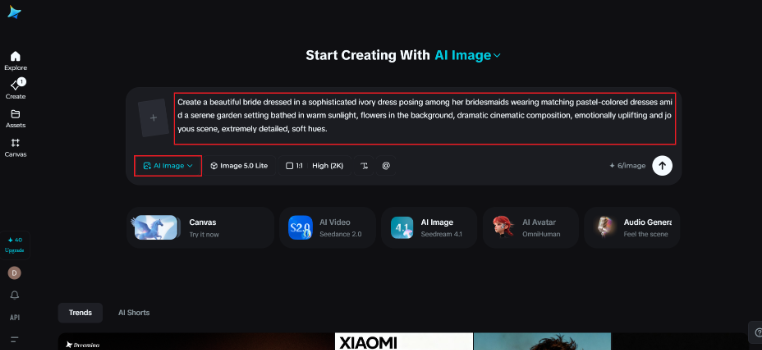
Step 1: Craft a text prompt
Begin by accessing Dreamina and crafting a specific prompt based on your concept. Consider the location, clothing, ambiance, and overall theme of your bridesmaid card.
For instance, your prompt could read: Create a beautiful bride dressed in a sophisticated ivory dress posing among her bridesmaids wearing matching pastel-colored dresses amid a serene garden setting bathed in warm sunlight, flowers in the background, dramatic cinematic composition, emotionally uplifting and joyous scene, extremely detailed, soft hues.
The more vivid your prompt is, the better your results.
Step 2: Fine-tune parameters and create
After crafting your prompt, select the appropriate model for your desired look and adjust the aspect ratio according to your card design.
Choose your desired image size and resolution, like 1k or 2k, to guarantee high-quality rendering. Now simply press the generate button in Dreamina.
Step 3: Edit and download
Once you get your image rendered, customize it according to your preferences by inpainting, expanding, removing, and retouching. When everything meets your satisfaction, simply press the Download button and obtain your final image in form of bridesmaid card.
Small details that will make your bridesmaid cards unique
Every detail counts when creating a wedding design; even the most impressive visuals can be improved through additional minor features like:
- Adding thematic images such as flowers, ribbons, or accessory-related items
- Choosing colors that correspond with one another across cards
- Maintaining balanced spaces throughout the card
- Paying attention to facial expressions and body posture if you choose character-based images
Such small nuances can make a huge difference in your design!
How Dreamina makes the process easy
Creating something that is meaningful can often feel very intimidating, even when you have a lot on your plate during wedding planning. But with Dreamina, all of the work involved becomes a breeze.
With Dreamina, you can:
- Come up with design ideas based on text input
- Test several different styles easily
- Improve visuals without restarting the whole thing from scratch
- Make professional looking designs even without previous experience
It is a way of making something that could have felt challenging much easier.
Transforming a simple idea into an unforgettable one
Choosing your friends to serve as bridesmaids is one of the biggest and most emotional moments in wedding planning. And you need to do it in a way that goes beyond merely writing a message.
Using Dreamina, you get to design an actual invitation that will make those special moments unforgettable. With its various styles ranging from romance to artsy or personalized designs, you can create memories out of your idea.
So take advantage and make your bridesmaid invitations into something unforgettable.