Kerala govt criticises removal of Periodic table, other topics from NCERT class 10 text book

Thiruvananthapuram (PTI): The Kerala government has criticised the removal of chapters on the Periodic Table and challenges to democracy, among other topics from Class 10 textbooks by the NCERT, and said it amounts to challenging democratic and secular values.
The new textbooks with the changes announced by the National Council for Educational Research and Training (NCERT) last year as part of a "rationalisation" exercise have now hit the market. Apart from the Periodic Table and challenges to democracy, contribution of agriculture to the national economy and sustainable management of natural resources were also dropped from Class 10 textbooks.
"The unilateral action of the NCERT to remove the topics under the guise of rationalisation is a challenge to the democratic and secular values of our country. Kerala has already declared that it cannot be accepted, as it challenges the entire existing democratic order in the country," State Education Minister V Sivankutty has said in a statement issued on Friday night.
He said NCERT has taken the approach of removing topics on our father of the nation Mahatma Gandhi, Maulana Azad, and other topics related to the country's common history, the theory of evolution, the periodic table, democratic values and the current challenges faced by the country.
"In order to protect secularism and democracy and to teach the real historic facts and to develop scientific temper, Kerala will guard public education and strengthen it," Sivankutty said.
"Kerala has already announced that we will publish supplementary textbooks incorporating the omitted text sections, upholding the original history enshrining democratic and secular values," he added.
The Left leader said the NCERT, which was set up on the basis of the 2005 National Curriculum Framework (NCF), has been demolishing the very goals of the NCF through the removal of such passages from textbooks.
Even though the Class 10 chemistry textbook drops the entire chapter that introduces students to the Periodic Table, it remains part of the syllabus for Class 11.
Among other deletions made last year in the Class 10 Science textbook were passages on Evolution. Topics that have been struck off the science textbooks include chapters on Fibre and Fabrics in Classes 6, 7 and 8. One deletion that stands out is that of the "Why do we fall ill" chapter from the Class 9 science textbook.
Among the references dropped from the Class 12 history textbook were certain portions on Mahatma Gandhi and how his pursuit of Hindu-Muslim unity "provoked Hindu extremists", and how there was a ban on the RSS.
"Gandhiji's death had a magical effect on communal situation in the country", "Gandhi's pursuit of Hindu-Muslim unity provoked Hindu extremists", and "Organisations like RSS were banned for some time" are among the portions deleted.
The portions referring to the Gujarat riots were also dropped from the Class 11 Sociology textbook, months after the NCERT removed the reference to the 2022 communal violence in two Class 12 textbooks.
Let the Truth be known. If you read VB and like VB, please be a VB Supporter and Help us deliver the Truth to one and all.
Voting underway for local body elections in Gujarat
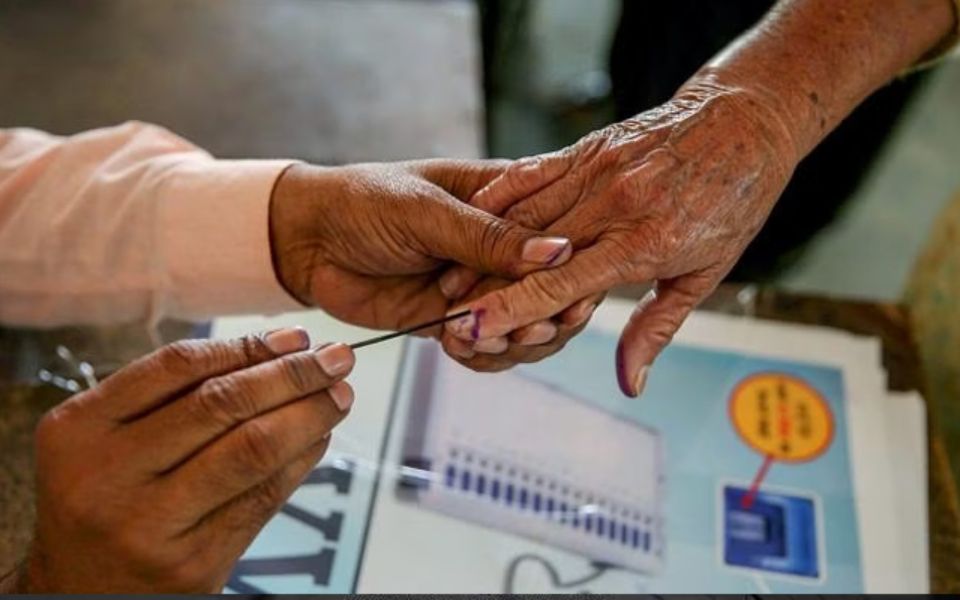
Ahmedabad (PTI): Voting got underway on Sunday morning for elections to several local bodies in Gujarat, including 15 municipal corporations and 84 municipalities.
Polling began at 7 am and will continue till 6 pm, as per the schedule announced by the State Election Commission.
The elections are being held for 15 municipal corporations, including Ahmedabad, Surat, Vadodara and Rajkot, 84 municipalities, 34 district panchayats and 260 taluka panchayats, making it one of the largest electoral exercises in the state.
A total of 9,992 candidates are in the fray, with more than 4.18 crore voters eligible to exercise their franchise.
A three-tier security is in place, aided by CCTV surveillance and deployment of special squads in sensitive areas, police officials said.
The polls are being conducted under revised norms for Other Backward Classes (OBC) reservations, and required extensive delimitation and restructuring of wards in several districts.
The ruling BJP, Opposition Congress and the Aam Aadmi Party (AAP) have emerged as the key players, while All India Majlis-e-Ittehadul Muslimeen (AIMIM) is also contesting in several places.
Among notable candidates are former Gujarat-cadre IPS officer M L Ninama, ex-radio jockey Abha Desai, and former AAP MLA Bhupendra Bhayani.
Ninama is contesting from the Odh seat in Shamlaji taluka for the Arvalli district panchayat elections, while the BJP has nominated Bhayani from the Bhesan seat of the Junagadh district panchayat.
Desai, popularly known as RJ Abha, is contesting as a Congress candidate from ward number 10 of the Rajkot Municipal Corporation.
Elections are also being held for the first time in nine newly-created municipal corporations, including Navsari, Gandhidham, Morbi, Vapi, Anand, Nadiad, Mehsana, Porbandar and Surendranagar.
Counting of votes will take place on April 28.
Chief Minister Bhupendra Patel campaigned extensively for the BJP.
The AAP had taken the lead over other parties in launching the campaign, with its national convenor, Arvind Kejriwal, and Punjab Chief Minister Bhagwant Mann addressing several rallies across Gujarat.
In a first for AAP, the Kejriwal-led party is contesting around 5,000 seats in local polls.
Other contestants include the Nationalist Congress Party (NCP) and Independents.
AIMIM chief Asaduddin Owaisi campaigned in the final phase, addressing public meetings in Ahmedabad and Bhuj.
In March 2021, the BJP scored a landslide win in the local polls in Gujarat, winning 6,236 out of 8,470 seats across various municipalities and establishing a wide gap with rival Congress.
The BJP had then dominated all six municipal corporations, besides 81 municipalities, 32 district panchayats, and 231 taluka panchayats.