Kerala HC sets aside transfer of judge who made controversial remarks on women's attire
_vb_89.gif)
Kochi (PTI): The Kerala High Court on Wednesday set aside the transfer of a sessions judge who had made controversial observations in his orders while granting bail to an accused in two sexual harassment cases in Kozhikode district of the state, saying the decision to transfer him was "punitive in nature" and "unfair".
A bench of Justices A K Jayasankaran Nambiar and Mohammed Nias C P, while setting aside the transfer of Sessions Judge S Krishnakumar as Presiding Officer of a labour court, said the same was not only "prejudicial and stigmatic" to him but would also have "a deleterious effect on the morale of the judicial officers in the state".
At the same time, the bench also said the observations of the appellant in the bail order were indeed "derogatory to women and wholly uncalled for".
It said the decision to transfer him was taken in the immediate aftermath of media reports criticising Krishnakumar for his observations and "there appears to be no other reason that necessitated the transfer".
The bench also noted that although the post of Presiding officer of a labour court was one that can be filled through the deputation of a District and Sessions Judge, "in practice and by convention, persons who have been posted as Principal District and Sessions Judges are not transferred and posted as Presiding Officers of the Labour Courts in the state".
"Viewed in the above backdrop and in light of the settled practice and convention in the state, therefore, the impugned transfer order does appear to be punitive in nature so far as the appellant is concerned, and one that was not preceded by any valid enquiry," the bench said.
It also held that the transfer order was "prejudicial and stigmatic" to Krishnakumar as he would be forced to work in a post that was not perceived to be of the same status as that of the Principal District and Sessions Judge.
"We are also of the view that upholding a transfer order such as the one impugned in these proceedings would, apart from meting out injustice to the appellant (Krishnakumar), also have a deleterious effect on the morale of the judicial officers in the state," it said.
The bench also said that the transfer order came at a time when the appellant has less than a year to retire and that he was also undergoing treatment for various ailments at a hospital in Kozhikode.
"Subjecting him to a transfer under the said circumstances would be unfairly prejudicial to the appellant," it said and allowed his appeal against the single judge's September 1 decision upholding his transfer.
The bench set aside the single judge decision and the transfer order.
It also observed in its 18-page judgement that a distinction has to be drawn between wrong orders passed by judicial officers in the discharge of their judicial function and other conduct that cannot be attributed to a legitimate exercise of their judicial function.
"The former category of errors are ordinarily to be corrected in proceedings brought by an aggrieved person before the higher courts in the judicial hierarchy. The latter category of cases, on the other hand, are to be corrected through disciplinary action initiated against the erring officer by the High Court, on its administrative side," it said
The bench further said that non-adherence to the guidelines issued by the Supreme Court, except when it is shown to be wilful and deliberate, "cannot be seen as a misconduct on the part of a judicial officer".
The non-adherence to the guidelines issued by the higher court on account of the ignorance or non-comprehension of a judicial officer ought to be viewed as a mistake that can be corrected by the higher courts in the judicial hierarchy, it said.
"Holding otherwise could have the deleterious effect of stifling the thought process of judicial officers who have to be accorded sufficient intellectual freedom if they are to function effectively under our legal system," the bench said
In the instant case, the bench said that if the High Court, on its administrative side, was of the view that orders passed by Krishnakumar warranted initiation of disciplinary action against him," then it ought to have called for an explanation from the appellant first and then established the misconduct in a disciplinary enquiry instituted for the purpose".
"Such action, however, was never initiated against the appellant by the High Court, which even in the counter affidavit filed before us maintains that the order of transfer was not punitive but in public interest and in the exigencies of the service," it noted.
The High Court in its affidavit had said the sessions judge's "successive inappropriate approaches" in dealing with sexual harassment cases was the reason for his transfer to a labour court in Kollam district.
Referring to the two controversial orders granting bail to writer and social activist 'Civic' Chandran in separate cases of sexual harassment, the Registrar General (RG) of the High Court had said in an affidavit that the decisions "point to the cussedness of the approach of the officer".
"These orders point to the cussedness of the approach of the officer subjecting the entire judiciary in a poor light among the general public which would lead to the erosion of the public confidence in the institution," the RG had said in his affidavit dated October 10.
On September 1, the single judge had dismissed his plea saying there was no reason to interfere with the transfer order.
Krishnakumar, in his August 2 order granting bail to Chandran in a case of sexual harassment had observed that the accused is a reformist, and against the caste system and it is highly unbelievable that he would touch the body of the victim fully knowing that she belongs to the Scheduled Caste (SC).
He had also made controversial observations about the "provocative" dressing of another survivor while granting bail to Chandran on August 12 in another case of sexual harassment against him.
Let the Truth be known. If you read VB and like VB, please be a VB Supporter and Help us deliver the Truth to one and all.
CM Siddaramaiah alleges ‘criminal conspiracy’ in Sringeri recount, vows legal action
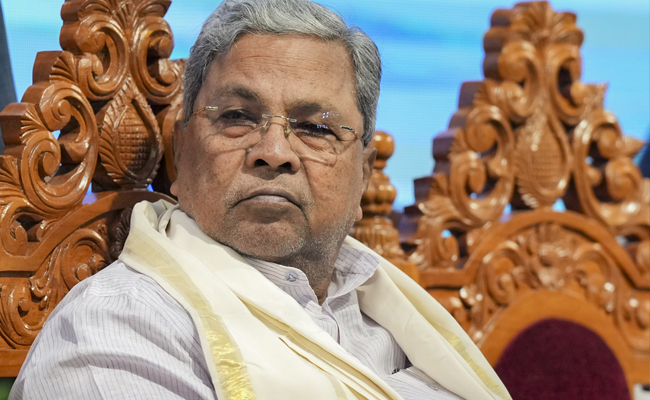
Bengaluru (PTI): Alleging a “criminal conspiracy” by BJP candidate D N Jeevaraj in the Sringeri Assembly poll recounting, Karnataka CM Siddaramaiah on Tuesday said the outcome was manipulated after valid postal ballot votes in favour of Congress leader T D Raje Gowda were tampered with during the recounting process.
Following a Karnataka High Court order on an election petition filed by Jeevaraj, challenging Raje Gowda’s election, the reverification and recounting were conducted on Saturday.
After the reverification and recount of postal ballots for the Sringeri Assembly constituency, votes polled in favour of Raje Gowda were reduced by 255, the returning officer said.
A report on the matter has been submitted to the Election Commission of India for further action, the officer added.
Congress leader Raje Gowda had won the 2023 Assembly polls from Sringeri by 201 votes, defeating his nearest rival Jeevaraj.
Addressing a press conference in Bengaluru, Siddaramaiah said the High Court had directed the recounting of postal ballots and that irregularities were noticed during the exercise conducted on May 2.
“This is a clear case of criminal conspiracy,” Siddaramaiah said, alleging that valid votes cast in favour of Raje Gowda were altered after being accepted by counting agents of all parties, including Congress, BJP, and JD(S).
He claimed that during the recounting of postal ballots, 255 votes were initially accepted as valid by all agents but were later tampered with by subordinate officials.
“There is a second mark on the votes polled in favour of Raje Gowda. They had accepted these as valid votes. Subsequently, another mark was made by officials. This is a clear case of criminal conspiracy,” he said.
When asked who was behind the alleged conspiracy, the CM replied, “It was hatched by Jeevaraj and others. It is planned.”
Siddaramaiah further alleged that the returning officer acted improperly by declaring the result despite the presence of an Election Commission observer during the recounting.
“Immediately after the counting, the returning officer announced the result. He should not have done so; this is against the law,” he said.
He pointed out that Raje Gowda had originally won by 201 votes, but after the recounting, the BJP candidate was declared the winner by 52 votes.
“The BJP has committed a criminal act of conspiracy. This is not vote chori but vote dacoity,” he alleged.
The CM said a police complaint had already been filed by Raje Gowda’s election agent, Sudhir Kumar, and emphasised the need for electoral integrity.
“We want transparency and free and fair elections. That is what our Constitution mandates,” he added.
Stating that the government would pursue legal remedies, Siddaramaiah said, “We are preparing an appeal challenging the returning officer’s announcement in a court of law.”
Responding to a separate query on elections in other states, the CM said there appeared to be an anti-incumbency factor in West Bengal, while results in Tamil Nadu were “surprising,” adding that Vijay’s party was emerging as the largest there.
Following the victory of party candidates in Bagalkote and Davanagere South, Siddaramaiah expressed confidence about future electoral prospects in Karnataka.
“Even in 2028, we will win the Assembly elections. We will come back,” the CM said.
Siddaramaiah added that he would order a forensic examination into the alleged tampering of postal ballots.