Kerala tops Niti Aayog's School Education Quality Index among large states, UP at the bottom
Know where Karnataka stands in the list

New Delhi, Sep 30: Kerala has emerged on top among 20 large states in terms of quality of school education, followed by Rajasthan and Karnataka secured third place, while the most-populous Uttar Pradesh was ranked at the bottom position during 2016-17, according to a report released by the Niti Aayog.
The overall performance score for the large states ranged from 76.6 per cent for Kerala to 36.4 per cent for Uttar Pradesh.
The report, titled 'The Success of Our Schools-School Education Quality Index' (SEQI) and jointly released by the Niti Aayog, Ministry of Human Resource Development and the World Bank, alongside sectoral experts, is based on indexing of states and Union Territories on the learning outcomes for school-going children.
SEQI, which used 2016-17 as the reference year and 2015-16 as the base year, was developed to evaluate the performance of states and Union Territories (UTs) in the school education sector .
Among eight smaller states, Manipur, Tripura and Goa bagged the top-three positions, respectively, followed by Mizoram, Nagaland, Sikkim, Meghalaya and Arunachal Pradesh.
Of the seven UTs, Chandigarh came at the top position, followed by Dadra and Nagar Haveli, Delhi, Puducherry, Daman & Diu, Andaman & Nicobar Islands and Lakshadweep.
The index, prepared on the basis of 30 indicators, was divided into two broad categories -- outcomes that consisted of learning, access, infrastructure & facilities, and equity outcomes; and governance processes aiding outcomes.
It provides states and UTs with a platform to identify their strengths and weaknesses and undertake requisite course corrections or policy interventions, Niti Aayog Chief Executive Officer Amitabh Kant said at the report launch here.
"In line with the Niti Aayog's mandate to foster the spirit of competitive and cooperative federalism, the index strives to facilitate the sharing of knowledge and best practices across states and UTs," Kant said.
Among the small states, the overall performance varied from 68.8 per cent for Manipur to 24.6 per cent for Arunachal Pradesh. In UTs, the overall performance scored from 82.9 per cent for Chandigarh to 31.9 per cent for Lakshadweep.
Out of the 20 large states, 18 improved their overall performance scores between 2015-16 and 2016-17. Five of these states -- Haryana, Assam, Uttar Pradesh, Odisha and Gujarat -- showed high rates of improvement, with increases of 18.5, 16.8, 13.7, 12.4 and 10.6 percentage points, respectively.
The report highlighted that amid challenges of improving learning outcomes, educational access and infrastructure are continuing for states and UTs and require more focus and investments.
"The index comprises indicators that will help steer a state/UT's efforts to improve the delivery of quality education. It is hoped that the index provides instructive feedback to them and non-governmental service providers to drive crucial reforms and encourage innovation in cost-effective policy approaches," the report said.
It is hoped that the index will help facilitate the sharing of best practices and drive improvements in the delivery of quality education across India, the report said.
Kant said ranking of the states on school education learning outcomes is in continuation of its philosophy of ranking states on ease of doing business, health care and on meeting sustainable development goals.
Niti Aayog Vice-Chairman Rajiv Kumar said time has now come to not only focus on access to education but on quality when it comes to the country's school education system.
"Now, we see more children in our schools but how much is the learning outcome is the key as school education is the foundation to prepare the future generation," Kumar said.
Let the Truth be known. If you read VB and like VB, please be a VB Supporter and Help us deliver the Truth to one and all.
Karnataka launches state-led Centre of Excellence for Space Technology in Bengaluru
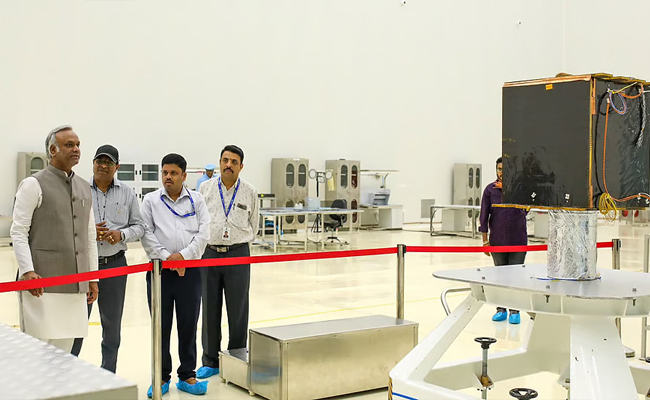
Bengaluru (PTI): In a significant boost to India’s rapidly expanding space economy, the Karnataka government on Friday launched the country’s first state-led Centre of Excellence for Space Technology here, officials said.
The initiative is aimed at strengthening India’s capabilities to translate space innovation into scalable commercial outcomes, they said.
The Centre, established by the Government of Karnataka through the Karnataka Innovation and Technology Society in collaboration with SIA (Satcom Industry Association India) -India, was inaugurated by Minister for Electronics, IT/BT, and Rural Development and Panchayat Raj, Priyank Kharge, in the presence of senior officials and industry leaders, officials said.
Speaking at the launch, Minister Kharge said that Karnataka has consistently been at the forefront of India's technology and innovation journey. With the launch of this Centre of Excellence for Space Technology, we are extending that leadership into one of the most strategic sectors of the future.
"Our focus is not just on advancing research, but on creating an ecosystem where innovation can translate into real-world applications, economic growth, and high-quality jobs. This Centre will play a critical role in positioning Karnataka as a key driver of India's space economy," he said.
According to an official statement, the CoE SpaceTech Foundation has been established under a Memorandum of Agreement between KITS and SIA-India to drive research and innovation in space technologies, industry-aligned training, startup incubation and cross-sector applications, it said.
The Centre has also formalised strategic MoUs with multiple industry and academic partners to support research in space biotech and microgravity, enable collaboration, build talent pipelines, and provide startups with training and market access, it added.