Kharge, Rahul, Priyanka among Cong's 40 star campaigners for 2nd phase Bihar polls

New Delhi (PTI): Congress president Mallikarjun Kharge and senior leaders Sonia Gandhi, Rahul Gandhi and Priyanka Gandhi Vadra, along with Kanhaiya Kumar and Independent MP Pappu Yadav, are among the party's 40 star campaigners for the second phase of the Bihar assembly polls.
AICC in-charge of Bihar Krishna Allavaru, Bihar Congress chief Rajesh Ram, Congress general secretaries K C Venugopal, Bhupesh Baghel, Sachin Pilot, Randeep Surjewala and Syed Naseer Hussain, as well as senior leaders Ashok Gehlot, Tariq Anwar, Gaurav Gogoi, Mohammad Jawed and Akhilesh Prasad Singh, are also on the list.
The Bihar polls will be held in two phases on November 6 and 11, and results will be announced on November 14.
The opposition INDIA bloc, which has RJD, Congress and Left parties as the main constituents, on Thursday declared RJD leader Tejashwi Yadav its chief ministerial candidate for the Bihar polls.
Himachal Pradesh Chief Minister Sukhvinder Singh Sukhu, senior leaders Digvijaya Singh, Adhir Ranjan Choudhary, Meira Kumar, Pramord Tiwiri, Ajay Rai, Imran Pratapgarhi, Pawan Khera, Shakeel Ahmed, Ranjeet Ranjan, Rajesh Ranjan alias Pappu Yadav, Jignesh Mevani, Anil Jaihind and Rajendra Pal Gautam are also on the star campaigners list for the second phase of polls released by the party.
Let the Truth be known. If you read VB and like VB, please be a VB Supporter and Help us deliver the Truth to one and all.
Passenger, railway staff in Maddur stabbed by two men who fought for train seat
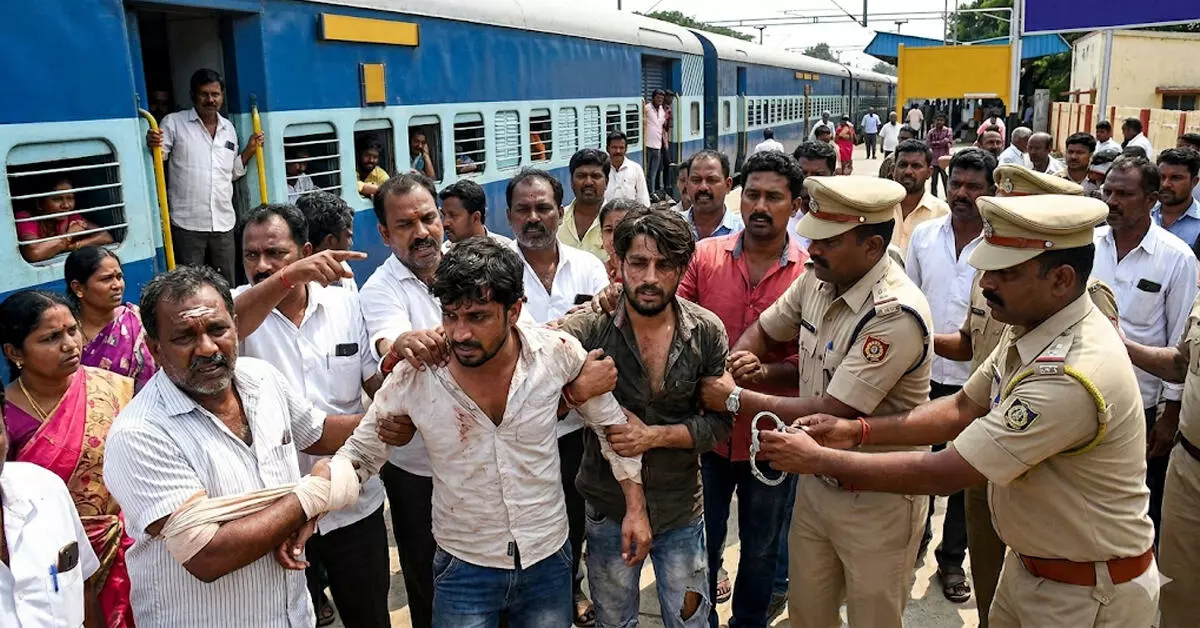
Mandya: An argument over a seat in a train intensified into a fight, resulting in a passenger and a Railways staff member being stabbed and sustaining grievous injuries near the Maddur Railway Station in the district on Wednesday.
The other passengers as well as the locals are said to have caught and assaulted the three accused as they were attempting to escape. The trio, Subaan Qureishi, Shoiab Qureishi and Wasim, has been handed over to the police.
The assault victims, identified as Shivakumar of Tumakuru and Railways staff Kumar were taken to the Maddur Taluk Hospital for first aid and later shifted to the Mandya Institute of Medical Sciences (MIMS) District Hospital.
The argument is said to have erupted over a seat in the Mysuru-Bengaluru train. When a third passenger, Shivakumar, tried to intervene, however, the men fighting for the seat allegedly stabbed him with a knife. Shivakumar is said to have pulled the chain of the train, which was arriving at the Maddur station and was at Channegowdanadoddi on the outskirts of the town, in a desperate attempt to save his life.
The suspects, who tried to jump off the train which was slowing down, stabbed Kumar, the railway gate-keeper near Channegowdanadoddi, as he attempted to stop the duo from escaping.
The other passengers in the train and the locals at the station caught up with the accused, who were escaping and assaulted them physically before handing them over to the police.
A case has been registered by the Railway Police and the officers are investigating the incident.