Knowledge power can help combat modern warfare: Venkaiah Naidu
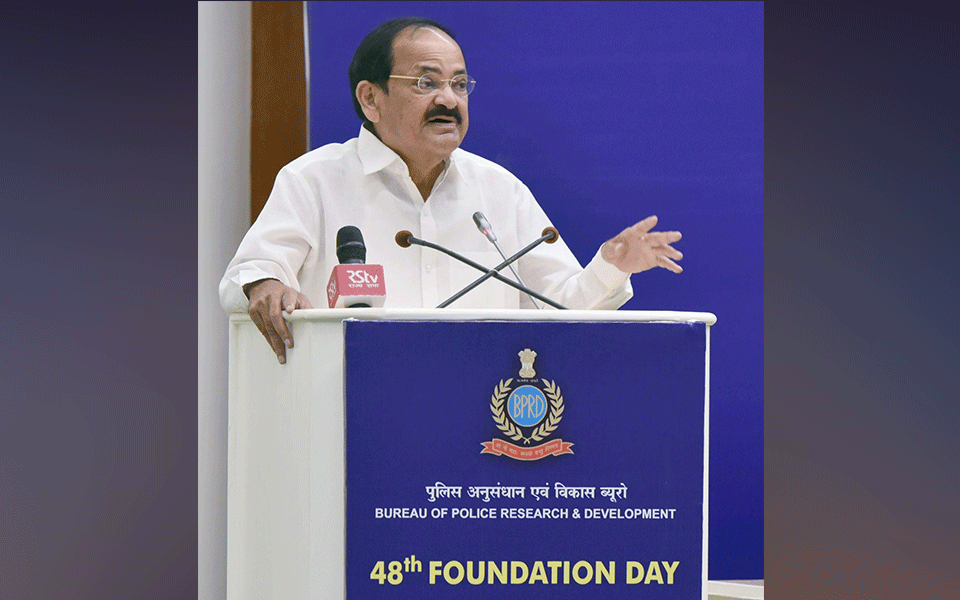
New Delhi, Aug 27 : New-age warfare can only be combated through the power of knowledge and it is imperative for our crime-fighting agencies that they equip themselves with technologies needed to ensure national security, Vice President M. Venkaiah Naidu said on Monday.
Addressing the 48th Foundation Day of the Bureau of Police Research and Development (BPRD), he said that in today's world a country can be crippled without firing a single shot or spilling even a drop of blood.
"This is the era of new-age warfare, the cyber warfare, and the new enemy can be combated only through the power of knowledge.
"Unlike the spies of the Cold War era, when collaborators would provide access to secret documents to physically copy and photograph documents, the new-age spies do not need any physical access... the hackers can suck out thousands of secret documents, jeopardising national security," Naidu was quoted as saying in a government statement here.
He said that the cyber warfare cannot be fought from inside the walls of a government agency, but through technology that transcends such boundaries.
"The set-up for combating the new enemy in cyberspace can no longer be housed within the walls of a seemingly secure single government agency. All police forces of the country have to equip themselves with the cyber forensic techniques and knowledge to counter a cyberattack or investigate a cybercrime," he said.
The Vice President emphasised that for a safe India (Surakshit Bharat), we need a competent India (Saksham Bharat).
"The knowledge and competence of our police forces and the ability to innovate, improvise and implement will be critical in strengthening national security," he said.
Let the Truth be known. If you read VB and like VB, please be a VB Supporter and Help us deliver the Truth to one and all.
Maharashtra sets up state vaccination task force to strengthen immunisation programme

Mumbai (PTI): The Maharashtra government has set up a State Vaccination Task Force to strengthen the regular immunisation programme and review the progress of related campaigns, a health department official said on Monday.
The State Vaccination Task Force will comprise at least 29 members and will be headed by the administrative head of the health department, he informed.
The government has also constituted separate district-level and municipal vaccination task forces to improve implementation and address challenges at the grassroots level, he said.
Municipal task forces, chaired by respective civic commissioners, have been constituted in view of the vast urban population in Maharashtra and the role of civic bodies in implementing different health programmes.
The district-level task forces will function under the chairmanship of collectors.
"Complete immunisation of children at the appropriate age is an extremely simple, cost-effective and highly effective measure to reduce child mortality and the prevalence of diseases among kids. Immunisation is a powerful tool for reducing illness in children," maintained the official.
To ensure full vaccination of all children, the state government implements various campaigns from time to time as per the central government guidelines, he pointed out.
"Active participation and cooperation of other relevant government departments are essential (in making these campaigns successful)," according to the official.
The state-level body will review the regular immunisation programme, associated campaigns and vaccine-preventable diseases in detail. It will also conduct focused assessments of high-risk districts and municipal corporations, including vacancies at district, municipal and sub-district levels, availability of cold chain equipment, resource gaps and training requirements, he noted.
The state task force will review allocation and utilisation of funds for immunisation and ensure timely action by officers concerned based on reports from district and municipal task forces and state-level monitoring mechanisms, the official said.
It will also ensure active coordination and participation of other government departments in immunisation drives, while district and municipal task forces will carry out similar functions at their respective levels, the official added.