Kumbh Mela stampede: BBC Hindi investigation reveals 82 deaths, contrasting with government's claim
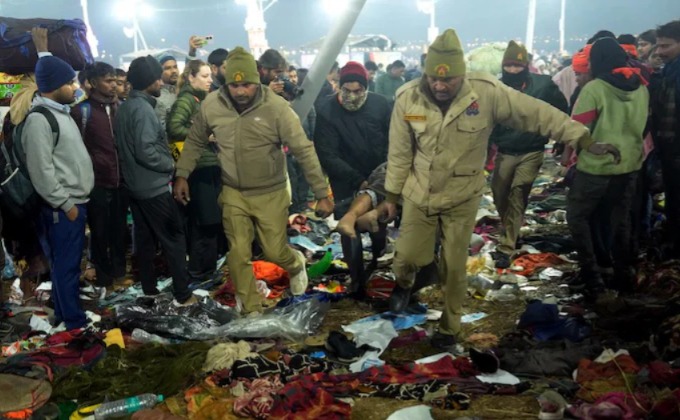
New Delhi: A recent in-depth investigation by BBC Hindi has revealed a significantly higher death toll in the stampedes that occurred during the Kumbh Mela in Prayagraj on January 29th, 2025, compared to the figures released by the Uttar Pradesh government. While the government stated that 37 people died in four stampede incidents on the day of Mauni Amavasya, the BBC's investigation has confirmed at least 82 deaths.
According to the BBC Hindi report published on June 10th, 2025, their reporters reached out to over 100 families across 11 states and more than 50 districts. These families claimed that their loved ones died in the Kumbh stampedes. The BBC stated that they have concrete evidence of at least 82 deaths, and this number only includes cases where families could provide substantial proof.
The Uttar Pradesh government, as mentioned in the report, had announced a compensation of ₹25 lakh for the families of the deceased. Chief Minister Adityanath stated in the assembly on February 19th that 66 devotees were affected near Sangam Nose between 1:10 AM and 1:30 AM, with 30 deaths confirmed. He also mentioned another 7 deaths in other locations, bringing the official toll to 37.
However, the BBC's investigation uncovered that while 36 families received ₹25 lakh in compensation through Direct Benefit Transfer (DBT) or cheques, an additional 26 families were given ₹5 lakh each in cash by the Uttar Pradesh government. These 26 families were allegedly not included in the official death count. The BBC claims to possess videos and photos showing police teams handing over bundles of ₹500 notes to these families.
Several families reported being pressured to sign documents stating that the deaths occurred due to sudden illness, not stampedes. The source of the ₹1.30 crore distributed in cash remains unclear, but the families confirmed the involvement of the Uttar Pradesh Police in all these cases. Furthermore, the BBC's investigation identified another 19 families who claimed their relatives died in the stampedes but did not receive any financial assistance from the government. These families presented evidence such as post-mortem reports, hospital morgue slips, and death certificates to support their claims. Some even showed photos and videos taken at the stampede sites on January 29th, showing the bodies of their relatives.
The BBC categorized the 82 confirmed deaths into three groups: those whose families received ₹25 lakh compensation, those who received ₹5 lakh in cash, and those who received no financial assistance.
The report detailed several harrowing stories. For instance, Nankan from Gonda district in Uttar Pradesh died in the stampede at Sangam Nose. His brother, Masru, recounted the chaotic scene where people became frantic after an announcement of "Amrit Baras Raha Hai" (nectar is showering) and a massive crowd surged forward, leading to Nankan being trampled. His family received ₹25 lakh compensation.
Similarly, Kanchan from Belagavi, Karnataka, lost her husband, Arun Narayan Koparde, in the Sangam Nose stampede. She described the horrific scene where people were stepping over others. The bodies of Arun and three other victims from Karnataka were eventually sent back home with a compensation of ₹25 lakh each.
The BBC also found that one of the deceased, KN Vasudevacharya, the younger brother of former BJP General Secretary KN Govindacharya, was initially identified as having no heir. However, the BBC's investigation revealed his identity, and despite this, no compensation was given in his case. The report also highlighted that the stampedes were not limited to Sangam Nose.
The BBC found evidence of a significant stampede near the Mukti Marg Chauraha at Kalpavriksh Dwar around 8 AM, where five more people died. These included Panne Lal Sahni and Nagina Devi from Gorakhpur, Meena Pandey from Sultanpur, Krishna Devi from Jind (Haryana), and Sonam Kumari from Aurangabad (Bihar). Only three of these families received ₹5 lakh in cash, while the families of Meena Pandey and Krishna Devi received no compensation.
Eyewitness accounts, like that of Archana Singh, who was with Meena Pandey, painted a grim picture of bodies lying at the stampede site for hours without any immediate help from authorities. Kusum Devi, the wife of Panne Lal Sahni, also described the chaotic scene and the lack of assistance, stating that they sat with the bodies of her husband and Nagina Devi in the sun until 4 PM.
The BBC Hindi investigation raises serious questions about the accuracy of the official death toll and the transparency of the compensation process following the Kumbh Mela stampedes. Despite the heavy security arrangements claimed by the government, including CCTV cameras, thousands of personnel, and ambulances, the report suggests a significant underreporting of fatalities and inconsistencies in the distribution of aid to the victims' families.
Let the Truth be known. If you read VB and like VB, please be a VB Supporter and Help us deliver the Truth to one and all.
NCW chief condemns rape-murder of 4-year-old girl in Pune, calls for swift action
New Delhi (PTI): National Commission for Women (NCW) Chairperson Vijaya Rahatkar has condemned the alleged rape and murder of a four-year-old girl in Maharashtra's Pune, calling it "deeply distressing" and a "blot on humanity".
The girl was allegedly raped and killed by a 65-year-old labourer, who has a criminal record, in Bhor tehsil of Pune on Friday. The accused allegedly lured the child to a cattle enclosure on the pretext of giving her food. After raping her, he killed her by hitting her with a stone, according to police.
The accused has been arrested.
In a post on X on Saturday, Rahatkar said the incident in the Nasrapur area in Pune was heartbreaking and has shaken society.
"The brutal torture and murder of a four-year-old innocent girl in Nasrapur (Bhor, Pune) is deeply painful, heartbreaking, and shocking. It is a blot on humanity," she said.
She said Pune Rural police has arrested the accused and noted that Maharashtra Chief Minister Devendra Fadnavis and Deputy Chief Minister Sunetra Pawar have assured strict action in the case.
Rahatkar said the NCW has taken cognisance of the matter and written to the National Commission for Protection of Child Rights (NCPCR), requesting the body to ensure necessary and prompt action.
It has also been recommended that the case be pursued under stringent provisions of the Protection of Children from Sexual Offences (POCSO) Act and be closely monitored from the filing of the chargesheet to proceedings in a fast-track special court to ensure time-bound justice, she added.
Ensuring justice for the victim and stringent punishment for the accused is a collective responsibility, the NCW chairperson underlined.
In a post on X, the NCW said it has taken suo motu cognisance of the extremely "heinous" incident.
"This heinous crime causes profound pain and outrage, and it highlights serious concerns regarding the safety of young girls," it said.
Strongly condemning this grave "inhuman act", the NCW said such crimes constitute a serious violation of children's rights and raise questions about society's security system.