Lack of info on China's COVID outbreak stirs global concerns
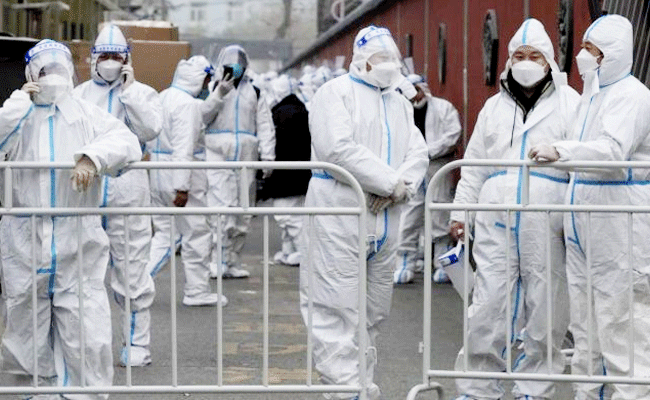
Beijing (AP): Moves by the US, Japan and others to mandate COVID-19 tests for passengers arriving from China reflect global concern that new variants could emerge in its ongoing explosive outbreak and the government may not inform the rest of the world quickly enough.
There have been no reports of new variants to date. But given the country's track record, the worry is that China may not be sharing data on any signs of evolving strains that could spark fresh outbreaks elsewhere.
The US, in announcing a negative test requirement on Wednesday for passengers from China, cited both the surge in infections and what it said was a lack of information, including the genomic sequencing of the virus strains in the country.
Japanese Prime Minister Fumio Kishida expressed a similar concern about a lack of information when he announced a testing requirement for passengers from China earlier this week.
More broadly, Director-General Tedros Adhanom Ghebreyesus said recently that the WHO needs more information on the severity of the outbreak in China, particularly regarding hospital and ICU admissions, "in order to make a comprehensive risk assessment of the situation on the ground."
India, South Korea, Taiwan and Italy have also announced various testing requirements for passengers from China. German health authorities are monitoring the situation but have not taken similar pre-emptive steps.
"We have no indication that a more dangerous variant has developed in this outbreak in China that would be grounds to declare a virus variant area, which would bring corresponding travel restrictions," Health Ministry spokesperson Sebastian Guelde said.
Chinese Foreign Ministry spokeswoman Mao Ning said last week that China has always shared its information responsibly with the WHO and the international community.
"We stand ready to work with the international community in solidarity to tackle the COVID challenge more effectively, better protect people's lives and health and jointly restore steady economic growth and build a global community of health for all," she said.
China rolled back many of its tough pandemic restrictions earlier this month, allowing the virus to spread in a country that had seen relatively few infections since an initial devastating outbreak in the city of Wuhan in early 2020.
The spiralling of infections led to shortages of cold medicine, long lines at fever clinics, and emergency rooms turning away patients because they were at capacity.
Cremations have risen several-fold, with a request from overburdened funeral homes in the city of Guangzhou for families to postpone funeral services until next month.
China has not reported this widely and blamed Western media for hyping up the situation. The government has been accused of controlling information about the outbreak since the start of the pandemic.
An AP investigation showed that China was controlling dissemination of its internal research on the origins of COVID-19 in 2020. A WHO expert group said in a report this year that "key pieces of data" were still missing on the how the pandemic began and called for a more in-depth investigation.
Let the Truth be known. If you read VB and like VB, please be a VB Supporter and Help us deliver the Truth to one and all.
AIITA welcomes Karnataka’s ban on obscene songs in school events
Bhatkal: The Karnataka unit of the All India Ideal Teachers Association (AIITA) has welcomed the Karnataka government’s decision to strictly ban school children from dancing to obscene songs during educational and cultural programmes in government, aided, and private schools across the state.
AIITA Karnataka State President M. R. Manvi congratulated the government for taking what he termed an important step to preserve the sanctity of education.
“Such decisions to safeguard the dignity of school children and uphold the values of education are the need of the hour. This rule should not be limited to government schools alone but must be strictly implemented in all private educational institutions as well,” he said.
He further urged the government to address other concerns within school programmes.
“The government should not only prohibit obscene dances in the name of school anniversaries, but also ensure that plays and dialogues that incite religious hatred are avoided. Schools should be centres of harmony, not platforms for spreading hatred,” he added.
According to a recent circular issued by the Department of School Education and Literacy, obscene dances are adversely affecting the mental health and moral values of students.
In this regard, schools have been advised to use songs that promote nationalism, positive thinking, the greatness of Kannada culture, and value-based traditions instead of inappropriate content during programmes.
The circular also emphasises that students should be dressed in decent attire.
AIITA also backed the department’s warning that disciplinary action would be taken against head teachers if such guidelines are violated. The association has further demanded that district Deputy Directors of Public Instruction strictly monitor the implementation of these rules.