Lalu admitted to Patna hospital
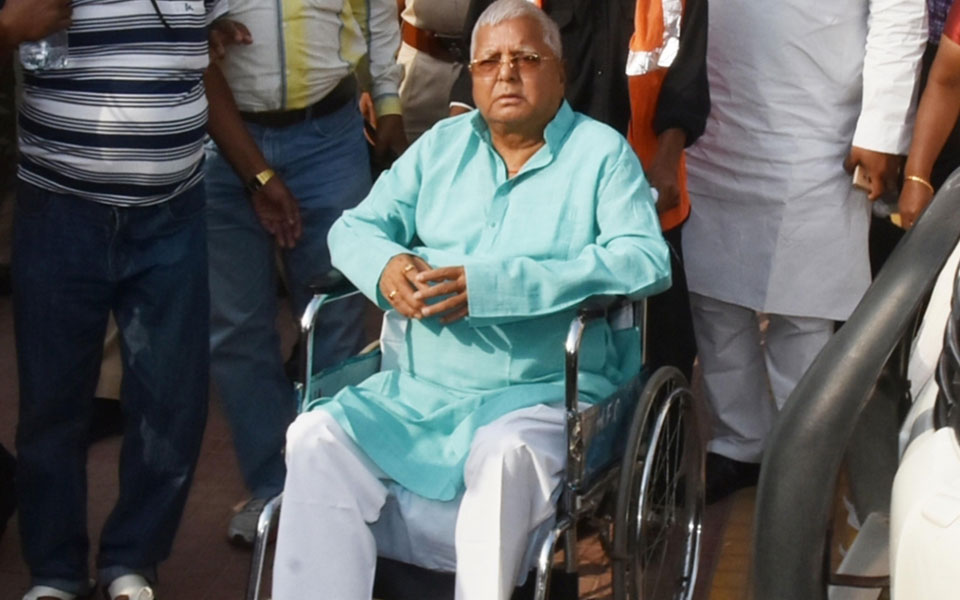
Patna, May 19: Rashtriya Janata Dal (RJD) chief Lalu Prasad Yadav was on Saturday admitted to a government-run hospital here after he complained of breathing problem and chest pain, a party leader said.
According to RJD leader Bhola Yadav, Lalu Prasad suddenly complained of breathing problem and pain in his chest after which he was admitted to the Indira Gandhi Institute of Medical Science.
"Lalu is under observation..." he said, adding that Lalu Prasad has been suffering from as many as 16 ailments.
The convicted RJD chief was granted provisional bail of six weeks earlier this week after nearly five months at the Birsa Munda Central Jail where he is serving a jail term since December 23, 2017 in connection with the fodder scam.
Lalu Prasad was admitted to RIMS in Ranchi on March 17.
He has been convicted in four fodder scam cases since 2013, the latest being the Dumka treasury case in which a special CBI court sentenced him to 14 years in jail.
Let the Truth be known. If you read VB and like VB, please be a VB Supporter and Help us deliver the Truth to one and all.
Karnataka launches state-led Centre of Excellence for Space Technology in Bengaluru
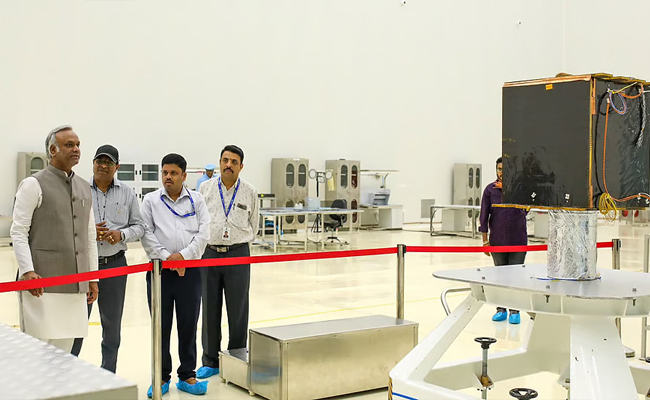
Bengaluru (PTI): In a significant boost to India’s rapidly expanding space economy, the Karnataka government on Friday launched the country’s first state-led Centre of Excellence for Space Technology here, officials said.
The initiative is aimed at strengthening India’s capabilities to translate space innovation into scalable commercial outcomes, they said.
The Centre, established by the Government of Karnataka through the Karnataka Innovation and Technology Society in collaboration with SIA (Satcom Industry Association India) -India, was inaugurated by Minister for Electronics, IT/BT, and Rural Development and Panchayat Raj, Priyank Kharge, in the presence of senior officials and industry leaders, officials said.
Speaking at the launch, Minister Kharge said that Karnataka has consistently been at the forefront of India's technology and innovation journey. With the launch of this Centre of Excellence for Space Technology, we are extending that leadership into one of the most strategic sectors of the future.
"Our focus is not just on advancing research, but on creating an ecosystem where innovation can translate into real-world applications, economic growth, and high-quality jobs. This Centre will play a critical role in positioning Karnataka as a key driver of India's space economy," he said.
According to an official statement, the CoE SpaceTech Foundation has been established under a Memorandum of Agreement between KITS and SIA-India to drive research and innovation in space technologies, industry-aligned training, startup incubation and cross-sector applications, it said.
The Centre has also formalised strategic MoUs with multiple industry and academic partners to support research in space biotech and microgravity, enable collaboration, build talent pipelines, and provide startups with training and market access, it added.