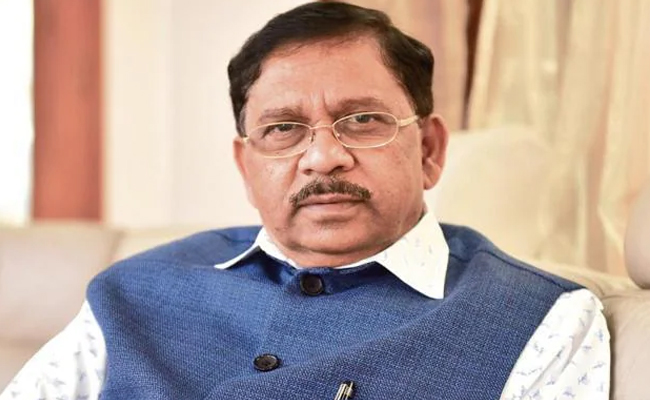
"Lander Vikram is there as a single piece, it's in a tilted position": ISRO Official
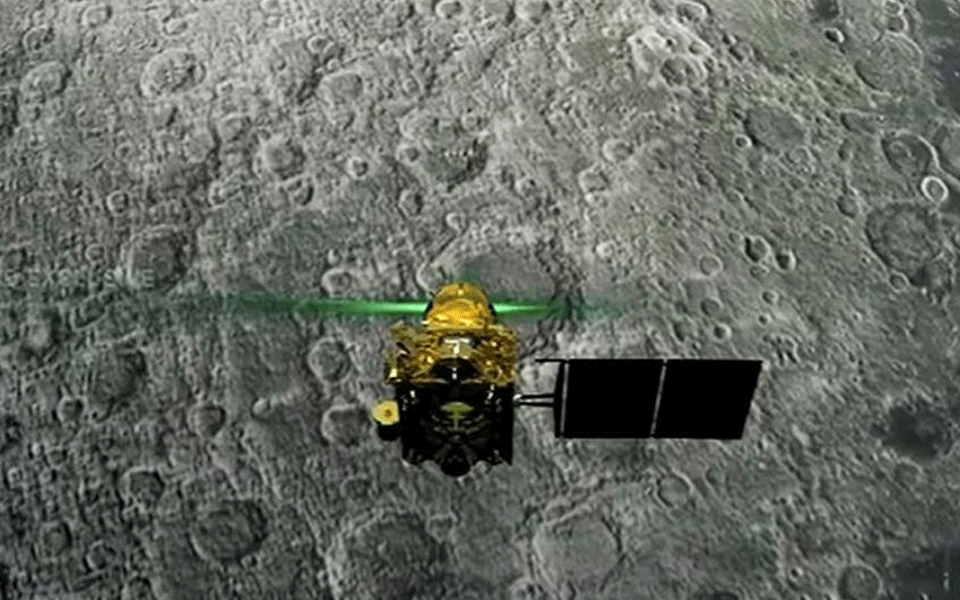
Bengaluru: Not losing hope, the Indian Space Research Organisation continued to make all-out efforts to establish link with Chandrayaan-2's 'Vikram' lander, now lying on the lunar surface after a hard-landing.
Vikram, with rover 'Pragyan' housed inside it, hit the lunar surface after communication with the ground-stations was lost during its final descent, just 2.1 km above the lunar surface, in the early hours of Saturday.
"It had a hard-landing very close to the planned (touch-down) site as per the images sent by the on-board camera of the orbiter. The lander is there as a single piece, not broken into pieces. It's in a tilted position," an ISRO official associated with the mission claimed on Monday.
"We are making all-out efforts to see whether communication can be re-established with the lander," the official said. "An ISRO team is the on the job at ISROTelemetry, Tracking and Command Network (ISTRAC) here."
Chandrayaan-2 comprises an orbiter, lander (Vikram) and rover (Pragyan). The mission life of the lander and rover is one Lunar day, which is equal to 14 earth days.
ISRO Chairman K Sivan had said on Saturday that the space agency would try to restore link with the lander for 14 days, and reiterated the resolve on Sunday after the orbiter's camera spotted it on the Lunar surface.
An ISRO official said: "Unless and until everything is intact (lander), it's very difficult (to re-establish contact). Chances are less. Only if it had soft-landing, and if all systems functioned, then only communication can be restored. Things are bleak as of now."
"I will rate it (restoring link) as good," another senior official of the space agency said, raising hope that lander springing to life again is not ruled out.
"But there are limitations. We have experience of recovering spacecraft (which had lost contact) in geostationary orbit. But here (in the case of Vikram), that kind of operational flexibility is not there. Already it's lying on the surface of the Moon, and we cannot reorient it.
Vital thing is antennas will have to pointed towards the ground station or the orbiter. Such operation is extremely difficult. At the same time, chances are good and we will have to keep our fingers crossed," the official said.
The official said the lander generating power is not an issue, as it has "solar panels all around it" and it also has "internal batteries" which "are not used much."
Vikram carried three payloads Radio Anatomy of Moon Bound Hypersensitive Ionosphere and Atmosphere (RAMBHA), Chandra's Surface Thermo-physical Experiment (ChaSTE) and Instrument for Lunar Seismic Activity (ILSA).
Let the Truth be known. If you read VB and like VB, please be a VB Supporter and Help us deliver the Truth to one and all.
National Synodal Assembly 2026 begins in Bengaluru with over 220 delegates
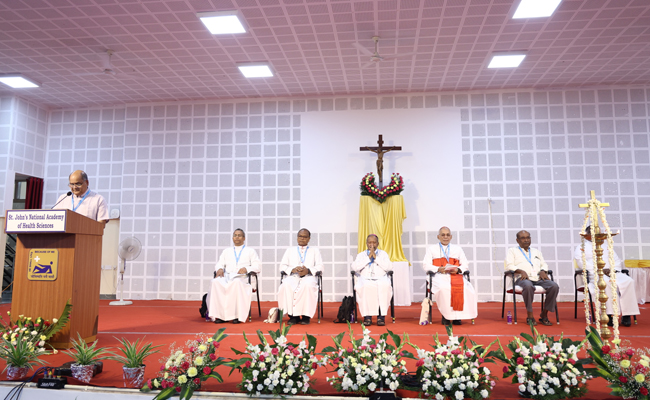
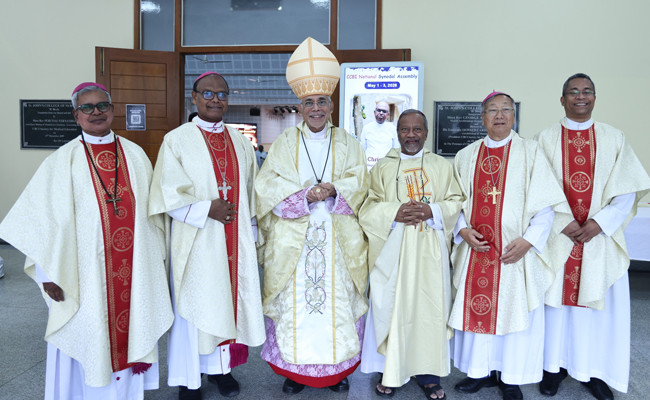
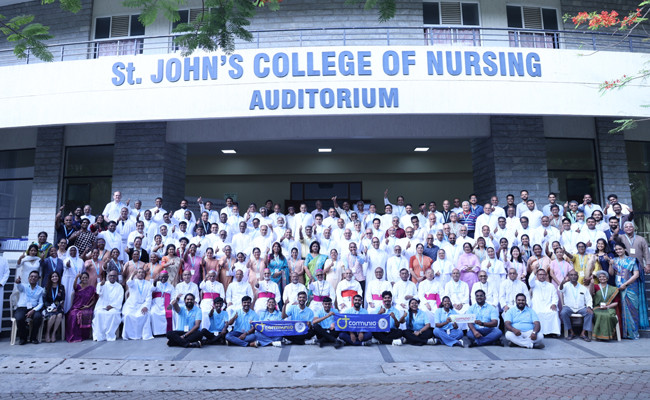
Bengaluru: The Conference of Catholic Bishops of India (CCBI) on May 1 inaugurated its National Synodal Assembly 2026 at St. John’s Medical College, bringing together more than 220 delegates from across the country under the theme Synodal Pilgrims of Hope.
The assembly is part of the global synodal process initiated in 2021 by Pope Francis, which calls for greater participation, dialogue and shared responsibility within the Church. In India, the process has involved consultations at diocesan, regional and national levels.
Participants at the assembly include two Cardinals, 25 Bishops, 65 priests, more than 20 women religious, and over 100 lay faithful, including youth and women leaders.
The gathering began with a Eucharistic celebration led by Filipe Neri Ferrão. In his homily, he described the assembly as a moment of grace and discernment and called on delegates to walk together in prayer, listening and missionary commitment.
He spoke about the importance of the Risen Christ in the mission of the Church and urged the faithful to be witnesses of the Gospel. Referring to the conversion of St Paul, he said every baptised person has a role in spreading the message of Christ. He also highlighted the example of St Joseph the Worker, stressing the dignity of labour and the call to holiness in everyday life.
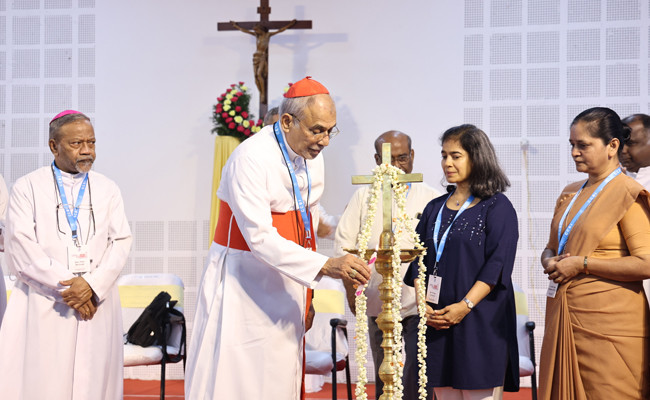
The formal inauguration included the invocation of the Holy Spirit through Veni Creator Spiritus and the lighting of the ceremonial lamp. Deputy Secretary General Fr. Stephen Alathara welcomed the delegates and described the gathering as a spiritual journey.
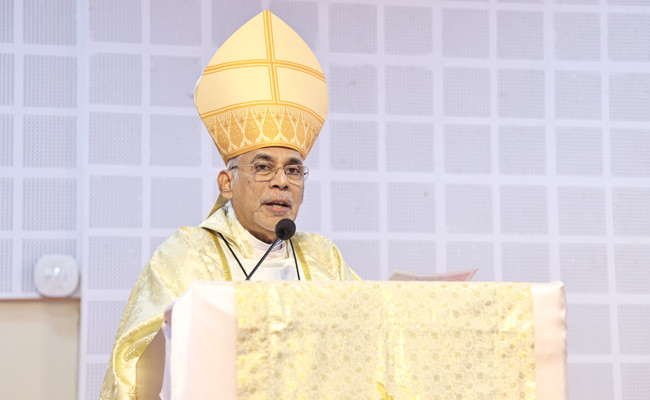
In his presidential address, Cardinal Ferrão referred to the CCBI pastoral plan titled Journeying Towards a Synodal Church: Mission 2033 and called on participants to build on the vision outlined at the 36th Plenary Assembly held in Bhubaneswar in 2025.
Delegates will reflect on four key themes identified from 16 pastoral priorities: interreligious dialogue and peacebuilding, inclusion of the excluded, poverty and integral ecology, and support for children and youth.
The discussions are being conducted through a method of spiritual conversation aimed at encouraging listening, dialogue and collective decision-making. The focus is on translating these discussions into practical actions within the Church.
The assembly also looks ahead to the Jubilee Year 2033, which will mark 2,000 years of the Redemption, and aims to strengthen the Church’s mission in the coming years.
Further consultations are scheduled for September 2026, with the process expected to conclude at the 38th Plenary Assembly of the CCBI in January 2027.
Organisers said the assembly seeks to strengthen unity within the Church and promote participation of all sections, including women and youth, in shaping its future direction.