Left unity sweeps JNU Students' Union polls, defeats RSS-backed ABVP
_vb_10.jpeg)
New Delhi (PTI): The Left Unity on Thursday retained its stronghold in the Jawaharlal Nehru University here, scoring a clean sweep by winning all four central panel posts in the students' union elections, the election committee said.
Just a year after the Akhil Bharatiya Vidyarthi Parishad (ABVP) broke a decade-long dry spell by securing the joint secretary's post in the previous JNUSU polls, the Left alliance 'comprising the All India Students' Association (AISA), Students' Federation of India (SFI) and Democratic Students' Federation (DSF) 'bounced back emphatically in the 2025'-26 election, reaffirming its long-standing dominance on the campus.
Aditi Mishra from AISA, contesting as the United Left's presidential candidate, defeated RSS-backed ABVP's Vikas Patel by a margin of 449 votes, polling 1,937 votes against Patel's 1,488.
Mishra, who hails from Varanasi, Uttar Pradesh, is a PhD scholar at the Centre for Comparative Politics and Political Theory, School of International Studies (SIS). Her research focuses on "Gendered violence and the ways women of Uttar Pradesh have been mounting resistance since 2012."
Known for her activism on gender justice, she said the results were a mandate "against hooliganism, Islamophobia, casteism, and misogyny" and "in favour of quality and low-cost education."
Kizhakoot Gopika Babu from SFI bagged the vice-president's post after defeating ABVP's Tanya Kumari by 1,314 votes. Gopika secured 3,101 votes.
A PhD student at the Centre for the Study of Law and Governance, School of Social Sciences, she joined JNU in 2022 after completing her master's in Sociology from Miranda House, Delhi University.
She was actively involved in campaigns to reopen Barak Hostel and to conduct the JNUSU elections after they had been stalled.
Sunil Yadav of DSF and Danish Ali of AISA won the general secretary and joint secretary posts, respectively, after defeating their right-wing rivals Rajeshwar Kant Dubey and Anuj. Yadav secured 2,005 votes against Dubey's 1,901, while Ali won by a margin of 286 votes.
Yadav, a first-generation graduate from Bedipur village in Uttar Pradesh's Basti district, is a PhD scholar from SIS.
Ali, a first-year PhD student from the School of Social Sciences, hails from Bandarbarru village in Madhya Pradesh's Narsinghpur district.
This year, around 9,043 students were eligible to vote. The polls recorded a 67 per cent turnout, slightly lower than the previous election's 70 per cent. The campus saw vibrant participation with students queuing up outside hostels and schools amid chants, drumbeats and campaign songs.
Let the Truth be known. If you read VB and like VB, please be a VB Supporter and Help us deliver the Truth to one and all.
Lebanon appoints new representative for talks with Israel, rejects linkage to Iran
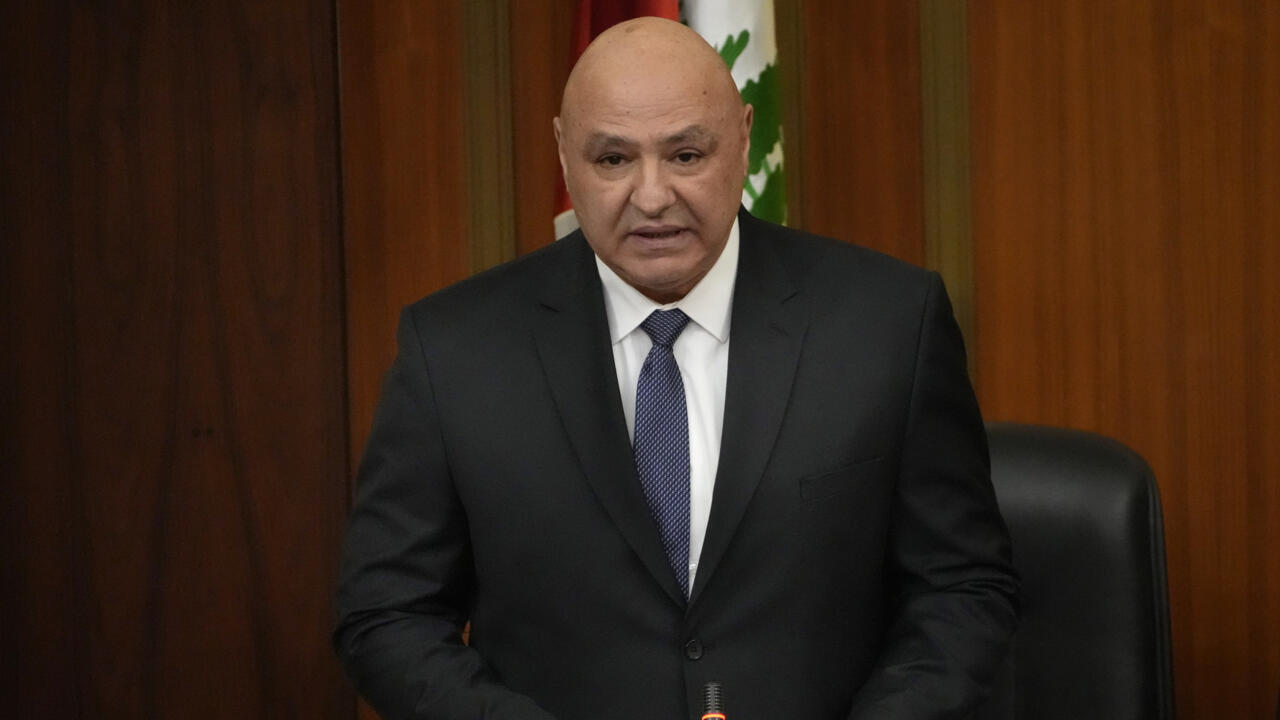
Beirut: Lebanon’s has moved to underline its independent position in ongoing regional developments, amid attempts to link the country to the broader conflict involving Iran, the United States and Israel.
President Joseph Aoun, while announcing the appointment of former US ambassador Simon Karam as Lebanon’s representative in talks with Israel, made it clear that Karam would be the sole representative for Lebanon and that there would be no substitute.
The move comes in response to what the Lebanese officials see as efforts by Iran to tie Lebanon’s situation to the wider regional conflict. Iran had indicated that there would be no ceasefire involving the US, Israel and Iran unless it also included a ceasefire in Lebanon.
Some groups, including Hezbollah and its supporters, had expressed support for linking the situations, citing concerns that the Lebanese government has limited leverage in negotiations with Israel. Lebanon is not formally a party to the conflict, and its army is considered weak.
However, others, including Prime Minister Nawaf Salam, have opposed this approach. They view Iran’s stance as an attempt to influence Lebanon’s internal affairs and see it as undermining the country’s sovereignty.
Officials backing the government’s position say the move is aimed at reaffirming Lebanon’s sovereignty and ensuring that decisions about peace and ceasefire within the country are not dictated externally.
They also see it as a safeguard, so that any breakdown in talks between the US, Israel and Iran does not automatically lead to renewed conflict in Lebanon.